
 Support
Nvidia earnings 2026: will beating expectations be enough this time
Nvidia has reached the point where beating expectations is no longer enough. Wall Street is heading into another earnings report expecting roughly $92 billion in quarterly revenue, another record for the company. But after several quarters in which Nvidia delivered impressive results only to see the stock stumble afterward, traders are focusing on a different question: can the next phase of the AI boom still justify today's valuations?
Wall Street expects roughly $92 billion in quarterly revenue.
Investors are watching whether another "beat-and-drop" reaction follows earnings.
High-bandwidth memory shortages are pushing AI server costs higher.
SpaceX's Nvidia-powered satellite plans are expanding the AI infrastructure story beyond Earth.
Will another earnings beat be enough?
Nvidia has spent the past two years turning extraordinary growth into something investors almost expect. Analysts already expect another strong quarter, with revenue around $92-95 billion and another step higher in data-center sales as Blackwell shipments continue expanding.
That is why guidance is more important than the headline number
The market has learned that Nvidia can beat estimates. What it wants to know now is whether customers are still committing enough money to keep the AI buildout accelerating into next year. That is where margins become part of the story memory shortages are becoming the next bottleneck.
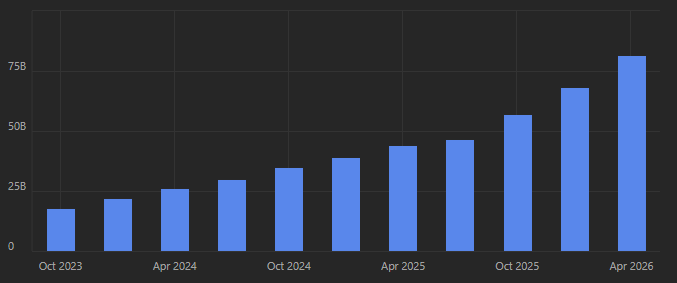
Source: Full ratio
The HBM shortage is becoming the pressure point
High-bandwidth memory has quietly become one of the most important battlegrounds in the AI trade. Every Blackwell server Nvidia ship depends on HBM, but adding capacity is proving much harder than adding demand. That imbalance is starting to reshape the economics of the entire AI buildout. Retail AI server prices are expected to climb by more than 15%, not because Nvidia has run out of customers, but because one of the most critical parts inside every server remains difficult to produce.
The opportunity is getting bigger at the same time. The HBM market is projected to expand at roughly 42% a year through 2033, turning what used to be a niche memory product into one of the fastest-growing segments in semiconductors.
The race is now shifting from demand to execution
SK Hynix, Nvidia's leading HBM supplier, is already reporting yields of around 80% on HBM3E production and roughly 70% on HBM4 test samples as it accelerates capacity. Samsung is making progress as well, with its latest 1c DRAM process reaching around 40% yields while it works to close the gap with rivals.
For Nvidia, this is becoming one of the biggest questions going into earnings. If customers keep absorbing higher memory costs, the AI spending cycle can continue pushing higher. But if tighter HBM supply starts delaying deployments instead of simply making them more expensive, investors may begin asking whether the next limit on AI growth is no longer demand for chips, but the memory needed to make those chips useful.
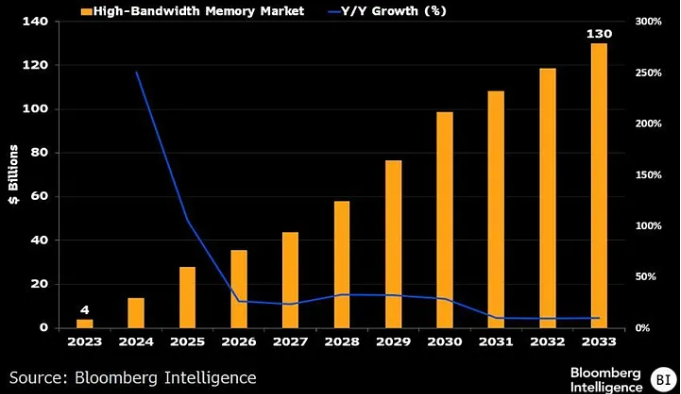
Source: Bloomberg Intelligence
Why SpaceX is becoming part of Nvidia's story
One of the more unusual developments is happening far above traditional data centers. SpaceX plans to launch its first Nvidia-powered AI satellites next year as part of a broader effort to move AI computing into orbit. The project, known as Starmind AI1, uses Nvidia chips as the core computing platform for space-based AI infrastructure.
The announcement extends Nvidia's role beyond selling chips
Whether the next AI factory is built in Texas or eventually placed in orbit, Nvidia remains positioned as the company supplying the computing layer underneath both. That reinforces one of Jensen Huang's biggest arguments: AI infrastructure is becoming a much larger market than traditional cloud computing alone.
Investors are also watching the ecosystem
Nvidia's influence now reaches well beyond GPUs. The company has invested heavily across the AI ecosystem through partnerships, startup investments and financing initiatives that ultimately strengthen demand for its own hardware. Supporters argue that the strategy keeps Nvidia at the center of AI development regardless of which application becomes the next winner.
Critics see a different risk
As Nvidia becomes increasingly involved with companies that later become customers, questions around competition and market influence become harder to avoid. U.S. regulators have already shown greater interest in the AI industry, and Nvidia's expanding ecosystem has become part of that broader conversation. For now, the scrutiny has not changed customer demand. But it has become another issue investors listen for every time management discusses future growth.
Why Nvidia keeps falling after good earnings
One statistic keeps returning before every Nvidia earnings report. The company has repeatedly beaten expectations, yet the stock has often fallen afterward. According to JPMorgan, Nvidia has averaged roughly a 5% decline in the month following its last four earnings reports despite delivering stronger than expected results. That pattern says something important about the AI trade.
The hurdle keeps moving higher
Each strong quarter raises expectations for the next one, leaving less room for management to sound cautious about spending, margins or deployment timelines.
The guidance may matter more than the revenue
The biggest takeaway may come after the numbers are released. Investors want to hear whether hyperscalers are still expanding data-center spending, whether Blackwell demand remains strong and whether Rubin is arriving on schedule. They also want clarity on memory constraints, energy availability and how quickly AI infrastructure can continue scaling.
That combination is why Nvidia has become more than another technology company reporting quarterly results. Its earnings have turned into a check on the entire AI investment cycle. If guidance reinforces the idea that spending is still accelerating, Nvidia could strengthen confidence across semiconductors, cloud companies and AI infrastructure builders.
If the tone becomes more cautious, the reaction may extend well beyond Nvidia itself. The market is no longer asking whether Nvidia can sell more chips. It is asking whether the company can keep convincing investors that the next trillion dollars of AI investment is still on the way.


