
 Support
SpaceX stock jumps 35% after 911.5 million share lockup - but the bigger supply test is still ahead
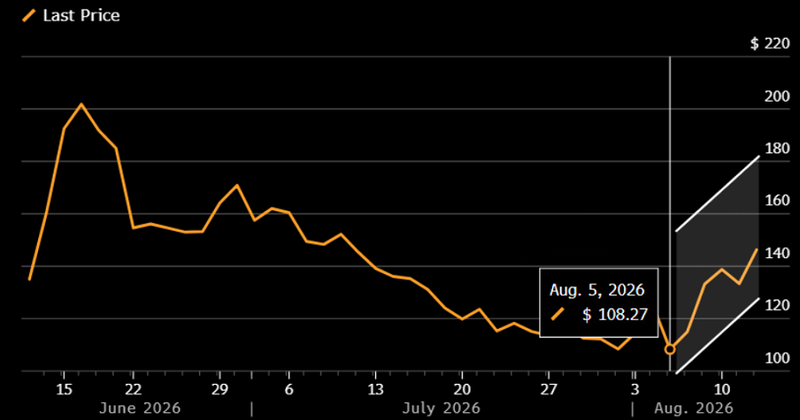
SpaceX has passed the first major test of its post-IPO life far better than Wall Street expected. Instead of collapsing after 911.5 million insider shares became eligible for sale, the stock surged 35% in five sessions and added roughly $500 billion in market value.

SpaceX shares surged 35% in five sessions after the August 6 lockup expiration, adding roughly $500 billion in market value.
The first unlock released 911.5 million shares from restrictions, more than the roughly 639 million shares originally placed in public hands.
SpaceX had fallen roughly 43% from its $201.80 post-IPO peak before the unlock, leaving much of the feared selling pressure already reflected in the price.
The company’s first earnings report showed revenue rising 92% to $7.81 billion, above the $6.93 billion expected, while its loss was narrower than forecast.
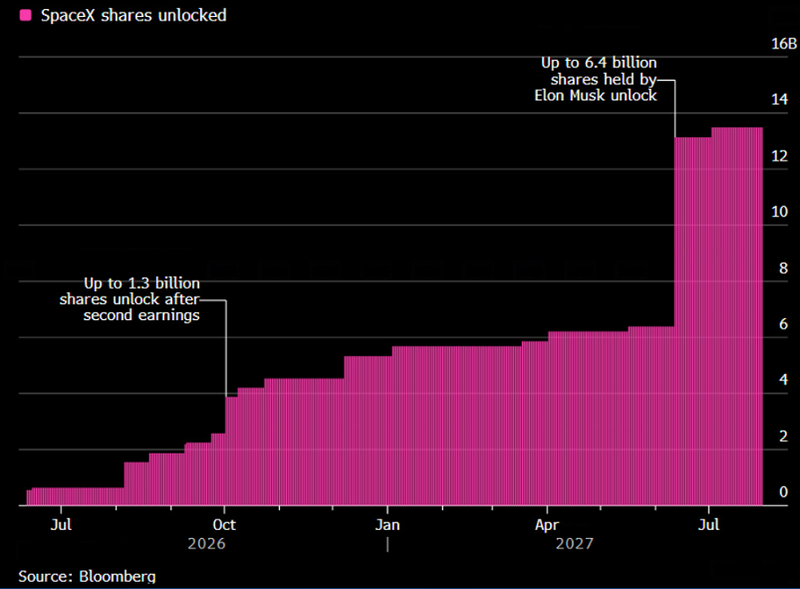
Another 319 million shares can become eligible for sale on August 20, with further lockup stages continuing before Elon Musk’s 6.4 billion shares unlock in June 2027.
SpaceX passed the lockup test Wall Street had been dreading
For almost two months, August 6 had been circled as one of the most dangerous dates on the SpaceX calendar.
The concern was simple. SpaceX had gone public with a remarkably small portion of its total equity available for trading, helping scarcity support the stock during its initial rally. Once employees and early investors were allowed to sell 911.5 million previously restricted shares, the market feared that a flood of supply would overwhelm demand and push the stock sharply lower.
The opposite happened.
SpaceX shares surged roughly 35% over the five trading sessions following the expiration and added about $500 billion in market capitalization. The rally pushed the stock decisively back above its $135 IPO price and transformed what had been viewed as a major technical threat into an unexpectedly bullish event.
The move matters because it suggests investors may have spent weeks pricing in a supply shock that ultimately proved less severe than feared. But it would be premature to conclude that SpaceX has solved its lockup problem entirely. The company deliberately divided its insider restrictions into nine stages, meaning billions of shares will continue entering the potential trading pool over the coming year.
The first test has been passed. The supply story is far from finished.
Why 911.5 million shares looked so dangerous
The scale of the first expiration was extraordinary.
SpaceX’s IPO placed approximately 639 million shares into public hands. On August 6, up to 911.5 million additional shares held by employees and early investors became eligible for sale - equivalent to roughly 140% of the original publicly available pool.
Had all of those shares reached the market simultaneously, potential tradable supply would have risen toward 1.55 billion shares.
That was never the most likely outcome. Employees who have spent years accumulating SpaceX stock do not automatically sell everything when restrictions disappear. Venture funds may distribute shares gradually, while long-term investors may remain convinced that the company’s eventual value will be much higher.
Still, markets are priced at the margin. Even a small fraction of 911.5 million shares would have been meaningful compared with SpaceX’s existing float and normal daily trading volume.
This explains why the expiration attracted so much attention. It was the first opportunity to see what SpaceX stock might look like when scarcity became less important and a larger group of insiders was free to decide whether the public market price was attractive enough to sell.
So far, the answer has been surprisingly constructive.
The stock had already absorbed much of the bad news
One reason the lockup produced less damage than expected is that SpaceX had already suffered a substantial correction before August 6.
The company priced its record IPO at $135 per share in June and later reached a closing high of $201.80. By August 4, the stock had fallen to $108, leaving it roughly 43% below its peak and about 15% beneath the IPO price.
More than $1 trillion in market value had disappeared from the company during the post-IPO reversal.
That decline fundamentally changed the lockup equation.
Had SpaceX still been trading near $200 or $225 when employees gained the ability to sell, years of accumulated gains might have created a much stronger incentive to take profits. Instead, the stock entered the expiration already deeply discounted from its high and below the price paid by IPO investors.
The market had therefore done part of the adjustment in advance.
Lockup expirations are often classic examples of markets selling the expectation and buying the event. Once investors realized that hundreds of millions of shares were not immediately flooding the market, some of the bearish positioning built before August 6 began to unwind.
Strong earnings gave buyers a reason to return
Supply alone does not explain the 35% rebound.
SpaceX’s first quarterly earnings report as a public company delivered substantially stronger operating results than expected, even though concerns over AI spending initially overshadowed them.
Revenue surged 92% to $7.81 billion, compared with analysts’ expectations of $6.93 billion. The company reported a loss of nine cents per share, substantially better than the expected loss of 26 cents, although accounting differences mean the comparison should be treated carefully.
All three major business segments exceeded forecasts. The space division generated $962 million in revenue versus $835 million expected. Connectivity, which includes Starlink, produced $4.29 billion compared with a $3.83 billion forecast. The AI business generated $2.56 billion, ahead of expectations for $2.18 billion.
Those figures gave investors something important to focus on once the lockup fear began fading: the underlying businesses are still expanding rapidly.
The initial post-earnings selloff was driven largely by higher-than-expected capital expenditure, particularly around artificial intelligence infrastructure. Once traders became more confident that the share unlock would not send the stock into free fall, attention shifted back toward revenue growth and the narrower-than-expected loss.
In other words, better fundamentals provided new demand precisely when investors feared insider supply would be strongest.
Musk has raised the expectations dramatically
Elon Musk used the earnings call to make another set of highly ambitious forecasts.
He said he expects SpaceX to reach an annual revenue run rate above $100 billion by the end of 2026, followed by as much as $1 trillion of annual revenue by 2030 - or potentially 2029.
Those projections are central to understanding why the stock can behave so differently from a traditional post-IPO company.
SpaceX is currently valued less on near-term free cash flow than on the possibility that Starlink, launch services and artificial intelligence evolve into enormous global businesses. That creates a particularly wide gap between bullish and bearish interpretations of the stock.
Bulls see a company that already dominates orbital launches, operates the largest satellite internet constellation and is moving aggressively into AI infrastructure. If those businesses scale anywhere close to Musk’s forecasts, the current market capitalization could ultimately be justified.
Bears see enormous capital expenditure, continuing losses and a valuation that requires growth almost without precedent in corporate history.
That disagreement is unlikely to disappear. It is one of the main reasons SpaceX shares may remain unusually volatile even after lockup fears fade.
Short sellers may have helped fuel the rebound
The setup before August 6 also contained another important ingredient: an enormous short position.
By July 29, roughly 219.3 million SpaceX shares were estimated to have been sold short, equivalent to approximately 34% of the public float and worth about $24.6 billion at the time.
That bearish position had grown remarkably quickly. In late June, only around 40 million shares were estimated to be short. Within little more than a month, the position had expanded more than fivefold as traders prepared for the earnings report and lockup expiration.
The crowded trade changed the risk around August 6.
If insiders had sold aggressively, the additional liquidity would have helped short sellers cover positions without driving the stock higher. But once selling proved lighter than feared and shares started rising, short sellers faced the opposite problem: they eventually had to buy stock to close bearish positions.
That does not mean the entire $500 billion rebound was a short squeeze. Strong earnings, bargain hunting and renewed optimism all contributed. But heavy short positioning likely increased the sensitivity of the stock to any positive surprise.
The important lesson is that by the time August 6 arrived, the lockup risk was hardly a secret. Investors had already positioned aggressively for it.
SpaceX’s unusual investor base may also matter
There may be another reason insider selling has been less disruptive than expected.
SpaceX does not trade entirely like a conventional aerospace or technology company. Part of its shareholder base is investing in something much broader: Elon Musk’s long-term vision of reusable rockets, global satellite communications, artificial intelligence and eventually large-scale economic activity in space.
That investor base can be unusually patient.
Traditional valuation measures focus on earnings, free cash flow and returns on invested capital. Many SpaceX investors are willing to look several years beyond those metrics because they believe the addressable markets could become dramatically larger.
This creates what may be described as a stickier shareholder base than a normal IPO.
That loyalty cuts both ways. It can provide substantial support when near-term fundamentals disappoint, but it can also encourage valuations to move far beyond what current financial results justify.
SpaceX’s stock is therefore likely to continue oscillating between two narratives: enthusiasm for Musk’s long-term ambitions and anxiety over how much money will need to be spent before those ambitions produce durable cash flow.
The August 6 unlock was the biggest - not the last
The structure of SpaceX’s lockup is unusually important.
A conventional IPO often prevents insiders from selling for approximately 180 days and then releases most restrictions at once. Given SpaceX’s enormous size and the potential market impact of billions of shares becoming tradable simultaneously, the company and its bankers instead designed a nine-stage expiration process.
The August 6 block was the largest initial hurdle, releasing up to 911.5 million shares.
The next expiration arrives on August 20, when as many as 319 million additional shares - approximately 7% of the stock subject to restrictions - can become eligible for sale.
Similar 7% blocks are scheduled to follow over the coming months. By December 8, as much as roughly 40% of the company could potentially be tradable under the staged structure.
The most important remaining block is far larger. Elon Musk’s approximately 6.4 billion shares are expected to remain restricted until June 2027.
That means investors should resist interpreting the successful August expiration as proof that future supply will be irrelevant.
The market has only completed the first stage.
The next lockups may follow the same pattern - until they do not
The first expiration may provide a possible template.
Shares weakened sharply in advance as traders anticipated selling pressure, then rebounded once the feared supply failed to materialize. If investors begin expecting the same pattern around future lockups, SpaceX could repeatedly experience weakness before expiration dates followed by relief rallies afterward.
But that strategy depends on insider behavior remaining relatively restrained.
A future release could look very different if the stock is trading significantly higher when restrictions disappear. Employees and early investors may be much more willing to sell at $180 or $200 than below the $135 IPO price.
The amount of stock actually reaching the market will therefore depend not only on how many shares become eligible, but also on where SpaceX is trading at the time.
That makes price itself part of the supply mechanism.
The higher the stock rises, the more attractive liquidity becomes for long-term holders sitting on enormous gains.
Capital expenditure remains the fundamental argument for bears
The lockup rally does not solve the biggest fundamental concern surrounding SpaceX.
The company continues spending extraordinary amounts of capital.
SpaceX lost approximately $4.9 billion last year, with much of the pressure linked to investment in artificial intelligence infrastructure following its merger with xAI. The launch business also remains loss-making despite major contracts, while Starlink is currently the principal source of profitability.
The AI strategy could require years of additional investment in chips, data centers, electricity, networking and potentially orbital computing infrastructure.
This creates a valuation tension that is likely to define the stock.
If revenue continues nearly doubling and AI becomes a major profitable business, enormous capital expenditure can be justified as the cost of building a dominant platform.
If growth slows before those investments produce adequate returns, investors may reassess how much they are willing to pay for revenues and cash flows that remain years away.
That is why bulls and bears can look at exactly the same company and reach radically different conclusions.
The $135 IPO price remains an important dividing line
The stock’s recovery above $135 is psychologically important.
An IPO price is not a measure of intrinsic value, but it provides an obvious reference point for several groups simultaneously. Public investors remember what they paid. Employees understand where the company was priced. Early shareholders can compare the market price with their much lower cost bases.
Trading sustainably above the IPO level suggests fresh investor demand is strong enough to absorb the larger float.
A return below it would revive questions about whether insiders might eventually become more aggressive sellers.
For the immediate future, investors should watch both price and volume. Strong trading volume accompanied by a stable or rising stock would suggest the market is successfully absorbing new shares. Heavy volume combined with persistent declines would point toward genuine supply pressure rather than temporary volatility.
Insider-sale disclosures will eventually provide additional clues about who is actually selling.


