
 Support
Why did Taiwan semiconductor hit a record high?
TSMC shares reached a record high as Elon Musk confirmed early-stage discussions over a potential role in Terafab, his multibillion-dollar semiconductor project in Texas. The talks strengthen the investment case for advanced chip manufacturing, but they also raise a bigger question: how much capacity will the AI industry ultimately need, and how much of that spending will translate into sustainable returns?
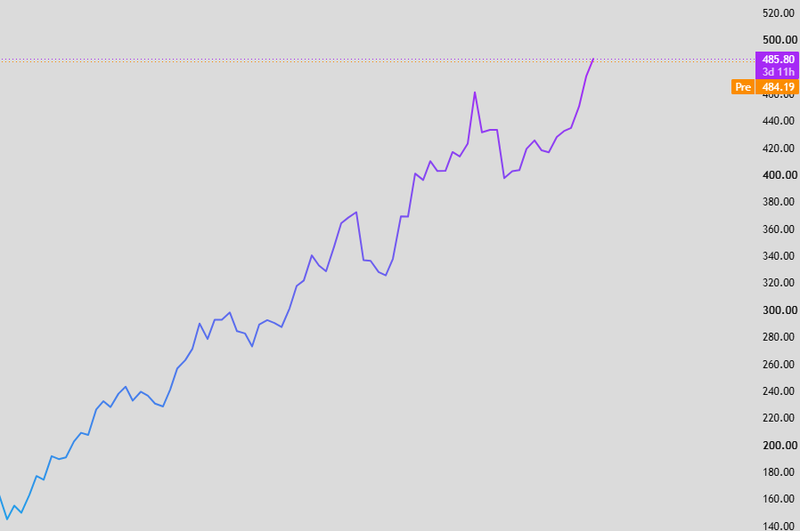
TSMC's reached a new record of $487.44.
TSMC generated $40.20 billion in second-quarter revenue.
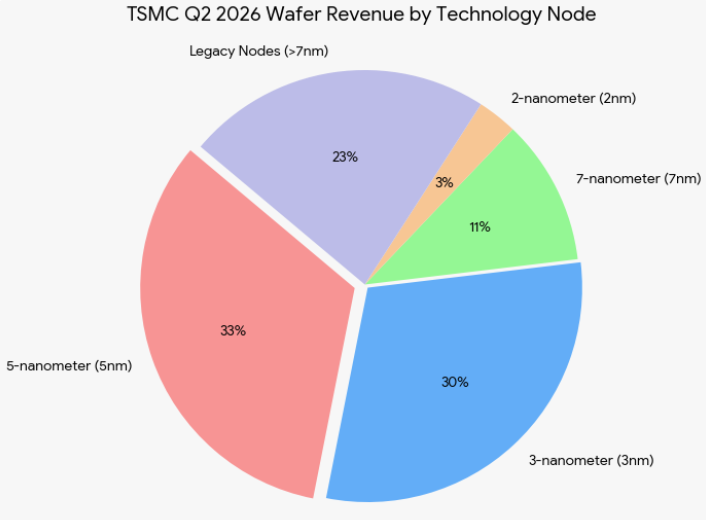
TSMC's 3nm and 5nm technologies accounted for 63% of wafer revenue.
Apple and Nvidia remain important customers for TSMC.
Terafab puts TSMC at the centre of Musk's AI ambitions
TSMC shares climbed to an intraday record of $487.44 after Elon Musk confirmed that discussions with the company were underway over a possible role in Terafab. The project, planned for Texas, is intended to support the growing computing requirements of Musk's businesses. No agreement has been finalised, however, so the immediate significance lies in the possibility of future demand rather than any confirmed addition to TSMC's revenue.
The project reflects a wider shift in the semiconductor industry. SpaceX and Tesla need substantial computing power for AI development, autonomous driving and robotics, and securing access to advanced chips is becoming increasingly important to those ambitions. Terafab's initial investment has been estimated at $16.8 billion, with the potential for substantially greater spending if additional phases proceed.
Source: TradingView
High-performance computing is becoming TSMC's growth engine
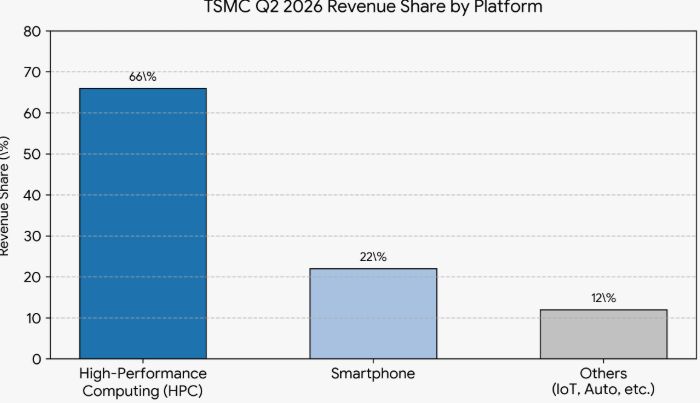
The more immediate support for TSMC's valuation comes from its existing business. Second-quarter revenue reached $40.20 billion, up 36% year on year, while high-performance computing accounted for 66% of total revenue.
That figure shows how closely the company's growth is tied to investment in AI accelerators, data-centre processors and the infrastructure needed to run increasingly complex models. Nvidia is a major customer in this market, while spending by large cloud providers continues to support demand for computing capacity.
The important question is how durable that spending will be. For now, technology companies are investing heavily to expand their AI capabilities, and the performance of their systems depends partly on access to increasingly powerful chips. TSMC benefits because it manufactures processors that are difficult to produce at the required technological level and scale.
But high exposure to one investment cycle cuts both ways. If AI adoption generates sufficient revenue for cloud providers and other customers, infrastructure spending can continue to support orders. If the commercial returns fall short of expectations, customers may become more selective about new projects, even if demand for computing power continues to increase.
Source: ChatGPT – authors idea
Advanced manufacturing is where TSMC's advantage lies
TSMC's 3nm and 5nm technologies accounted for 63% of wafer revenue in the second quarter. These advanced processes are important for producing high-performance chips while improving power efficiency, making them central to both AI computing and premium consumer electronics.
The significance goes beyond the technology itself. Leading-edge manufacturing requires expensive equipment, specialised engineering and years of process development. Even competitors with substantial financial resources cannot immediately reproduce the yields, scale and manufacturing experience of an established producer.
Source: ChatGPT – authors idea
Apple and Nvidia illustrate the breadth of TSMC's customer base
Apple's demand is closely linked to its premium devices, while Nvidia's AI accelerators connect the foundry directly to data-centre investment. These markets have different demand drivers, giving TSMC exposure beyond a single category of end products.
That position helps explain why investors are willing to assign considerable value to the company. Yet maintaining a technological lead requires continuous capital expenditure. The financial advantage ultimately depends on TSMC generating enough revenue and profit from its advanced facilities to justify the cost of staying ahead.
Terafab could change the competition, but execution matters more
Musk's interest in TSMC also raises questions about the future structure of semiconductor manufacturing. Terafab suggests that some technology companies may want greater control over the production capacity supporting their AI ambitions, rather than relying exclusively on existing supply arrangements.
That does not necessarily mean they can easily replace established manufacturers. Building fabrication capacity involves more than constructing a plant. Production yields, process technology, specialised equipment and the ability to manufacture at scale all influence whether a facility can compete economically.
Intel adds another dimension
TSMC's possible involvement does not automatically mean Intel will lose its role. The eventual allocation of manufacturing responsibilities remains unclear, and the two companies could have different roles depending on the project's technical and commercial requirements.
For TSMC, a successful collaboration could create another source of demand and potentially strengthen its US manufacturing presence. But the announcement alone does not establish the scale of the opportunity.
The record high leaves less room for disappointment
TSMC's share price reflects confidence in its manufacturing advantage and the expectation that AI infrastructure investment will continue expanding. The challenge is that a higher valuation leaves less room for growth to disappoint.
If demand for advanced chips remains strong relative to available capacity, TSMC could benefit from high utilisation and firm pricing. If customers moderate spending or new capacity comes online faster than demand grows, revenue growth and returns on investment could come under pressure. Neither outcome depends on AI disappearing; the difference is whether spending continues to generate enough economic value to justify further expansion.
This is where capital expenditure becomes important. New facilities require substantial investment before they contribute fully to earnings. Even when demand is healthy, the timing of capacity additions, production efficiency and operating costs can influence profitability.
The market is therefore looking beyond revenue growth. Investors need evidence that TSMC can convert demand into sustained margins and attractive returns on the capital being deployed.
Earnings will show whether the growth story remains on track
TSMC's September sales report, scheduled for October 8, and its third-quarter results on October 15 are the next catalysts identified for investors to watch. Revenue growth will indicate whether demand remains firm, while margins, capital expenditure and management's outlook should provide a clearer picture of how much that growth is worth. The Terafab discussions have added to the positive sentiment surrounding TSMC, but they are not yet a confirmed source of revenue.
The stronger case rests on the company's established position in advanced manufacturing and the demand already being generated by AI infrastructure. The question after a record high is no longer simply whether AI needs more chips. It is whether TSMC can turn that demand into earnings growth that justifies its valuation


