Support

US AI chip restrictions threaten billions in data center financing across Asia
New US restrictions on advanced AI chips are disrupting billions in data center financing, exposing credit risks across Asia's rapidly expanding AI infrastructure market.

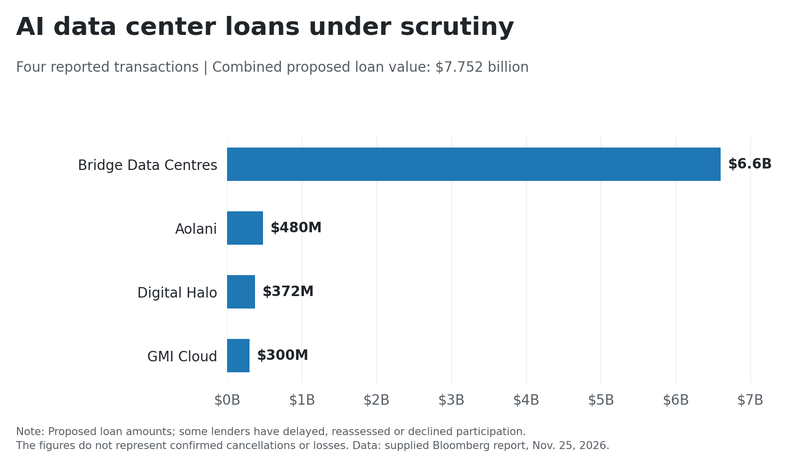
Four proposed data center financing transactions worth a combined $7.75 billion are facing increased lender scrutiny.
Asia-Pacific data center lending has surged from virtually zero in 2023 to more than $49 billion.
New US export controls cover five countries, while affected overseas data centers serving Chinese companies face a 90-day licensing deadline.
Banks and private credit funds are reassessing their exposure, while the uncertainty is spreading to IPOs and acquisition valuations.
US AI chip restrictions trigger a financing rethink
The artificial intelligence investment boom is encountering a new obstacle. Banks that spent the past three years financing Asia's rapidly expanding data center industry are reconsidering their exposure as Washington tightens restrictions on Chinese access to advanced computing power.
Jensen Huang's return to Nvidia briefly revived sentiment toward AI stocks, but the recovery in equities has failed to ease concerns in credit markets. Financing transactions that were approaching completion are being delayed, while lenders attempting to sell existing loan exposure are struggling to find buyers.
The problem is particularly acute for infrastructure developers serving ByteDance, Alibaba and Tencent. Their ability to generate revenue increasingly depends on US regulatory approval, complicating the assessment of whether their underlying projects can generate sufficient cash flow to repay lenders.
More than $7.75 billion in AI financing deals under scrutiny
The largest transaction facing uncertainty is a proposed $6.6 billion loan for Bain Capital-backed Bridge Data Centres, whose Malaysian facilities serve customers including ByteDance. Several lenders are conducting additional due diligence before proceeding.
The disruption extends to a $480 million loan sought by Singapore-based neocloud Aolani, which has commercial ties to ByteDance, and a fully underwritten $372 million financing package for Partners Group-backed Digital Halo, whose Malaysian facility serves Alibaba and other customers. At least one bank has decided against participating in the latter transaction.
Private credit is also showing signs of retreat. At least one fund has declined to participate in a $300 million loan for GMI Cloud, an Nvidia cloud partner seeking to finance GPUs for a Thai data center intended to serve Tencent.
Data source: Bloomberg
The four transactions represent approximately $7.75 billion in proposed financing. While they have not all been cancelled, the growing reluctance among lenders could delay infrastructure deployment, increase financing costs and defer semiconductor orders.
Washington targets China's access to overseas computing power
Export restrictions introduced in 2022 helped create a thriving market for rented computing capacity across Southeast Asia. Chinese technology companies could access advanced processors remotely, encouraging regional developers to build data centers and specialized cloud infrastructure.
The latest US rules, effective November 19, target that business model directly. Covered shipments of advanced AI chips to Singapore, Malaysia, Indonesia, Thailand and Brazil now require export licenses, subject to specified exemptions.
Data centers worldwide providing significant computing capacity to restricted Chinese-linked entities must also obtain authorization within 90 days to continue covered operations.
Regulatory uncertainty becomes credit risk
For lenders, the distinction between owning advanced hardware and having permission to monetize it is becoming critical. A fully operational data center could lose a substantial portion of its expected revenue if restrictions prevent it from serving a major customer.
Banks must consequently reassess customer concentration, contractual obligations, regulatory compliance and the ability of borrowers to replace affected revenue streams.
S&P Global Ratings warned in a November 24 report that lenders and operators could remain cautious even if the restrictions were reversed, given their exposure to sudden changes in US export policy.
A $49 billion data center lending boom faces its first major test
Loans to Asia-Pacific data center companies have surged from virtually zero in 2023 to more than $49 billion, reflecting the scale of investor confidence in AI infrastructure.
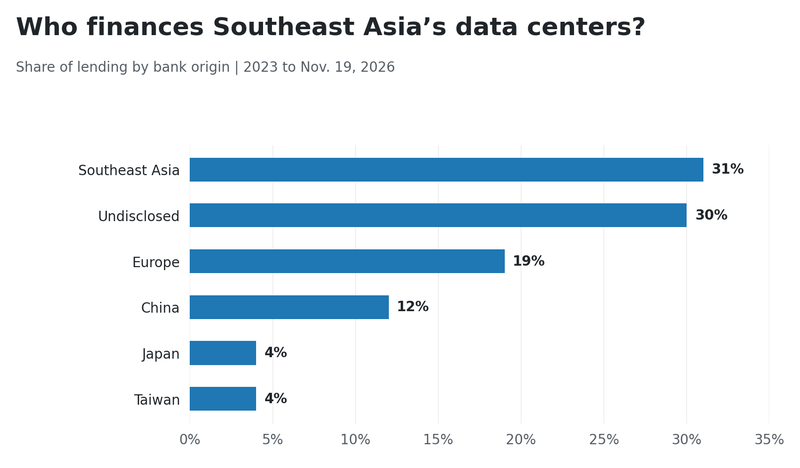
Regional banks have played a central role in that expansion. Southeast Asian lenders accounted for 31% of tracked financing between 2023 and November 19, 2026, followed by European banks at 19% and Chinese institutions at 12%. Japanese and Taiwanese lenders each represented 4%, while the origin of the remaining 30% was undisclosed.
Source: Natixes, Bloomberg and BNEF
Citigroup, Standard Chartered and major Singaporean banks have reportedly launched extensive reviews of their data center clients. Some institutions are also exploring secondary loan sales and other mechanisms to reduce their exposure.
Banks seek to transfer AI-related credit risks
Singapore's United Overseas Bank is reportedly pursuing a significant risk transfer transaction of approximately $1 billion, covering data center and infrastructure loans alongside exposure to other industries.
These transactions allow banks to transfer portions of their credit risk to external investors without necessarily selling the underlying loans. However, uncertainty surrounding the new restrictions is complicating negotiations.
The timing is particularly challenging for GPU financing, where lenders already face the risk of rapidly depreciating collateral as newer generations of processors enter the market. Regulatory restrictions introduce an additional vulnerability by potentially limiting the customers able to use that hardware.
AI infrastructure valuations are also under pressure
The financing slowdown is spreading beyond debt markets. DayOne Data Centers, whose largest customer is ByteDance, has reportedly suspended preparations for a US IPO. Meanwhile, a consortium involving BlackRock is considering lowering its offer for a portfolio of Asia-Pacific data centers.
Both developments point toward a broader reassessment of infrastructure valuations. Higher borrowing costs reduce expected investment returns, while restrictions on major customers make future revenues less predictable.
After three years of rapid credit expansion, tighter lending standards could help distinguish commercially viable projects from those whose valuations depended heavily on abundant financing and uninterrupted growth in AI demand.
What the financing slowdown means for Nvidia and AI stocks
The consequences for Nvidia could emerge even without a meaningful decline in global demand for artificial intelligence. Data center operators unable to secure financing or regulatory approval may postpone GPU purchases, weakening near-term orders across the semiconductor supply chain.
Memory manufacturers, advanced chip producers, server suppliers and electricity infrastructure companies could also experience slower demand if projects are delayed.
The episode exposes a distinction that equity markets have largely overlooked during the AI boom: demand for computing power and the financial capacity to build it are two different things.
With Asia-Pacific data center lending exceeding $49 billion, the next phase of AI infrastructure investment may depend increasingly on credit availability, customer eligibility and regulatory certainty.
The greatest threat to AI infrastructure growth may no longer be a shortage of chips, but a shortage of lenders willing to finance them.