Support
 Brent advances amid concerns that the US-Iran conflict could prolong
Brent crude futures rose by 4.07% to $104.28 per barrel following comments from the US President indicating no immediate attacks on Iran, whilst ongoing Middle East tensions continue to fuel energy supply concerns.

President Trump announced a delay in immediate military strikes linked to the upcoming US elections, prolonging supply risks in the Middle East.
Current hostilities threaten vital oil transit corridors, including the Strait of Hormuz and the Bab el-Mandeb Strait.
Persistent clashes between the Houthis and Saudi Arabia signal ongoing geopolitical instability across the region.
Date: 9 October 2026
US President Donald Trump states Washington will not attack Tehran before midterm elections as oil prices rise
The Brent crude futures contract (BRN) surged by 4.07% to $104.28 per barrel following comments from US President Donald Trump regarding the ongoing conflict with Iran. The US President stated that Washington will not launch strikes against Iran prior to November's midterm congressional elections. Despite President Trump's approval ratings falling to record lows, the US administration is maintaining its firm stance on continuing the conflict.
This market reaction comes amid expectations that the conflict could be extended by at least another month. By the end of October, the US–Iran conflict will have reached its eighth month, a duration that has consistently driven energy prices higher. Additionally, heightened tensions persist across the Middle East, generating severe concerns over potential oil supply disruptions in two critical maritime transit corridors: the Bab el-Mandeb Strait and the Strait of Hormuz.
Against this backdrop, the Houthi movement maintains an open confrontation with Saudi Arabia and Yemeni military forces. According to a Reuters report, the Houthis launched strikes targeting Saudi Arabian airspace and oil facilities. This followed an intense military campaign by Yemeni government forces—backed by Saudi Arabia—aimed at reclaiming Houthi-occupied territory. Meanwhile, Iran has announced potential attacks on commercial vessels attempting to navigate the Strait of Hormuz, raising grave concerns for tankers traversing this highly volatile waterway.
Although crude flows through the Strait of Hormuz have returned to levels comparable to those seen prior to the outbreak of war on 28 February, regional tensions continue to fuel fears of further escalation, particularly given the persistent confrontations between the Houthis and Saudi Arabia.
Technical analysis of the Brent futures contract
From a technical perspective, the Brent crude futures contract is exhibiting a short-term bullish impulse. A detailed examination of the underlying market structure reveals several key observations:
- Trend Context: Over recent months, the Brent contract has entered a highly volatile price regime. Nevertheless, from a structural standpoint, the asset has advanced firmly above its 50-day, 100-day, and 200-day Simple Moving Averages (SMAs). In the short term, price action has bounced off a downward trendline acting as support, confirming an ascending structure.
- Resistance Levels: Should short-term resistance near $110.00 be breached to the upside, the next major technical ceiling lies at $112.00—a level that converges with the Volume Profile’s Value Area High (VAH). A decisive breakout above these levels would increase the probability of the contract trading at higher valuations, potentially towards the $118.00 resistance mark.
- Support Levels: In the event of a price retracement, the primary downside floors are situated at $96.00 and $88.00 per barrel, representing a short-term structural support and the 200-day SMA, respectively. A decisive breakdown below these levels would elevate the likelihood of a deeper market contraction.
- Momentum Indicators: Both the Moving Average Convergence Divergence (MACD) and the Relative Strength Index (RSI) are currently trending upwards, suggesting that short-term bullish momentum could persist.
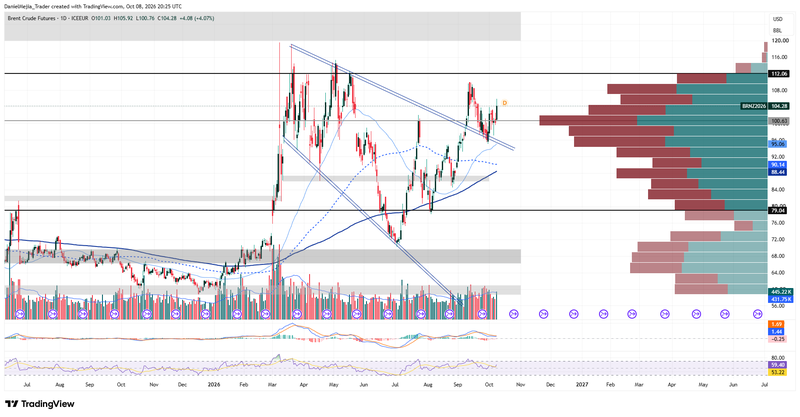
Figure 1: Brent Futures Contract (2025–2026). Source: Data from ICE Futures Europe; author's analysis conducted via TradingView.