Support
 Brent crude rises as renewed US-Iran attacks heighten geopolitical risks
Renewed US–Iran strikes have pushed Brent crude above $90 per barrel, heightening energy supply and inflation concerns whilst elevating Federal Reserve rate-hike expectations and pushing 10-year US Treasury yields higher.

Brent crude rose by 2.76% to $90.47 per barrel following military strikes between the US and Iran.
Re-escalating geopolitical risks could impair diplomatic negotiations, reigniting concerns over global energy supplies.
Financial markets are pricing in a 65.4% probability of a Federal Reserve rate hike in September as oil-driven inflation risks escalate.
How could oil prices perform if tensions between the US and Iran return?
The Brent crude futures contract (BRNX6) advanced by 2.76% to $90.47 per barrel amid renewed bilateral strikes between the US and Iran in the Middle East.
According to reports from Reuters, the US struck Iran's Larak Island over the weekend. In response, Tehran launched missiles at two US air bases in Jordan. Following these reciprocal attacks, the US President stated in an interview that Washington would "hit Iran very hard". Concurrently, Iranian officials declared that Tehran possesses sufficient military resources to respond forcefully.
The renewed tensions demonstrate how both nations are able to respond to military pressure from the opposing side, despite the conflict had evolved into an economic and geopolitical confrontation several weeks ago. In this context, it is possible that both countries could be testing their relative military capabilities prior to undertaking further intervention. Therefore, neither party currently appears interested in returning to diplomatic negotiations to resolve the conflict.
This re-escalation comes as the US–Iran conflict reaches its sixth month, heightening concerns over persistent energy supply disruptions and rising inflationary pressures worldwide.
How do renewed US–Iran tensions impact Fed interest rate expectations?
Following the bilateral US–Iran military actions, market expectations of an interest rate hike by the Federal Reserve have intensified. According to the CME FedWatch Tool, the market-implied probability of a rate increase at the Federal Reserve's September meeting rose to 65.4%, compared to a 34.6% likelihood of rates remaining unchanged. This highlights how closely market participants track oil prices to infer potential monetary policy moves by the US central bank.
At market close, the 10-year US Treasury yield advanced by 2.5 basis points to 4.75%, its highest level since January 2025. This move reflects selling pressure on US sovereign debt, driven by the inverse relationship between bond prices and yields.
Technical analysis of the Brent futures contract
From a technical perspective, the Brent crude futures contract is navigating a highly volatile consolidation phase. A detailed examination of the underlying market structure reveals several key observations:
- Trend Context: Over recent months, the Brent contract has entered a highly volatile price regime. Nevertheless, from a structural standpoint, the asset continues to trade above its 200-day Simple Moving Average (SMA), suggesting that the primary bullish bias remains intact. In the short term, price action is forming a technical triangle pattern, reinforcing the presence of near-term market uncertainty.
- Resistance Levels: Should buyers break above immediate structural resistance at $100.00, the next major technical ceiling lies at $112.00—a level that converges with the Volume Profile’s Value Area High (VAH). A decisive upside breach of these levels could open the door to higher valuations, notably the $118.00 psychological resistance level.
- Support Levels: Should immediate short-term support at $86.50 fail to hold, the next primary floor is situated at $79.00 per barrel, representing a key long-term structural pivot area. A decisive breakdown below this region would materially increase the probability of a broader trend correction towards the $70.00 psychological threshold.
- Momentum Indicators: Both the Moving Average Convergence Divergence (MACD) and the Relative Strength Index (RSI) display neutral readings, underscoring the lack of an immediate directional bias. Nevertheless, geopolitical catalysts and underlying supply fundamentals are expected to remain the primary drivers shaping near-term price action.
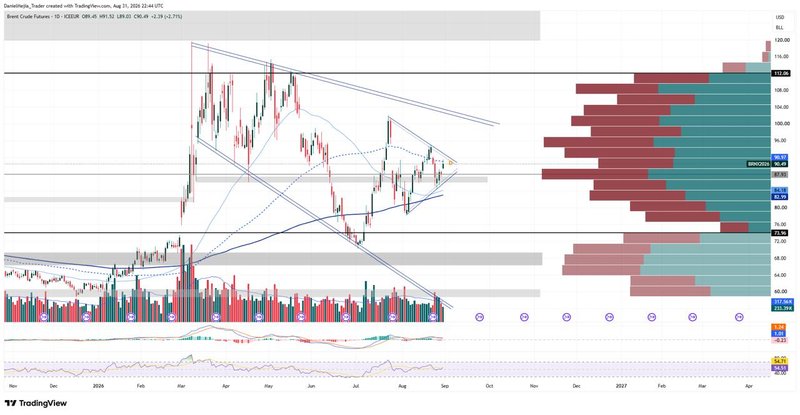
Figure 1: Brent Futures Contract (2025–2026). Source: Data from ICE Futures Europe; author's analysis conducted via TradingView.