
 Support
 Brent rises as renewed US-Iran tensions fuel supply concerns
Brent crude climbed above $102 following US troop deployments and escalating rhetoric with Iran, raising fears of Middle Eastern supply disruptions.

Brent crude rose by 4.37% to $102.31 per barrel as US military deployments rekindled fears over Middle Eastern energy supply.
The United States is deploying a third aircraft carrier strike group and approximately 10,000 troops, signalling a potential escalation in hostilities.
Iran has warned of a forceful response to any military strikes, rendering a diplomatic resolution increasingly remote.
Date: 2 October 2026
Can renewed US–Iran tensions drive Brent crude higher?
The Brent crude futures contract (BRN) increased by 4.37% to $102.31 per barrel amid renewed concerns over Middle Eastern supply disruptions, following the United States' announcement of additional military force deployments to the region. Consequently, the benchmark crude contract has once again surpassed the key $100 threshold.
According to reports cited by CNBC, the US is deploying a third aircraft carrier strike group to the Middle East, signalling that Washington is preparing for a renewed period of hostilities. Furthermore, CNBC cited US officials as informing The Wall Street Journal that US Marine Corps vessels and approximately 10,000 troops are being deployed to the region.
These military manoeuvres follow statements by US President Donald Trump indicating that he expects to resume military strikes against Iran after the November mid-term elections, highlighting the potential for bilateral frictions to escalate. Although Iranian officials had sought to resume diplomatic talks as Trump's approval ratings declined amid rising inflationary pressures, the US President remains adamant about pursuing the confrontation, despite the potential political fallout.
Conversely, Reuters reported that Iranian officials have warned Tehran is preparing a broader and more forceful response should the United States resume military strikes. This reinforces the assessment that both parties are prepared to engage in military action, rendering a near-term diplomatic resolution increasingly improbable.
Notably, although international media reports indicate that Middle Eastern crude oil flows have recovered to volumes comparable to those recorded prior to the outbreak of hostilities on 28 February, ongoing geopolitical instability leaves producers and exporters exposed to severe uncertainty. With commercial vessels facing a persistent threat of attack, this volatility is driving up insurance premiums and logistical costs across the energy sector.
Market participants are now focused on geopolitical developments and the possibility that military attacks could resume after of the US midterm elections.
Technical analysis of the Brent futures contract
From a technical perspective, the Brent crude futures contract is navigating a highly volatile consolidation phase. A detailed examination of the underlying market structure reveals several key observations:
- Trend Context: Over recent months, the Brent contract has entered a highly volatile price regime. Nevertheless, from a structural standpoint, the asset continues to trade above its 50-day, 100-day, and 200-day Simple Moving Averages (SMAs), suggesting that the primary bullish bias remains intact. In the short term, price action is testing a descending trendline that serves as a key technical support level. Consequently, a successful test of this boundary could reinforce the ongoing bullish momentum should demand resurge amid geopolitical tensions.
- Resistance Levels: Should short-term resistance near $103.00 be breached to the upside, the next major technical ceiling lies at $110.00—a prominent psychological barrier. A decisive breakout above these levels would increase the probability of the contract trading at higher valuations, potentially towards the $115.00 resistance mark.
- Support Levels: In the event of a price retracement, the primary downside floors are situated at $96.00 and $88.00 per barrel, representing short-term structural support and the 200-day SMA level, respectively. A decisive breakdown below these levels would elevate the likelihood of a deeper market contraction.
- Momentum Indicators: Although both the Moving Average Convergence Divergence (MACD) and the Relative Strength Index (RSI) are currently trending downwards, both indicators are signalling a potential bullish inflection point, suggesting that short-term momentum may be regaining strength.
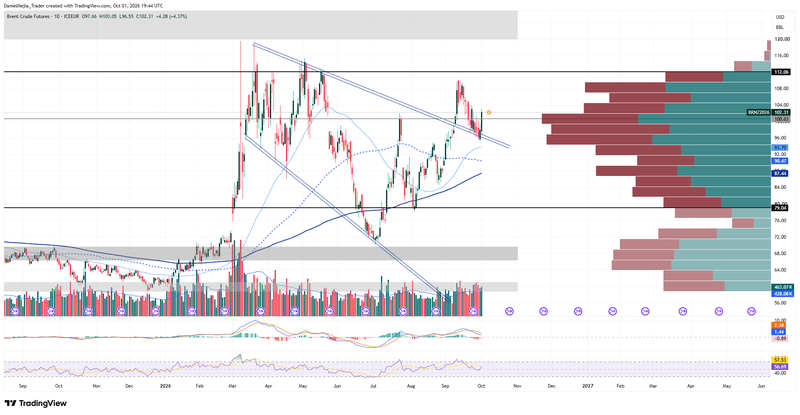
Figure 1: Brent Futures Contract (2025–2026). Source: Data from ICE Futures Europe; author's analysis conducted via TradingView.


