Support
British pound strengthens against the US dollar as UK unemployment rate falls
UK unemployment fell unexpectedly to 4.7% alongside a surge in job creation, prompting sterling to appreciate against the US dollar as market participants anticipate potential interest rate hikes by the Bank of England to contain persistent inflation.

An unexpected decline in the UK unemployment rate to 4.7% was driven by robust job creation.
Strong labour market data could be heightening market expectations of near-term interest rate hikes by the Bank of England.
Headline inflation remaining above target at 3.1% further reinforces the potential central bank's hawkish monetary policy stance.
Date: 21 October 2026
Why is the British pound rising against the US dollar following lower unemployment?
According to data released by the Office for National Statistics (ONS), the UK unemployment rate declined from 4.9% in July to 4.7% in August, defying market expectations of an unchanged reading. Notably, this represents the lowest level recorded since July 2025, signalling a substantial improvement in the labour market. Figure 1 illustrates an inflection point in the unemployment indicator that had been trending upward over the preceding three years.
Concurrently, the ONS reported a positive employment change of 102,000 jobs, comfortably exceeding both the market consensus forecast of 20,000 and the previous figure of 67,000.
Consequently, following the ONS release, the British pound strengthened against the US dollar, with the GBP/USD currency pair advancing by 0.53% to $1.3374. This performance can be attributed primarily to two key drivers: first, a resilient employment sector demonstrates underlying strength in the broader UK economy; second, against a backdrop of robust employment and economic activity, the Bank of England (BoE) is likely to prioritise inflation containment—a scenario that points towards potential interest rate hikes at upcoming monetary policy meetings.
Currently, the headline inflation rate stands at 3.1% (for the August reading), remaining well above the BoE's 2.0% target. Meanwhile, the core inflation rate—which excludes the volatile components of energy and unprocessed food—stands at 2.6%, having held steady at this level since May 2026.
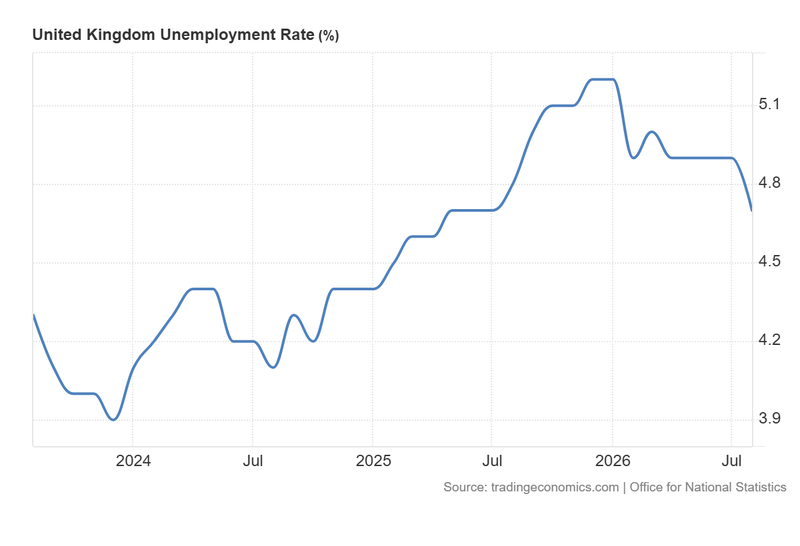
Figure 1. United Kingdom Unemployment Rate (2023–2026). Source: Data from the UK Office for National Statistics; chart retrieved via Trading Economics.
Technical analysis of the GBP/USD pair
From a technical perspective, the GBP/USD pair continues to trade along an upward trajectory. The following are the key factors to highlight.
- Trend Context: Although the pair maintains a long-term bullish posture defined by a sequence of higher highs and higher lows, it is currently oscillating within a consolidation range. Notably, while GBP/USD continues to trade below its 50-day, 100-day, and 200-day Simple Moving Averages (SMAs), short-term bullish momentum is building as price action rejects a key support zone where structural support converges with the floor of a long-term ascending trendline.
- Momentum Indicators: Both the Moving Average Convergence Divergence (MACD) and the Relative Strength Index (RSI) display upward trajectories, suggesting that short-term bullish momentum may persist.
- Resistance Levels: Should short-term bullish momentum strengthen further, the next critical resistance level lies at $1.3430—where the 200-day SMA converges with the Volume Profile’s Point of Control (POC). Above this technical barrier, the next major ceiling stands at $1.3577—the Volume Profile’s Value Area High (VAH).
- Support Levels: In the event of a market retracement, the primary support level is located at $1.3150, representing long-term structural support. A downside breach of this zone would expose the next technical floor at $1.3000—a key psychological level that converges with a relevant volume distribution area.
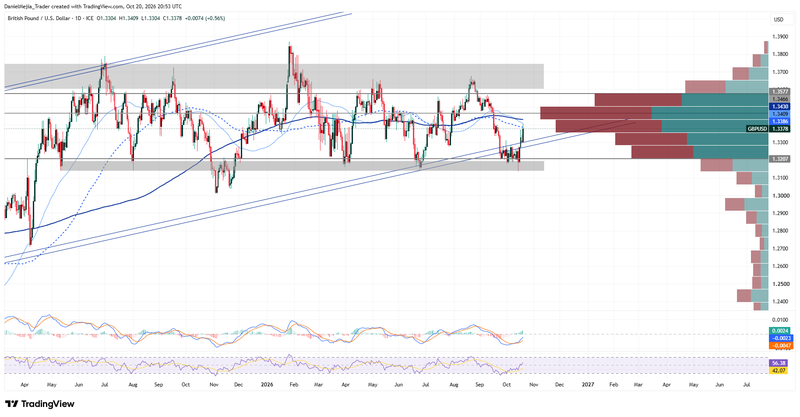
Figure 2. GBP/USD Pair (2025–2026). Source: Data from the Intercontinental Exchange (ICE); author's analysis conducted via TradingView.