Support
Canadian dollar gains despite softer-than-expected inflation
The Canadian dollar strengthened against the US dollar as headline inflation breached the central bank's target range, despite missing market forecasts, driven primarily by surging gasoline prices and slight US dollar weakness.

Headline inflation rose to 3.1%, driven by higher gasoline prices, exceeding the Bank of Canada's 1–3% target range.
Core inflation eased from 2.4% to 2.2%, despite the acceleration in headline inflation.
The Canadian dollar gained against the US dollar, buoyed by the headline inflation print and underlying weakness in the greenback.
Date: 20 October 2026
Why is the Canadian dollar rising despite an inflation miss?
According to data released by Statistics Canada, the headline inflation rate accelerated from 3.0% in August to 3.1% in September; however, the reading came in below the market consensus forecast of 3.2%. Conversely, the core inflation rate—which excludes the most volatile components, namely energy and unprocessed food—decelerated from 2.4% to 2.2%.
Data from Statistics Canada revealed that the primary driver of the higher headline inflation figure was gasoline prices, which accelerated from 22.8% to 27.8% over the period—as cited by Trading Economics. Persistently high energy prices continue to exert upward pressure on global inflation amid ongoing geopolitical tensions in the Middle East, which continue to raise concerns regarding potential oil supply disruptions.
Against this backdrop, the Canadian dollar appreciated against the US dollar despite the easing in core inflation and the headline metric missing market forecasts. This movement can be attributed primarily to two factors: first, headline inflation has breached the Bank of Canada’s 1–3% control range, reinforcing the upward trend observed over the past twelve months; and second, the sustained underlying weakness in the US Dollar Index (DXY) observed over recent days.
At market close, the USD/CAD currency pair declined by 0.21% to 1.4107, reflecting a cumulative appreciation of approximately 1.40% for the Canadian dollar over the past week.
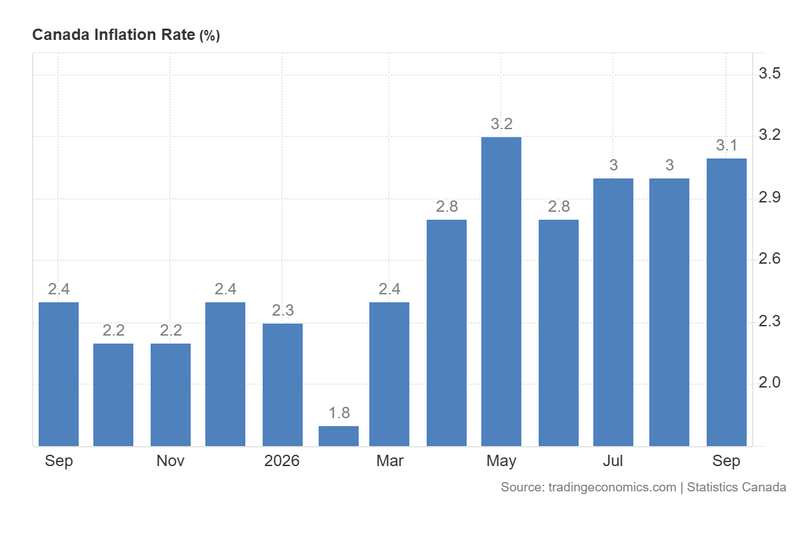
Figure 1. Canada Inflation Rate (2025–2026). Source: Data from Statistics Canada; chart retrieved from Trading Economics.
Technical analysis of the USD/CAD currency pair
From a technical perspective, the USD/CAD currency pair has exhibited a bullish trajectory over recent weeks; however, it is currently encountering significant selling pressure in the short term. Key structural observations include:
- Trend Context: The USD/CAD pair has established an upward trajectory in recent weeks. The spot price is trading comfortably above its 50-day, 100-day, and 200-day simple moving averages (SMAs), reinforcing the prevailing bullish bias. Nevertheless, the pair is confronting short-term selling pressure that is driving price action towards lower valuation levels.
- Momentum Indicators: Both the Moving Average Convergence Divergence (MACD) and the Relative Strength Index (RSI) display downward trajectories, signalling that short-term selling pressure may persist.
- Bullish Scenario: Should price action regain its upward momentum, the primary technical ceiling is located at 1.4270. A decisive breakout above this level would expose the next major resistance at 1.4400—a prominent psychological barrier and technical ceiling. A sustained move above this threshold would increase the likelihood of trading at higher valuation levels.
- Bearish Scenario: If the 1.4090 level—which aligns closely with the 38.2% Fibonacci retracement of the last bullish momentum—is breached to the downside, the immediate technical support levels sit at 1.4030 and 1.3965, corresponding to the 50% and 61.8% Fibonacci retracement levels, respectively. A decisive breakdown below these support zones would significantly raise the probability of a deeper market correction.
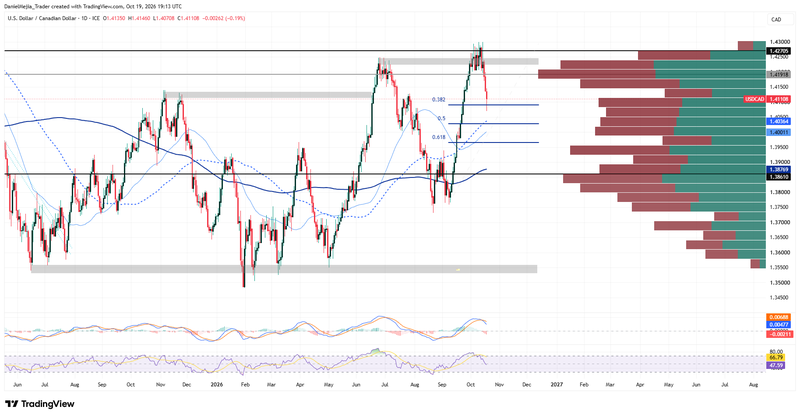
Figure 2. USD/CAD Currency Pair (2025–2026). Source: Data from the Intercontinental Exchange (ICE); author's analysis conducted via TradingView.