Support
 Canadian employment declines, missing forecasts; USD/CAD advances
Canada’s labour market contracted unexpectedly by 68,000 jobs in September, driving the unemployment rate up to 6.5%. Rising inflation pressures, United States trade tariffs, and diverging monetary policy stances have pushed USD/CAD higher towards 1.4254.

Canadian employment fell by 68,000 in September, missing forecasts and pushing unemployment to 6.5%.
Public sector cuts, US tariff pressures, and elevated inflation continue to weigh on domestic productivity.
USD/CAD advanced to 1.4254 as markets priced in potential monetary neutrality by the Bank of Canada at its upcoming meeting.
Date: 10 October 2026
Canadian employment declines as unemployment rate rises slightly; USD/CAD advances
According to data released by Statistics Canada, the employment change indicator contracted by 68,000 jobs in September, substantially missing analysts' consensus forecasts of a 7,000 gain. This marks a second consecutive monthly decline, bringing employment to its lowest level since February 2026. Additionally, the Canadian unemployment rate rose from 6.4% to 6.5%, signalling that the labour market is struggling to sustain growth. According to the employment report, the sharpest contractions occurred within the public sector—most notably across the healthcare, social assistance, and education sectors.
Against this backdrop, a strong relationship exists between the underlying deterioration in the job market, persistent inflationary pressures, and the imposition of tariffs by the United States. Over recent months, the US administration has announced new tariff measures on Canadian goods. This represents a significant adverse impact on Canadian productivity, given that over 70% of total exports were destined for the US market, according to 2024 data from the Observatory of Economic Complexity (OEC). Amid this complex macroeconomic landscape, many firms are choosing to curb costs by trimming payrolls or curtailing workforce expansion.
Following the release of the employment report, the Canadian dollar depreciated by 0.23% against the US dollar, with the USD/CAD currency pair advancing to the 1.4254 level. This market movement can be explained primarily by expectations that the Bank of Canada (BoC) will face diminished pressure from a weak labour report to maintain its benchmark interest rate at its next monetary policy meeting—particularly with Canadian inflation currently at 3.0%. Conversely, the Federal Reserve faces persistent pressure to maintain a restrictive monetary stance amidst an environment of elevated inflation in the US, which currently stands at 3.4%.
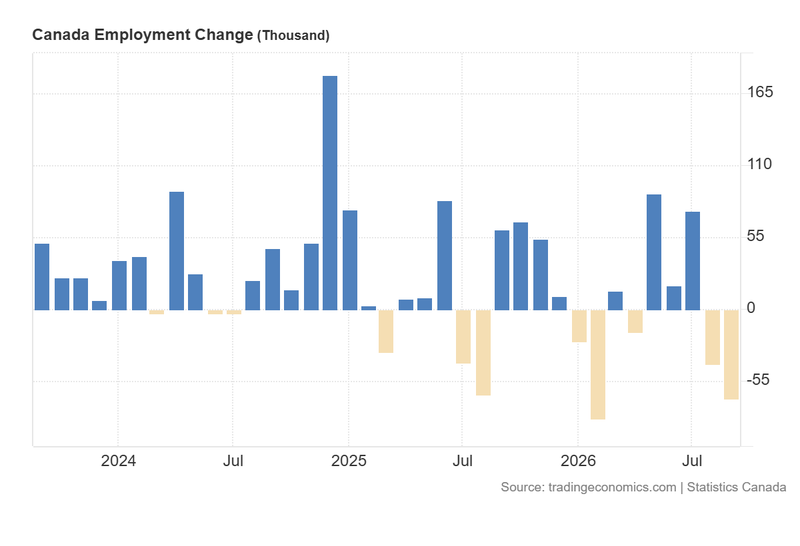
Figure 1. Canada Employment Change (2023–2026). Source: Data from Statistics Canada; chart retrieved from Trading Economics.
Technical analysis of the USD/CAD currency pair
From a technical perspective, the USD/CAD currency pair has exhibited a short-term bullish performance over recent weeks. Key structural observations include:
- Trend Context: The USD/CAD pair has developed an upward trajectory in recent weeks, trading comfortably above its 50-day, 100-day, and 200-day Simple Moving Averages (SMAs), thereby reinforcing the bullish bias. However, the pair is currently confronting a short-term structural resistance level that will prove critical in determining whether the upward momentum gains further traction or undergoes a downside rejection.
- Resistance Levels: Should price action break above the structural resistance at 1.4240, the next major technical ceiling is located at 1.4500. A decisive breakout above this barrier would increase the likelihood of the pair testing higher valuation levels.
- Support Levels: If price action is rejected at the 1.4240 level, key support floors rest at 1.4142 and 1.4030—representing structural support and the 100-day SMA, respectively. A decisive breakdown below these support levels would significantly increase the probability of a deeper market correction.
- Momentum Indicators: The Relative Strength Index (RSI) is trading in overbought territory, signalling a potential consolidation phase or market reversal. Furthermore, the MACD is exhibiting a potential bearish crossover in an elevated zone relative to its historical performance, reinforcing the hypothesis of price reversal. Nevertheless, macroeconomic and geopolitical factors are expected to remain the primary drivers of future market direction
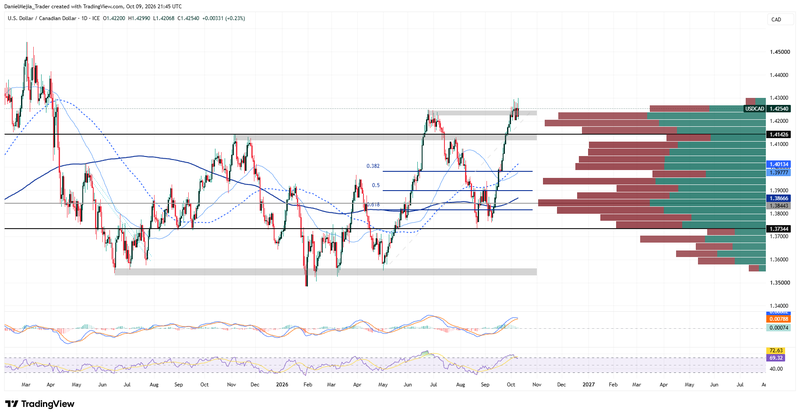
Figure 2. USD/CAD Currency Pair (2025–2026). Source: Data from the Intercontinental Exchange (ICE); author's analysis conducted via TradingView.