Support
Why is the oil market facing a refining bottleneck?
Diesel and other refined products remain unusually expensive because damaged refineries, lower Middle Eastern and Russian exports, depleted inventories and higher freight costs have reduced the amount of usable fuel reaching consumers. Crude can therefore fall without producing an equivalent decline in transport, agricultural and industrial costs.

Global diesel prices remain close to twice the level of crude despite easing from September's record.
US distillate inventories are 10% below their five-year seasonal average.
Holding above $96.80–97.00 could support a recovery towards $100–102.
The barrel is available before the fuel is
Crude oil has limited economic value until it is converted into diesel, gasoline, jet fuel and other products. The current disruption has affected both stages of that process.
Restricted flows through the Strait of Hormuz reduced access to crude, but attacks on refineries, lower Russian processing and reduced Middle Eastern fuel exports created a second bottleneck.
Even if more crude becomes available, the market still needs sufficient refining capacity in the correct regions to turn those barrels into the products facing shortages.
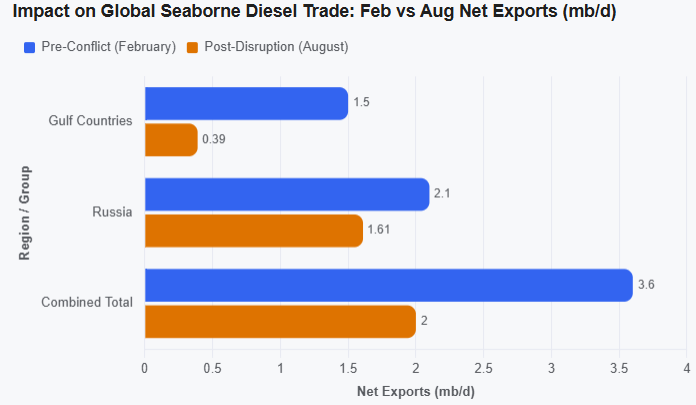
The IEA estimates that Gulf and Russian diesel exports were around 1.6 million barrels per day lower in August than before the conflict. Those suppliers previously represented almost 45% of global seaborne diesel trade.
A decline in crude lowers one part of the refiner's cost, but it does not repair damaged capacity or replace missing product exports. The result can be cheaper crude alongside expensive fuel.
Source: Google
Diesel is setting the economic cost of the shock
Diesel matters more to the wider economy than its share of household fuel spending suggests. It powers freight, agriculture, mining, construction and parts of manufacturing. Higher diesel prices therefore reach consumers indirectly through the cost of producing and transporting other goods.
That changes how the inflation impact should be measured
A fall in crude may quickly reduce market-based inflation expectations, the effect on actual business costs will be slower if diesel, freight and refining margins remain elevated.
Companies facing those costs may continue raising prices even after the crude benchmark has turned lower. Central banks could therefore see headline energy inflation improve before the broader passthrough has ended.
US inventories reveal a product mismatch
Commercial crude stocks fell by 1.9 million barrels, extending their decline for a fourth consecutive week. Distillate inventories dropped by 1.5 million barrels to 102.8 million and remain approximately 10% below their five-year average.
Gasoline inventories moved in the opposite direction, increasing by 3.9 million barrels. Gasoline demand over the previous four weeks was also slightly weaker than a year earlier.
Divergence challenges two simple conclusions
The crude draw does not necessarily mean overall demand is booming because strong exports and high refinery runs can reduce inventories while domestic gasoline consumption weakens.
The gasoline build does not mean the entire market is comfortable because refineries cannot freely transform excess gasoline into the diesel required by freight companies, farms and industry.
The market is facing weak demand in some areas and acute scarcity in others. Crude alone therefore provides an incomplete picture.

Source: U.S. Energy Information Administration
Technical outlook
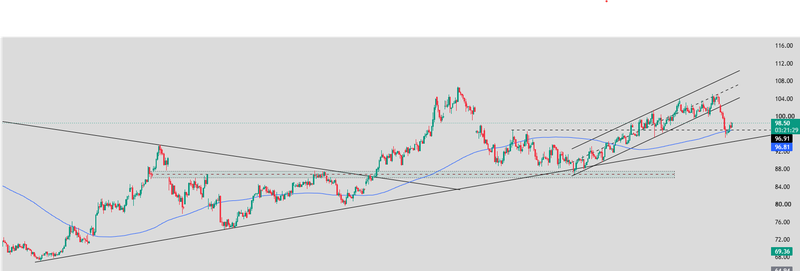
WTI crude oil is trading near $98.50, attempting to recover after a sharp correction from the recent peak around $104–105. Despite the latest decline, the broader technical structure remains constructive, supported by a rising long-term trendline and the moving average near $96.81.
The immediate question is whether the recent pullback represents a healthy correction within the broader uptrend or the beginning of a deeper reversal.
Crude made a substantial recovery from the July low near $67, followed by a sequence of higher highs and higher lows. The advance accelerated after crude broke above the previous consolidation zone around $86–88.
More recently, WTI established a rising price channel, with buyers repeatedly defending its lower boundary. The rally towards $104–105 marked the latest significant high, but profit-taking subsequently triggered a sharp decline.
The important development is that the correction has brought prices back towards the rising trendline and the moving average, both currently concentrated around $97.
Scenario ahead
Holding above $96.80–97.00 could support a recovery towards $100–102. A sustained breakout above this area would reopen the way towards $104–105, followed by $108–110.
However, a decisive break below $96.80 would weaken the rising structure and expose $93–94. Further selling could bring the major $86–88 demand zone back into focus.
WTI retains a medium-term bullish bias, but the recent correction has brought prices to a critical area of support. The $96.80–97.00 region is the key level to monitor. Holding above it would favour another attempt towards $100–105,
While a sustained breakdown would increase the risk of a deeper correction. Geopolitical developments and changes in physical supply flows remain important catalysts for the next directional move.
Source: Trading view