Support
DXY price forecast: higher inflation and new tariffs could fuel another dollar rally
New US tariffs could strengthen the dollar by keeping inflation elevated and extending the Federal Reserve's tightening cycle. However, higher import costs may also weaken economic growth, leaving investors to weigh the dollar's interest-rate advantage against the risk of a slowdown.

A stronger dollar could in part mitigate the inflationary impact of the tariffs.
A sustained close above the descending trendline 105.00 could push price toward 108.
US core PCE inflation jumped to 3.3% annually from 3.2%, with the monthly reading holding steady at 0.3%.
Could Trump new tariffs provide further support for the dollar?
Higher import tariffs could lead to higher US consumer prices if businesses choose to pass the additional costs on to consumers, firms that absorb the cost would be left with tighter profit margins. Higher prices would in turn be likely to reduce consumer demand.
If inflation stays high after another round of tariffs the Fed may be forced to rising rates even after mid-2027, and if the ECB is more dovish then the wider interest rate differential could make dollar assets more attractive to foreign investors and that would be supportive of the DXY.
A stronger dollar could offset some inflationary pressure
A stronger dollar could in part mitigate the inflationary impact of the tariffs by lowering the dollar cost of goods priced in foreign currencies but that would not, however, get rid of the extra import duties that US businesses are still going to have to pay.
The bigger risk is that the tariffs will keep inflation up while at the same time reducing consumer purchasing power and corporate profits.
If growth is going to be significantly weaker then investors will start to wonder just how much further the Fed can go with tightening.
For DXY the issue will be whether the higher US rates continue to attract capital or whether the weaker growth is going to start to outweigh the yield advantage of the dollar.
US inflation remains elevated despite resilient economic growth
US core PCE inflation rose to 3.3% annually, with the monthly reading holding at 0.3%, while the initial estimate of third-quarter GDP showed annualized growth of 3.4%.
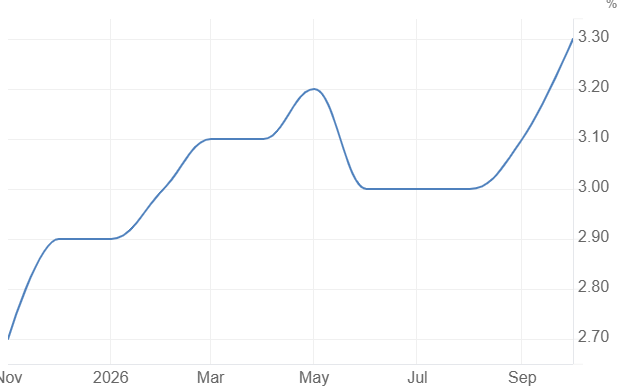
Source: U.S. Bureau of Economic Analysis
The concern for the Fed is that lower energy prices have not been enough to contain underlying inflation with economic growth remaining resilient, policymakers have more room to raise interest rates without immediately threatening economic activity.
Markets are already pricing three additional rate hikes through mid-2027, while Fed Governor Christopher Waller has opened the door to a 50-basis-point increase in December if inflation remains persistent.
For the dollar, the focus shifts to whether other major central banks will follow the Fed's tightening path however if the ECB and other central banks move more cautiously, widening interest-rate differentials could attract additional capital into dollar-denominated assets.
Technical outlook
DXY is trading near 104.05, extending its recovery from the 96–98 support area. The move above 101.42, which previously acted as resistance, and the moving average near 98.74 suggests that buyers are regaining control after several unsuccessful recovery attempts.
However, the broader structure remains within a large symmetrical triangle, with descending resistance extending from the 120 area and rising support originating near 72.
DXY has continued forming higher lows along the ascending trendline, indicating that buyers have been stepping in at progressively higher levels. Yet each recovery has struggled to overcome the descending resistance, leaving the index without a confirmed breakout.
The latest advance has brought DXY closer to the upper boundary of the triangle, making the 104.50–105.00 area particularly important for determining whether the recovery can extend further.
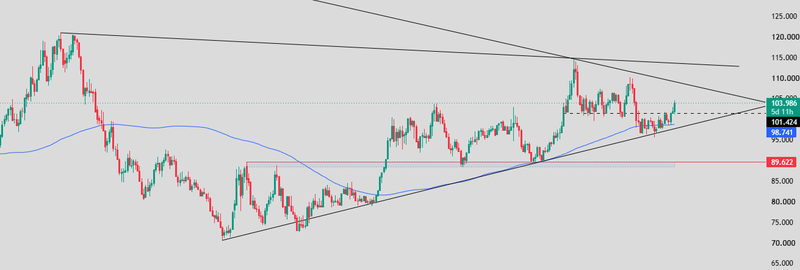
Source: Trading view
Scenario ahead
A sustained close above the descending trendline around 104.50–105.00 could signal a break in the sequence of lower highs that has constrained previous recoveries. This would strengthen the bullish outlook and open the way toward 108–110, where earlier buying momentum faded.
A further move above 110 could bring the 113–115 resistance area into focus. However, a breakout followed by a successful retest of the former descending resistance would provide stronger confirmation than a temporary move above 105
On the other hand, immediate support is at 101.42, a previous resistance level that buyers will need to defend to maintain the recovery.
A sustained break below 101.42 would weaken the recent bullish momentum and could bring the moving average near 98.74 back into focus, followed by the ascending trendline around 97–98.
A break below that rising trendline would challenge the broader symmetrical triangle structure, suggesting that selling pressure is no longer being contained by the sequence of higher lows. This could increase the risk of a deeper decline toward 89.62.
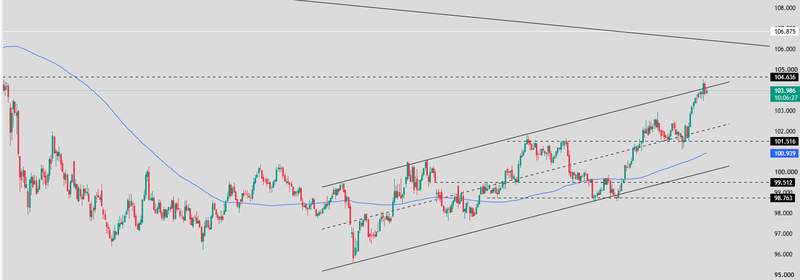
Source: Trading view