
 Support
 Euro falls amid growing concerns over France’s government debt
The euro dropped to a low not seen since May 2025, weighed down by surging French bond yields and hawkish rate expectations from the Federal Reserve.

French 10-year government bond yields reached 4.85% as mounting fiscal deficit concerns undermined investor confidence.
German and broader Eurozone bond yields hovered near 15-year highs amidst widespread selling pressure across European sovereign debt markets.
The US dollar rallied on expectations of a 25-basis-point Federal Reserve rate hike before the end of the year.
Date: 8 October 2026
Why is the euro under pressure from France's fiscal concerns?
The euro declined to its lowest level since May 2025 amidst heightened concerns regarding France's sovereign debt outlook and rising expectations that the Federal Reserve will maintain a hawkish monetary policy stance.
On the one hand, the French 10-year government bond yield rose by 6.9 basis points to around 4.85%—a level last registered in 2002. This persistent selling pressure on French debt reflects mounting inflation concerns that continue to fuel expectations of additional European Central Bank rate hikes. Furthermore, bondholders are increasingly concerned about France's fiscal deficit, which risks deteriorating significantly should interest rates continue their upward trajectory.
In an environment of elevated interest rates, net debt-servicing costs absorb a growing proportion of the national budget, curbing fiscal space for social programmes and infrastructure projects. These prospective interest rate hikes are dampening market sentiment—eroding investor confidence in fixed-income assets while diminishing consumer purchasing power. Concurrently, German and broader Eurozone benchmark yields are trading near multi-year highs not observed since 2011, indicating that sovereign debt sell-offs reflect a widespread trend among European bondholders.
On the other hand, the greenback strengthened following the publication of the Federal Reserve's meeting minutes, which revealed that policymakers anticipate an additional interest rate hike before the end of 2026. Within the document, Federal Open Market Committee (FOMC) members signalled potential further monetary tightening to combat sticky headline inflation, which has persisted above the central bank's 2.0% target for nearly five years. However, the FOMC refrained from specifying the exact timing of the rate adjustment, reiterating a strictly data-dependent approach for upcoming policy meetings.
Against this backdrop, the CME FedWatch Tool indicates an 81% market-implied probability that the Federal Reserve will maintain steady interest rates at its October meeting, while pricing in a 66% likelihood of a 25-basis-point rate hike in December.
Consequently, the EUR/USD currency pair fell by 0.57% to close at $1.1196. Over the past month, the euro has accumulated a 3.5% loss against the US dollar.
Technical analysis of the EUR/USD pair
From a technical perspective, the EUR/USD pair is breaking out of its consolidation range amidst intensified selling pressure. Key observations include:
- Trend Context: On the higher timeframes, the pair is breaching a consolidation pattern that had persisted for over twelve months. Furthermore, the exchange rate is trading below its 50-day, 100-day, and 200-day Simple Moving Averages (SMAs), reinforcing a dominant bearish bias. Nonetheless, price action is currently testing a structural support zone that has historically served as a critical pivot point.
- Resistance Levels: In a bullish recovery scenario, the primary technical ceiling lies at $1.1367—a level that converges with the Volume Profile's Value Area Low (VAL). Should price break above this hurdle, the next major technical resistance is the 200-day SMA near $1.1600. A decisive breakout above these zones could indicate scope for further upside extension.
- Support Levels: Should the downward move persist and breach the structural support at $1.1162, the next key support area is identified at $1.0830—a significant volume distribution zone. A sustained breakdown below these levels would heighten the probability of a deeper market correction.
- Momentum Indicators: The Moving Average Convergence Divergence (MACD) continues its downward trajectory, signalling that bearish momentum may persist. However, the Relative Strength Index (RSI) is approaching oversold territory, suggesting caution regarding immediate downside continuation.
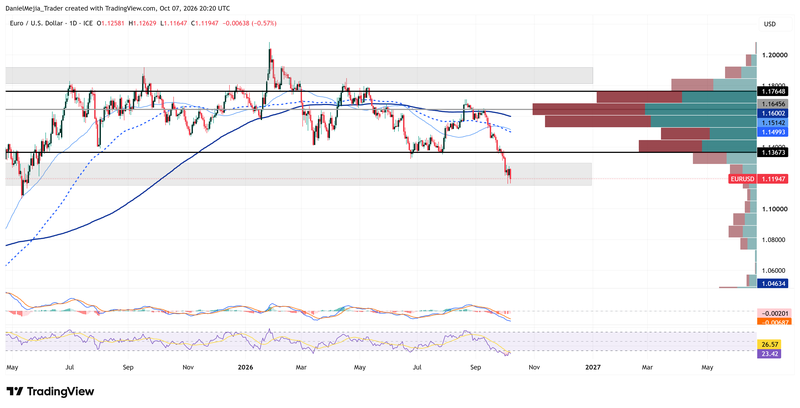
Figure 1. EUR/USD Currency Pair (2025–2026). Source: Data from the Intercontinental Exchange (ICE); own analysis conducted via TradingView.


