Support
 Gold price scenarios: can buyers reclaim $4,229?
Gold continues to attract strategic demand from central banks and private investors, but a possible easing of US-Iran tensions could change the forces supporting prices. The World Gold Council’s latest survey points to sustain official-sector interest, while record quarterly ETF inflows show that investment demand remains strong.
The World Gold Council’s 2026 survey found that 45% of central banks plan to increase their gold reserves over the next 12 months.
Global physically backed gold ETFs attracted US$10 billion in September.
A break below $4,100 will make gold target $3,943.
Central banks continue to favour gold diversification
The World Gold Council’s 2026 survey found that 45% of central banks plan to increase their gold reserves over the next 12 months, the highest share since the survey began in 2018. Another 54% expect to maintain their holdings, suggesting that official-sector demand remains structurally supportive even as prices fluctuate.
This interest reflects more than short-term price expectations
Central banks are using gold to diversify reserves, reduce exposure to geopolitical risks and preserve value during periods of financial uncertainty. Unlike government bonds, gold does not depend on another government’s ability or willingness to meet its obligations.
That makes official-sector buying an important source of support when confidence in currencies, sovereign debt or the international political environment comes under pressure. However, survey intentions do not guarantee actual purchases, and central-bank demand alone cannot determine the next price move.
ETF inflows show that private investors are also buying
Investment demand has reinforced that longer-term support. Global physically backed gold ETFs attracted US$10 billion in September, bringing third-quarter inflows to a record US$31 billion. Global holdings increased by 67 tones during September to a record 4,256 tones, despite a decline in gold prices.
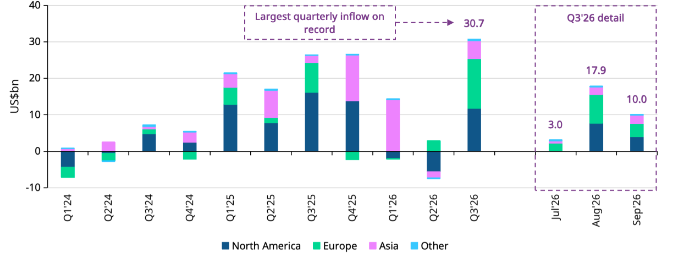
Source: Bloomberg
The regional breakdown is particularly notable
UK-listed funds recorded their strongest quarter on record, adding US$7.5 billion during the third quarter. UK funds also marginally overtook China as the largest country-level contributor to year-to-date ETF inflows, with US$9.5 billion in cumulative inflows by the end of September.
These flows suggest that investors are not relying exclusively on geopolitical tensions to justify holding gold. Inflation, uncertainty, bond-market volatility and concerns about elevated equity valuations have also supported demand. Yet ETF flows can change more quickly than central-bank reserve allocations, making them more sensitive to interest-rate expectations and shifts in market sentiment.
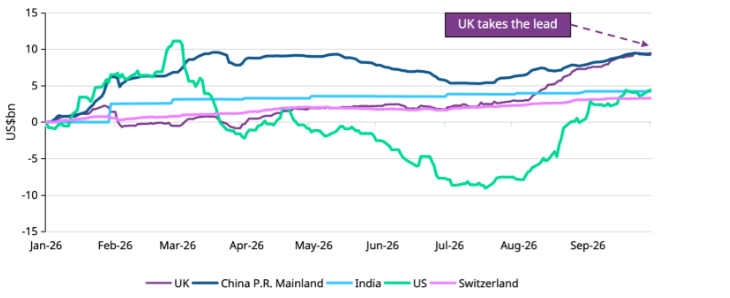
Source: Bloomberg
Could a US-Iran agreement change the outlook?
A credible agreement that restores normal shipping through the Strait of Hormuz could reduce oil prices and ease concerns about another energy-driven inflation shock. That would change the monetary-policy outlook as well as oil geopolitical premium.
Lower energy prices could give the Fed more room to wait before tightening further, particularly if core inflation and employment are also moderate. Lower expectations for interest rates could support gold by reducing the opportunity cost of holding a non-yielding asset. But the effect would not be automatic. If falling oil prices also reduce safe-haven demand and Treasury yields rise for other reasons, gold could face pressure.
The timing of any agreement remains uncertain
Trump has indicated that military action against Iran would be paused ahead of the November midterm elections, but that does not establish that a comprehensive peace agreement or a full restoration of shipping will follow immediately after the vote.
Technical outlook
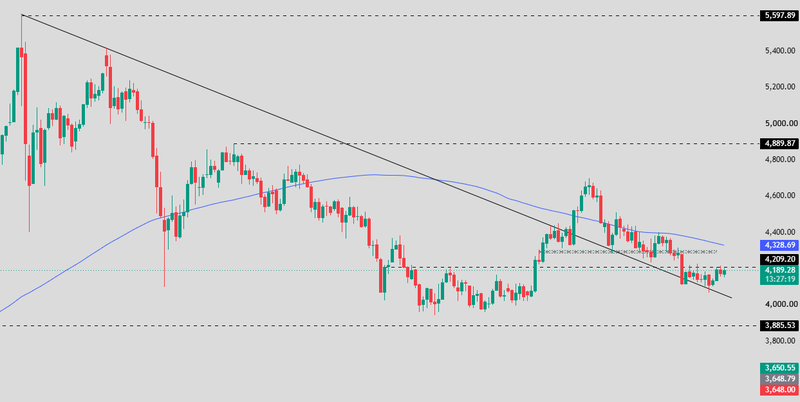
Gold is trading around $4,191, attempting to stabilize after a prolonged decline from the $5,598 peak. The broader structure remains bearish, with price trading below the descending trendline and the moving average near $4,328.
The recent rebound from the $4,000 area has been modest, and gold remains below the former support zone around $4,209–$4,221. This area is now an important resistance region, while the moving average reinforces the broader selling pressure. The trendline breakout has not yet translated into a sustained recovery.
The broader market backdrop remains challenging. The dollar is still elevated, and high US Treasury yields continue to limit gold's appeal, although easing yields could provide some relief. The upcoming US CPI report is an important catalyst for rate expectations and gold's next move.
Source: Trading view
Scenarios ahead
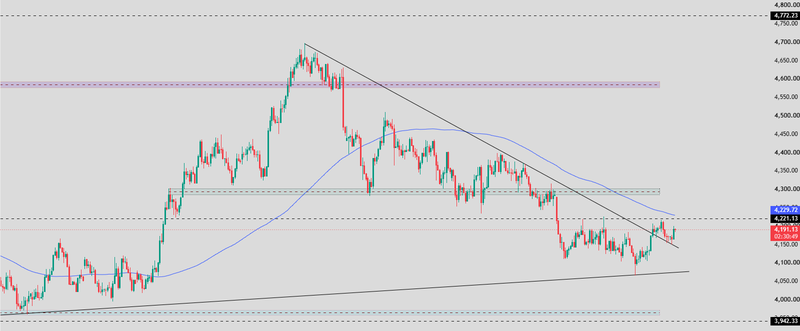
A sustained break above $4,221–$4,229 would strengthen the recovery, opening the way toward $4,280–$4,300. A breakout above that zone could extend gains toward $4,350–$4,400.
However, rejection below $4,221–$4,229 could send gold back toward $4,150–$4,120. A break below $4,100 would expose $4,060–$4,080, followed by major support at $3,943.
Gold needs to reclaim $4,229 to improve its short-term outlook. Until then, the recovery remains vulnerable, with $4,100 the key downside area to watch.
Source: Trading view