Support
Gold price near $3,900: will the psychological level hold?
Latest escalation between the United States and Iran is producing a more complicated reaction, gold is no longer trading only on fear. It is also trading on what higher oil prices could mean for inflation, interest rates and bond yields. Right now, those forces are pulling the market in opposite directions.

Rising oil prices are reviving inflation concerns.
Higher Treasury yields are increasing the cost of holding gold.
The market is balancing geopolitical demand against interest-rate risk.
Gold ETF trading hits record highs despite slower inflows
ETF investors have not walked away from gold. Holdings attracted around $8 billion of net inflows during the first half of 2026, showing that investors are still using gold as a portfolio hedge against inflation, geopolitical uncertainty and growing fiscal concerns.
What has changed is the pace, not the direction. Inflows remained positive, but they were the weakest first-half performance since 2025. That suggests investors are becoming more selective. The urgency to add gold at any price has eased, even though the longer-term case for holding the metal remains intact.
Trading activity tells a different story. While inflows slowed, global gold ETF trading volumes averaged $12 billion a day in the first half of the year, the highest level on record and 73% above the previous annual average. Investors may not be building positions as aggressively as they were, but they are trading gold more actively as markets react to changing expectations for inflation, interest rates and geopolitical risk.
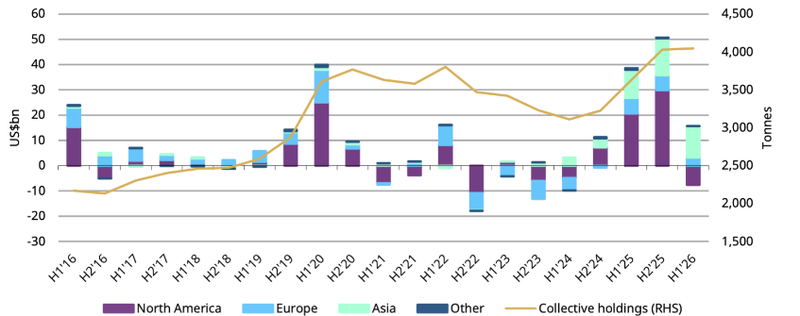
Source: World gold council
Higher yields are becoming a headwind
The biggest pressure on gold is not the conflict itself. It is the market's reaction to what the conflict could mean for interest rates.
Investors are starting to price the possibility that the Federal Reserve will need to keep policy restrictive for longer if inflation proves more persistent, and maybe one rate hike this year. Even if inflation continues to cool, higher oil prices make it harder for the Federal Reserve to start easing policy. The market is moving away from the idea of rate cuts this year and toward a "higher for longer" outlook instead. That is a very different environment for gold. As long as rates stay elevated and real yields remain firm, gold may struggle to fully benefit from geopolitical demand, even with tensions in the Middle East still running high.
Technical outlook
Gold continues to trade under pressure, with the broader technical picture still favoring sellers. Since reaching nearly 5,600, the market has remained below a well-defined descending trendline, creating a series of lower highs. Each recovery attempt has been met with selling pressure, showing that buyers have not yet regained control.
The decline has slowed recently, but the market still needs a stronger signal before the trend can be considered changed.
Gold is currently consolidating around 3,990, just above the important support area between 3,850 and 3,900. This zone has attracted buyers several times in recent months and remains the key level protecting the market from a deeper correction.
At the same time, the descending trendline continues to limit upside attempts. Until gold breaks above that structure, rallies are likely to face selling pressure.
Momentum indicators are showing some improvement
The RSI has started recovering from oversold conditions and is forming slightly higher lows while price remains near support. That suggests selling pressure may be easing. However, RSI remains below the neutral 50 level, meaning buyers have not yet established clear momentum.
Scenarios ahead
The bearish structure remains intact unless gold can break above the descending trendline and reclaim 4,209.
A move above that level would be an important technical shift because it would break the pattern of lower highs that have dominated the market. From there, gold could attempt a recovery toward 4,493, with 4,800 becoming the next major resistance if buyers regain stronger momentum.
The immediate focus, however, remains on support. A decisive break below the 3,850–3,900 zone would be a significant warning sign. It would show that buyers have failed to defend one of the most important areas on the chart and could trigger additional selling as stop-loss orders are activated. In that scenario, the correction could extend toward the next support areas around 3,600, where the market would begin testing levels closer to the early stages of the previous rally.
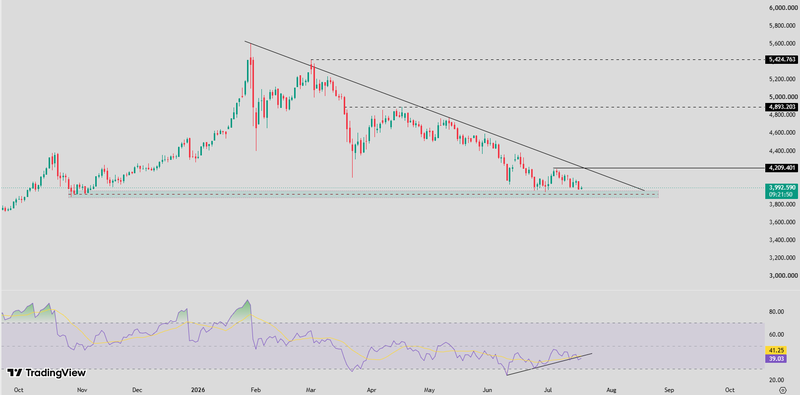
Source: Trading view