
 Support
Micron blockbuster quarter turns memory cycle into an AI profit story
Micron is no longer trading like a simple memory-cycle recovery. The latest Q3 results have pushed the stock into a different debate: whether AI demand can turn the company into one of the most profitable US technology names outside Nvidia and Google.

Fiscal Q3 revenue jumped to $41.46 billion.
Revenue rose 345% from the same quarter last year.
GAAP’s net income reached $28.24 billion.
Micron is being revalued as an AI supplier
Micron reported $41.46 billion in revenue for fiscal Q3, a 345% increase from $9.30 billion in the same quarter last year. GAAP net income reached $28.24 billion, or $24.67 per diluted share.
For years, investors treated Micron as a deeply cyclical company. When memory prices rose, profits improved quickly. When supply caught up, margins collapsed just as fast. That history is why the stock often traded with a discount compared with software or platform companies.
AI is changing the way investors look at memory
AI infrastructure does not only need chips from Nvidia. It also needs massive amounts of high-performance memory to train and run models efficiently. That makes Micron less of a background component supplier and more of a direct beneficiary of the AI compute buildout.
This is why the latest quarter matters. Revenue growth of 345% and net income above $28 billion suggest Micron is capturing a much larger share of the AI infrastructure profit pool than the market had previously priced. The question is no longer whether memory demand has recovered. The question is whether AI has created a stronger, longer and more profitable demand cycle than past memory booms.
Valuation is now the key test
The market’s reaction will depend on whether investors believe this profit level is sustainable.
Micron’s P/E ratio is now 12% above its last four-quarter average of 21.4. That tells us the stock is no longer being priced as a cheap cyclical rebound. Investors are starting to give it a higher multiple because they see stronger earnings quality, better pricing power and deeper exposure to AI infrastructure.
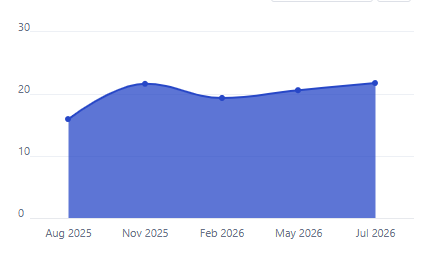
Source: Fullratio
But that higher multiple also creates risk
If investors begin to believe Micron is becoming a structural AI winner, the stock can justify trading above its historical valuation range. But if the market decides Q3 was peak-cycle strength, the premium may become harder to defend. Memory remains a competitive business, and supply discipline will matter. If competitors add capacity too quickly, pricing power could weaken later.
That is the balance investors must judge
Micron’s earnings are strong enough to change the story, but not strong enough to remove the cycle risk completely. The company is closer to the AI centre than before, yet it still operates in a market where margins can move sharply when supply and demand shift.
For now, the quarter gives bulls a powerful argument. Micron is no longer just recovering with the semiconductor trade. It is proving that AI demand can flow directly into memory profits.
Technical outlook
Micron is starting to feel the pressure from profit-taking after a powerful run in the semiconductor trade. Investors are not abandoning the AI theme, but they are becoming more selective. Some capital is rotating away from highly valued hardware names and moving back toward AI software companies, where investors may see cleaner margins and less exposure to the semiconductor cycle.
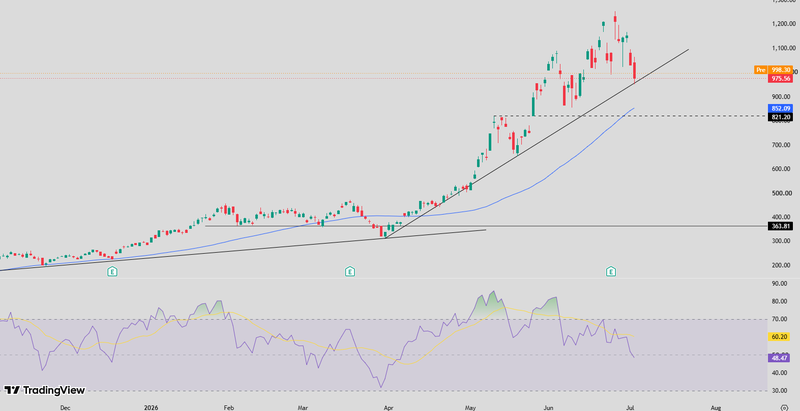
The pullback has brought Micron back toward its rising trendline, which now sits near 975. This is an important area because it also sits close to the psychological 1,000 level. Buyers have already reacted around this zone, which suggests the broader uptrend is still alive. If Micron continues to hold this trendline, the recent weakness looks more like a reset after an aggressive rally than the start of a major reversal.
The next support area is 850–821. This zone matters because it includes the 50-day moving average near 852 and the previous breakout area around 821. If the 975–1,000 region fails, this would be the next place where longer-term buyers may try to step in. Below that, the major structural floor remains near 364, but that level is far below the current market and would only become relevant if sentiment toward the entire AI semiconductor trade deteriorates sharply.
RSI has fallen below 50 after spending several weeks in overbought territory. That shows short-term buying pressure has weakened, but it does not automatically mean the trend has turned bearish. In strong rallies, momentum often needs to cool before the stock can build another base. The key is whether price can hold support while RSI stabilizes.
Scenarios ahead
The bullish scenario depends on Micron holding the 975–1,000 support zone and staying above the rising trendline. If buyers continue defending that area and momentum starts to recover, the stock could retest 1,150–1,200. A clean move above those highs would put Micron back into price discovery and confirm that the broader uptrend remains in control.
The weaker scenario begins with a break below 975 and the rising trendline. That would show that profit-taking is becoming more aggressive and could open the way toward 850–821. Even that move would not necessarily destroy the long-term uptrend, but it would tell us the market needs more time to digest the scale of Micron’s rally before another sustainable move higher can develop.
Source: Trading view


