
 Support
Micron joins the trillion-dollar club as AI memory becomes the new bottleneck
Micron has now reached a market valuation above $1 trillion, while its share price is trading close to the $1,000 mark, after a surge driven by demand for high-bandwidth memory and tighter supply across the memory market.

Micron has crossed the $1 trillion valuation level.
Micron is trading near $1,000 after a sharp AI-driven rally.
The company has started manufacturing 1-alpha DRAM in the US.
HBM capacity is already fully booked through 2026, with demand extending into 2027.
Micron is no longer being treated like a normal memory stock
For years, Micron was viewed through the old memory-cycle lens. Investors bought it when DRAM prices were recovering and sold it when supply caught up. That framework has not disappeared, but it is no longer enough to explain what is happening now.
The market is starting to price Micron as a strategic AI infrastructure company, not just a cyclical chipmaker. That is a major shift. Memory used to be seen as a supporting part of the semiconductor story. Now it is becoming one of the main constraints.
The $1 trillion valuation is about scarcity, not just optimism
Micron reaching a $1 trillion valuation matters because it shows how aggressively investors are revaluing companies tied to AI bottlenecks. The rally is not only based on excitement around artificial intelligence. It is based on the belief that memory supply may remain tight for longer than usual.
That is why the stocks’ move toward the $1,000 area has drawn so much attention. A high share price alone does not prove value. But in this case, the market is reacting to a stronger revenue outlook, long-term customer commitments and limited available supply.
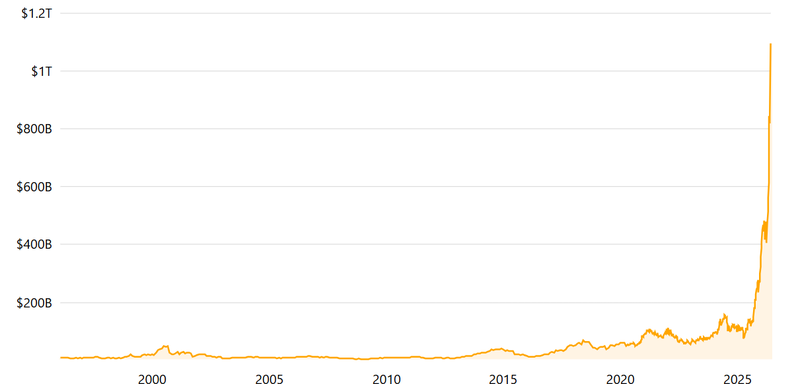
Source: Companies marketcap
HBM is the center of the story
The strongest part of Micron’s current narrative is high-bandwidth memory. Management has confirmed that HBM supply for 2026 is already fully sold, with demand expected to exceed supply well into 2027.
That changes the way investors think about the business. When capacity is booked far in advance, revenue visibility improves. Pricing power also becomes stronger because customers cannot easily walk away if memory is scarce across the industry.
This is exactly why Micron’s story now feels different from older memory upcycles. The demand is not coming from a temporary consumer electronics rebound. It comes from AI data centres, cloud infrastructure and long-term hardware buildouts.
US manufacturing adds another layer
Micron also officially began manufacturing 1-alpha DRAM at its Manassas, Virginia facility, a move tied to the broader push to strengthen domestic semiconductor supply. Reports said the expansion involved around $2 billion in investment, with qualified production expected by the end of 2026.
That matters because investors are not only looking at demand. They are also looking at supply security. In a world where chips have become a geopolitical asset, US-based memory production gives Micron a stronger strategic position.
Technical outlook
The expansion phase in MU is being driven by rising expectations around AI-related memory demand. The bigger trend is clearly bullish, especially after the stock moved from the 360–365 support area in April to almost 1,000 in a relatively short period. That kind of move shows strong institutional demand, but it also changes the nature of the risk. At this stage, the question is no longer whether momentum is strong. It is whether the move can be sustained.
The breakout above 821 was an important technical shift. This level had previously acted as a major resistance area, and the fact that price managed to clear it gives the current rally more credibility. As long as MU stays above 821, the broader uptrend remains intact, and the breakout continues to look valid.
The push toward the 970–1,000 zone has now taken the stock into an area with very little historical resistance. That means MU is effectively trading in price discovery, where sentiment, momentum, and investor positioning matter more than old technical levels. In this type of environment, moves can extend further than expected, but they can also become more sensitive to profit-taking.
For now, 821 is the first key level to watch. Below that, the broader support zone sits around 700–720, which was the last major consolidation area before the latest acceleration. A deeper structural level remains around 360–365, where the longer-term trendline and earlier breakout base come together. That area is far below current prices, but it still matters as the main reference point for the long-term trend.
If price maintains acceptance above 950–1,000, the bullish momentum could extend further as trend-following flows continue to support the move. However, the vertical nature of the rally also increases the probability of consolidation or a corrective pullback, as markets rarely sustain such steep advances indefinitely without periods of rebalancing. A failure to hold above 821 would be the first sign that momentum is cooling and that a broader consolidation phase may be developing.
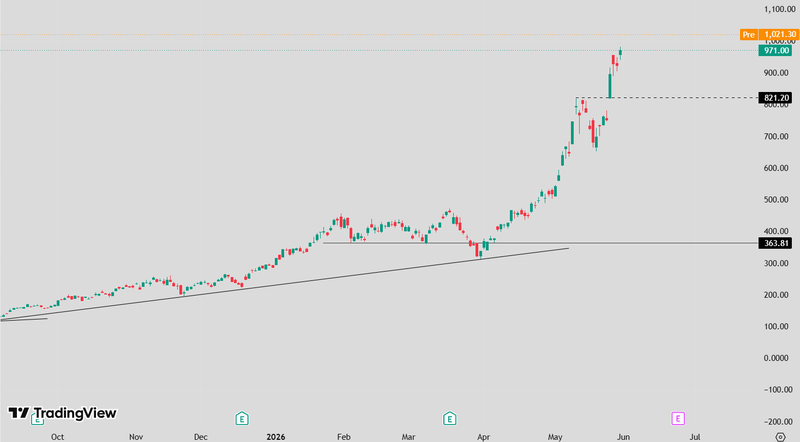
Source: Trading View


