
 Support
Nasdaq holds above 30,000 despite 5.2% treasury yields: what comes next?
The US 10-year Treasury yield has pushed above 5.2%, while the 10-year real yield has climbed to around 2.9%, its highest level in years. Yet Nasdaq has remained relatively resilient, supported by strong earnings and continued AI investment. On September 29, Nasdaq slipped only 0.1% even as the 10-year yield reached 5.25%.

Nasdaq has remained resilient despite the 10-year Treasury moving above 5.2%.
The 10-year real yield reached around 2.9% on September 28, showing that the rise in borrowing costs is not solely an inflation story.
Nvidia's second-quarter fiscal 2027 revenue rose 106% year on year to $96.2 billion, while Broadcom's latest quarterly revenue increased 86%.
Why have higher real yields not broken the Nasdaq?
The answer starts with the economy. A rising real yield can mean investors expect tighter monetary policy, but it can also reflect stronger expected real growth and a higher return on capital.
The current bond sell-off contains both elements
US economic activity remains firm, and the S&P Global US Composite PMI has surged to 58.4, its highest level since July 2021, pointing to a significant acceleration in private-sector activity. At the same time, the Treasury market is demanding more compensation to absorb government debt as investors reassess inflation, fiscal risks and the path of Fed policy.
That distinction matters for equities
A 5.2% Treasury yield alongside collapsing earnings expectations would be a very different environment from a 5.2% yield alongside double-digit revenue growth. For now, Nasdaq is benefiting from the second story.
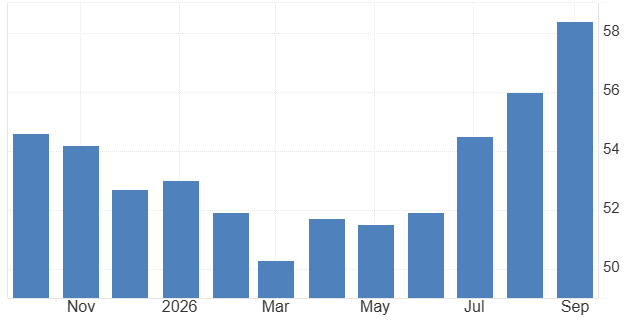
Source: Trading economics
The earnings cushion is real
This is where the largest AI companies differ from many of the growth stocks that struggled when rates rose sharply in 2022.
Nvidia generated $96.2 billion of quarterly revenue, more than double the prior year, with data-centre revenue reaching $89 billion. It also generated $74.4 billion of operating cash flow during the first half of fiscal 2027 and held $56.6 billion in cash, cash equivalents and marketable debt securities at the end of July.
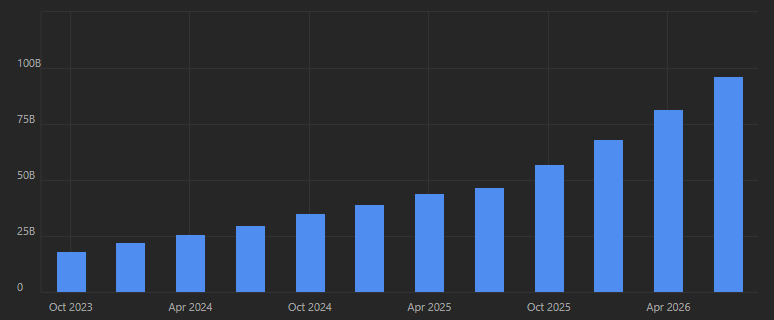
Source: Full ratio
Broadcom provides another example
Revenue increased 86% in its latest quarter, while free cash flow reached $13.7 billion, equal to 46% of revenue. The company ended the quarter with $24 billion of cash. These balance sheets do not make higher rates irrelevant. They change the transmission mechanism.
Companies with enormous internal cash generation do not face the same immediate refinancing pressure as highly leveraged businesses. They can continue funding research, acquisitions, infrastructure and shareholder returns even while the cost of external capital rises.
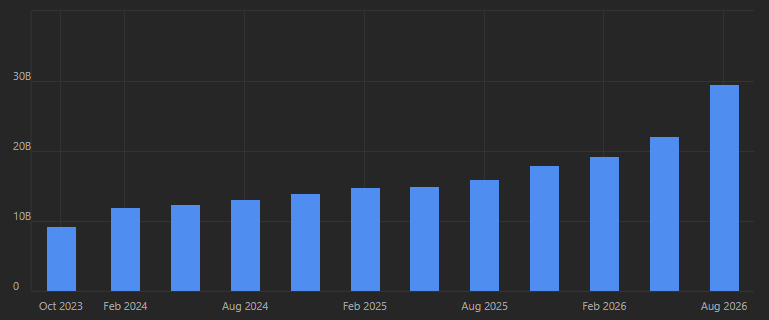
Source: Full ratio
The AI cycle is buying Nasdaq time
The AI investment cycle provides an additional buffer. Demand for accelerated computing remains exceptionally strong. Nvidia's data-centre revenue increased 117% year on year in its latest quarter, while Broadcom expects fourth-quarter revenue of about $34.8 billion, up 93% from the same period a year earlier.
This is why the market has been able to tolerate a Treasury yield above 5%. Investors are not looking at a technology sector with stagnant demand. They are looking at companies whose earnings are expanding rapidly enough to partially offset a higher cost of capital.
But that creates another risk
The stronger the AI earnings expectations become, the higher the standard for future results. A slowdown in AI orders, weaker pricing or disappointing capital-efficiency data could remove that earnings cushion very quickly.
Technical outlook
Nasdaq is trading around 30,310, close to the recent 30,762.5 swing high, after recovering strongly from the 27,000 area.
The broader structure remains constructive. Prices are holding above the rising moving average near 29,010, while the latest advance has also moved the index back above the descending trendline that had capped previous rebounds.
The break above 29,753.5 is important, but the market has not yet cleared the previous high. That leaves 30,762.5 as the key level for the next move.
Scenario ahead
A sustained break above 30,762.5 would confirm a new higher high and strengthen the broader bullish structure. The quality of the breakout will matter. Holding above the previous high would suggest that the resistance has turned into support rather than producing another failed attempt.
However, failure below 30,762.5 followed by a break back under 29,753.5 would weaken the current momentum.
That would open the way towards 29,010.8, with the 28,871.1–28,199.7 zone becoming the next important support area. A deeper correction could eventually bring 26,254.2 back into focus, although the chart would need to deteriorate significantly before that level becomes relevant.
For now, the structure remains constructive. 30,762.5 is the decisive level above it, the Nasdaq confirms continuation; below 29,753.5, the breakout begins to lose credibility.
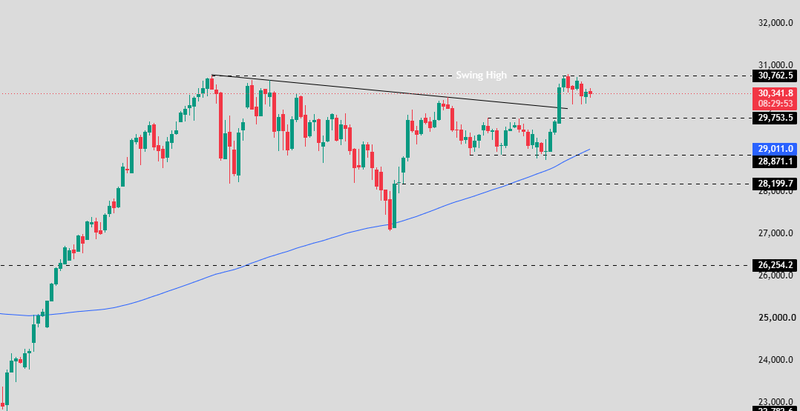
Source: Trading view


