
 Support
Can WTI reclaim 93.43 and return toward 100?
Recent estimates show crude flows through the Gulf and Hormuz corridor have climbed back toward 13 million barrels a day, with Saudi Arabia driving much of the recovery. Saudi exports increased as the kingdom shifted more shipments back toward Gulf terminals after attacks disrupted alternative routes through the Red Sea.

Crude shipments have recovered sharply but remain below normal pre-conflict levels.
Maritime security and energy infrastructure remain vulnerable to renewed disruption.
Iran’s seven-day proposal and the latest US response could become important for the next phase of oil-market risk.
The recovery is real, but it is not the same as normalization
The market has become more capable of moving barrels through disruption than it was several months ago. Alternative pipelines, rerouting and greater naval assistance have allowed producers to restore part of their export capacity.
But that resilience should not be confusing with a return to normal shipping conditions. The International Maritime Organization has verified dozens of attacks on commercial vessels around Hormuz and continues to warn that the security environment remains highly volatile. On Tuesday, three oil tankers were struck by projectiles while navigating the strait, according to maritime intelligence cited by Reuters.
Why is oil still vulnerable if more barrels are moving?
Because the market is not pricing only the barrels that are moving today, it is pricing the probability that those barrels can keep moving tomorrow.
Hormuz handled around 20 million barrels a day in 2025, equivalent to roughly one-quarter of global seaborne oil trade. Bypass routes exist, particularly through Saudi Arabia and the UAE, but their capacity is limited relative to the volumes normally dependent on the strait.
Energy infrastructure adds another layer. Attacks on pipelines and export facilities can force producers to change routes again, meaning an improvement in one corridor can quickly be offset by pressure somewhere else. The September rebound therefore says as much about the adaptability of Gulf exporters as it does about the security of the underlying supply chain.
The diplomatic channel now matters for the physical market
Iranian Foreign Minister Abbas Araqchi has received a US response through Qatari mediators regarding Tehran’s proposal, which links steps toward reopening Hormuz and restoring maritime passage with broader measures. Reuters reports that discussions are now focused heavily on the sequencing of commitments, rather than simply whether communication between the two sides exists.
That matters because a durable reopening would change the market in a way higher tanker traffic alone cannot. For now, oil is caught between two opposing forces... recovering exports are easing the immediate supply shock, while unresolved security risks are keeping the cost of that supply elevated.
The next important signal is therefore not simply how many barrels leave the Gulf. It is whether those barrels can continue moving without another disruption to the ships, pipelines and infrastructure carrying them.
Technical outlook
WTI is trading near 91.90, after climbing from the 69.36 low and breaking out of the long decline that had dominated the chart. The move above the long-term descending trendline, followed by a breakthrough 87–88, shifted the broader structure into a recovery phase.
The rally then extended toward 104–105, where sellers finally returned. The rejection has produced a sharp pullback, but the correction has not yet damaged the underlying trend. Price remains above the rising trendline connecting the major recovery lows, leaving the medium-term structure intact even as momentum has eased.
The immediate test now sits at 93.43. This level has become the main barrier between the current pullback and another attempt to extend the recovery. A sustained break above it would put 100 back in focus, followed by the 104–105 region.
Below the market, 87–88 has become the first important pivot. Holding this area would keep the recent breakout structure alive. Beneath it, the rising trendline around 84–85 becomes critical. A decisive break there would signal that the recovery is losing momentum and expose 80, with 76 becoming the next broader downside reference.
Scenario ahead
The chart is now defined by a relatively narrow battle... 93.43 on the upside and 87–88 on the downside. A reclaim of 93.43 would suggest that the recent rejection was corrective rather than a broader reversal, opening the way toward 100 and potentially 104–105 again.
A failure to recover 93.43 followed by a break below 87–88 would change the short-term balance. A move through 84–85 would be more significant, as it would break the recovery trendline and place the lower support zones back into play. For now, the structure remains constructive, but the next move depends on whether buyers can reclaim 93.43 without losing 87–88 first.
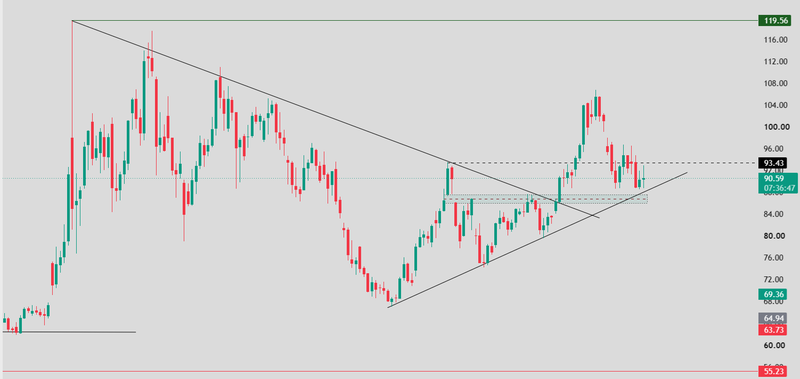
Source: Trading view


