
 Support
Oracle suffers worst week since dot-com crash as AI spending fears deepen
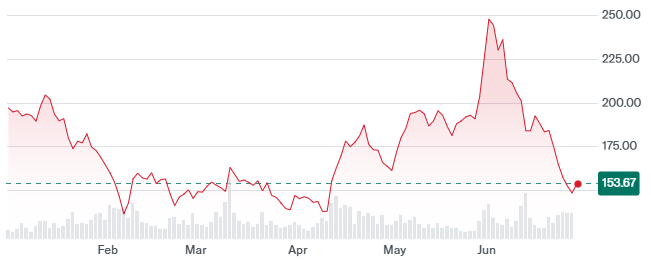
Oracle’s Shares sank 19%, marking worst week since the 2001 dot-com bust. The company’s market value has now fallen roughly 55% from its September peak, stabilizing near $428 billion. That scale of decline shows the market is no longer rewarding AI exposure automatically. Investors are now asking a harder question: how expensive is growth?
Oracle shares fell 19% in their worst week since the dotcom bust.
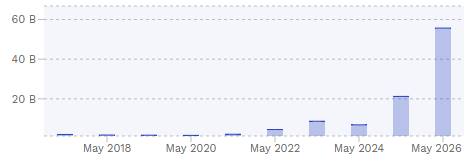
Capital expenditure jumped 162% to nearly $56 billion in fiscal 2026.
The company’s market value has dropped about 55% from its September peak.
Oracle’s AI story is becoming a balance-sheet story
Oracle has been one of the companies most closely tied to the AI infrastructure buildout. Its cloud and datacenter expansion gave investors a reason to treat the stock as part of the AI supply chain, not just as an old enterprise software name. That helped drive the earlier rally.
But the latest filings changed the tone. Capital expenditure surged 162% to nearly $56 billion as Oracle accelerated its datacenter buildout. That level of spending tells the market the company is serious about AI demand, but it also shows how capital-intensive this race has become. AI infrastructure is not a light software upgrade. It requires land, chips, power, cooling, networking and long-term capacity commitments before the revenue fully arrives.
Source: Finbox
That is where investors became more cautious
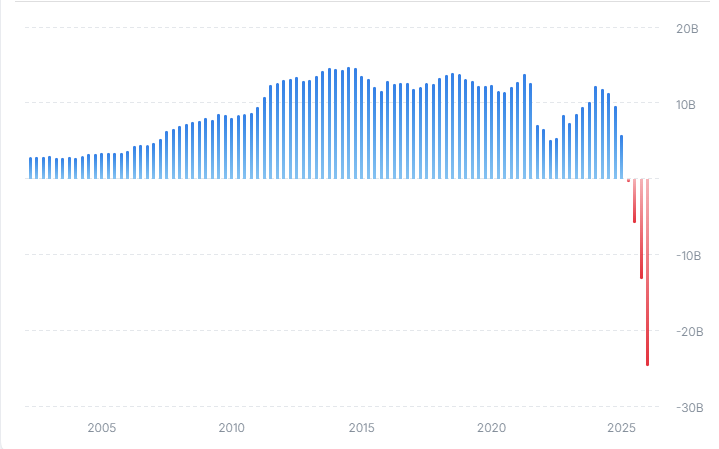
The company reported negative free cash flow of $23.7 billion, while total corporate debt climbed to around $130 billion. This is the pressure point. Oracle may be building assets that support future growth, but for now the buildout is absorbing cash instead of producing it. In a market that has started to punish expensive AI trades, that matters.
Source: Alpha spread
The market is no longer paying for AI without discipline
Earlier in the AI cycle, investors were willing to reward any company with exposure to cloud capacity, chips or datacenter demand. The assumption was simple: if AI demand is real, the infrastructure winners should grow into the spending.
Oracle’s decline shows that the market is separating AI revenue potential from AI capital intensity. A company can have strong demand and still face pressure if the cash burn becomes too large, the debt load becomes too heavy, or the payback period looks too far away.
A 19% weekly fall is not only about one number in the filing. It reflects a broader concern that Oracle’s AI expansion may be moving faster than its cash generation. When market value has already been retraced by more than half of the peak, investors are clearly demanding proof, not just ambition.
The next phase of the Oracle story will depend on whether the company can convert this spending into durable cloud revenue and stronger free cash flow. Until then, the AI narrative may continue to support long-term interest, but the balance sheet will set the limit on how much investors are willing to pay.
Source: Yahoo Finance
Technical outlook
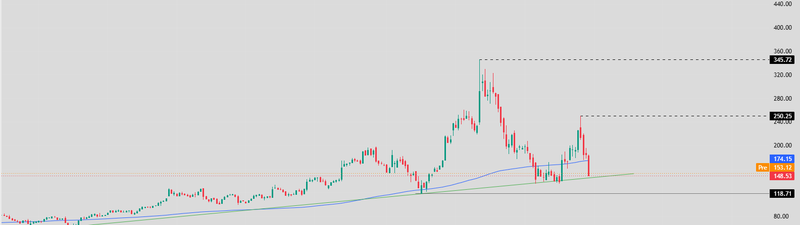
Oracle has moved from recovery mode into a more defensive setup. The stock pushed close to 345, but the rally could not hold, and the reversal has now erased a large part of that move. The real warning came when price broke below the 126-day moving average near 174. That break showed the market was no longer willing to chase the earlier momentum and that investors were starting to reassess the strength of the AI-led rally.
The decline has now brought Oracle back into the 148–155 area. This zone matters because buyers are trying to defend it just above the long-term rising trendline that has guided the stock for more than a year. As long as Oracle holds above that trendline, the broader structure is damaged but not fully broken. The message from the chart is clear: the stock has lost momentum, but it has not yet confirmed a full trend reversal.
The first support to watch is 148–150. This is where buyers have started to appear during the latest sell-off. If that area fails, the next important level is 118.70, the previous major swing low and the real structural floor on the chart. A break below 118.70 would change the story from a correction after a strong rally into a deeper bearish reversal.
Scenarios ahead
The constructive scenario starts with Oracle defending 148–150. But holding support alone is not enough. The stock also needs to recover the 174 area, where the 126-day moving average now sits. A clean move back above 174 would suggest sellers are losing control and that buyers are starting to rebuild confidence. If that happens, attention could shift toward 250.25 as the first major resistance. Above that, the previous high near 345.70 would return as the longer-term upside reference.
The weaker scenario is a clear break below 148. That would show that the current support area has failed and that investors are still reducing exposure after the earlier rally. In that case, Oracle could extend the correction toward 130 first, with 118.70 becoming the major level to watch after that. A move into that zone would suggest the price needs more time to build a base before any serious recovery attempt can develop.
Source: Trading view


