Support
USD/JPY tests intervention zone as yen pressure builds
Washington has placed Japan on the U.S. Treasury’s 2026 monitoring list. That does not stop Tokyo from intervening, but it makes the decision more sensitive, Japanese yields have climbed to their highest levels in three decades, and the old carry-trade advantage is starting to fade.
Washington has placed Japan on the U.S. Treasury’s 2026 monitoring list.
Japanese yields have climbed to their highest levels in three decades.
USD/JPY is still trading with a constructive medium-term bias.
Japan intervention risk is becoming more political
Washington has placed Japan on the U.S. Treasury’s 2026 monitoring list. That does not stop Tokyo from intervening, but it makes the decision more sensitive. The issue is not only whether Japan buys yen. The issue is how that intervention is funded, how Washington reads it, and whether the market sees it as currency management or pressure on the U.S. Treasury market.
Japan is largest foreign holders of U.S. government debt
If Tokyo intervenes unilaterally, especially by selling part of its U.S. Treasury holdings to fund yen purchases, investors will not treat it as a normal FX operation. Japan is one of the largest foreign holders of U.S. government debt, so any perception that it is using Treasuries to defend the yen could quickly spill into the bond market. The move may support the yen in the short term, but it could also add upward pressure to U.S. yields if investors start worrying about foreign official demand for Treasuries.
Japan may want to slow yen weakness, but defending the currency is no longer a clean domestic decision. It now sits between FX stability, U.S. bond-market sensitivity, and political pressure from Washington. Verbal warnings may still come first, but if yen weakness continues and imported inflation keeps hurting households and smaller companies, the market may begin to price a higher chance of real intervention rather than just another round of official comments.
The risk for investors is that intervention solves one problem while creating another. It could slow USD/JPY upside, but if it is funded through reserve liquidation, it may tighten global financial conditions through higher U.S. yields. That would make USD/JPY less of a simple currency trade and more of a test of how far Japan can defend the yen without disturbing the Treasury market.
Japanese yields pressures USD/JPY
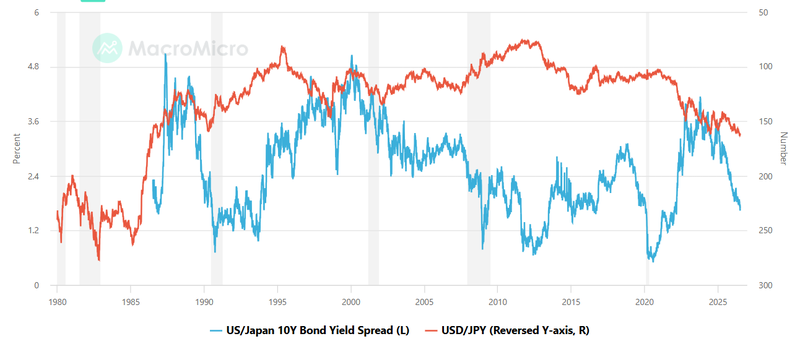
Japanese yields have climbed to their highest levels in three decades, and the old carry-trade advantage is starting to fade. The US-Japan 10-year yield spread has narrowed to around 1.69%, the smallest gap since 2022. That matters because the carry trade needs a wide enough yield gap to justify borrowing in yen and taking currency risk abroad.
If the adjustment happens slowly, markets can absorb it. But if the yen strengthens quickly, or if investors start pricing another BoJ hike more aggressively, leveraged carry trades could be unwound much faster.
Japan’s large pension funds, insurers and asset managers are also part of the story. If domestic yields become attractive enough, more capital may stay at home. That would mean less Japanese money flowing into global bonds and risk assets that benefited for years from cheap yen funding.
Source: MacroMicro
Technical outlook
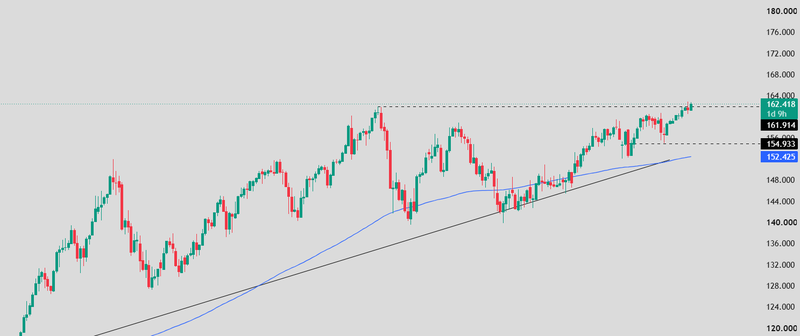
USD/JPY is still trading with a constructive medium-term bias. Buyers have continued to defend the rising trendline, and the pair has stayed comfortably above the 200-day moving average. After the correction toward the 142–144 area earlier this year, the market started building higher lows again, which showed that demand was gradually coming back.
The pair is now around 162.40, right at the major 162–164 resistance zone. This is an important area because it sits near the previous swing high and has already attracted selling pressure before. The recovery from the 155 area shows buyers are still active, but this is also the kind of level where the market becomes more sensitive to profit-taking and intervention headlines from Japan.
The first support sits around 154.90–155.00. This area used to act as resistance, and the latest advance has turned it into an important floor. As long as USD/JPY holds above it, the pattern of higher highs and higher lows remains intact. Below that, the next level to watch is the 126-day moving average near 152.40. A break below would not destroy the broader uptrend immediately, but it would tell us that momentum is starting to cool.
Scenarios ahead
The stronger scenario needs USD/JPY to break and hold above 162–164. If buyers can build acceptance above that zone, the pair could extend toward 166 first, then 170. That would confirm that the uptrend is still in control, but it would also increase the risk of stronger warnings, or even direct action, from Japanese authorities.
The weaker scenario is a rejection from 162–164. If the pair fails to hold the breakout and drops back below 155, it suggests that buyers are losing some control and that the market may need a broader consolidation. In that case, attention would shift to 152.40, then the 148–150 region. The larger trend would only come under real pressure if USD/JPY starts breaking the higher-low structure that has supported the recovery so far.
Source: Trading view