
 Support
Oil price technical analysis: Profit-taking or the start of a deeper reversal?
The oil market started the week with two opposing forces. Washington and Tehran are leaving the door open to diplomacy, while attacks on Saudi infrastructure have cut an important export route. That is why crude has pulled back from its recent highs without removing the supply premium altogether.
Trump said he would be open to meeting Pezeshkian at the U.N. General Assembly.
China has asked Iran to use its influence over the Houthis to reduce attacks around the Red Sea.
Three pumping stations on Saudi Arabia's East-West pipeline were damaged.
Trump opens another channel with Tehran
Trump's comments are important because the possibility of direct talks comes while the war is still disrupting energy markets. The United States has allowed Pezeshkian and other senior Iranian officials to attend the U.N. General Assembly, and Trump said he would be open to a meeting.
There is still no confirmed meeting or agreement. Iran has continued to demand concessions from Washington before restarting broader negotiations, so the diplomatic opening remains narrow.
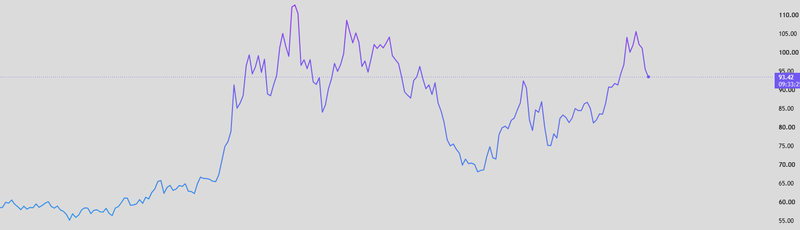
Oil nevertheless reacted to the possibility of talks. Crude fell more than 4% to around $94 as traders reduced some of the geopolitical premium.
Source: Trading view
China now has a reason to contain the Houthi escalation
Beijing has become more directly involved because the conflict is beginning to threaten the energy routes China depends on.
Saudi Arabia asked China to intervene, after Houthi forces expanded their attacks along the Red Sea and near the Bab el-Mandeb Strait. Chinese officials then privately asked Tehran to use its influence to rein them in.
That gives Iran another pressure point
China remains one of Iran's most important economic partners, but Beijing also has a strong interest in keeping Gulf oil moving. If Chinese pressure reduces Houthi attacks, shipping risks around the Red Sea could ease even without a wider Iran-U.S. settlement.
Saudi Arabia still must deal with the barrels
The diplomatic developments are moving faster than the physical supply problem.
Drone attacks damaged three pumping stations on Saudi Arabia's East-West pipeline, forcing the system offline and disrupting crude loadings at Yanbu. The pipeline had become especially important because it gives Saudi Arabia a route to the Red Sea that avoids Hormuz.
Aramco is reportedly trying to restore partial flows within days, while full repairs could take around six weeks. In the meantime, the company has increased shipments through the Gulf using ship-to-ship transfers near Oman's Sohar port.
Timing is important. Saudi exports through Hormuz have already increased sharply, reaching more than 4 million barrels a day in September, compared with about 2.4 million barrels a day in August.
Technical outlook
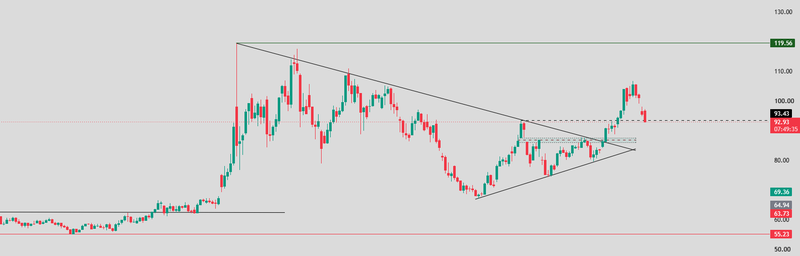
WTI has pulled back after breaking out of the multi-month triangle and reaching the 104–105 area. The move has cooled, but the chart has not broken down. Price is now back near 93.43, the level that capped the market for months before the breakout.
That makes 93.43 the main test
The recovery from 69.36 had been building through a series of higher lows before buyers finally cleared the descending trendline and pushed through 100. As long as 93.43 holds, that structure remains in place. The latest decline therefore looks more like profit-taking after a sharp rally than a clear change in trend.
The problem is that buyers no longer have much room for error. The rejection from 104–105 has created the first lower high since the breakout, so the next reaction around 93.43 will tell us whether buyers are preparing for another move higher or whether the breakout is starting to lose strength.
Scenarios ahead
A hold above 93.43 would keep the breakout intact. The first upside test would be 100, followed by 104–105. Clearing that zone would bring 119.56 back into focus as the next major resistance.
Bearish scenario, a clear break below 93.43 would weaken the breakout and increase the risk of a deeper pullback toward the mid-80s. If selling continues from there, 69.36 becomes the level to watch again and would mark a much bigger change in the recovery structure.
Source: Trading view


