
 Support
Yen returns to the spotlight as the U.S. backs Japan's intervention
The Japanese yen is back at the centre of the global currency market after Japan and the United States carried out their first coordinated intervention since 2011. The move represents more than a one-day attempt to stabilize the exchange rate. It signals that Washington is becoming increasingly concerned that the yen's prolonged weakness is creating risks that extend beyond Japan's borders.

Japan and the U.S. carried out their first joint currency intervention since 2011 to support the yen.
Officials from both countries signaled they are prepared to act again if excessive volatility returns.
A dissenting vote from BOJ board member Hajime Takata reinforced expectations that Japan's debate over further rate hikes is far from over.
Washington sends a stronger message
Markets have heard plenty of verbal warnings from Japanese officials over the past two years, but they have rarely produced more than a temporary reaction.
This time was different
By joining the intervention, the United States gave Tokyo something it has not had for more than a decade: international backing. That matters because currency intervention tends to carry far more weight when traders believe governments are acting together rather than trying to defend the currency on their own.
The move also reflects growing concern over the pace of the yen's decline. A weaker currency may help exporters, but it also raises import costs, keeps inflation elevated and increases volatility across global financial markets. From Washington's perspective, excessive moves in the yen have become an issue worth addressing rather than simply watching from the sidelines.
Policymakers are keeping every option on the table
The intervention was quickly followed by a coordinated message from both governments. Japanese Finance Minister Satsuki Katayama and U.S. Treasury Secretary Scott Bessent both indicated they are prepared to intervene again if market conditions require it. The message was aimed at as much at speculators as at the broader market.
Officials know they do not need to intervene every day if traders believe they are willing to do so. That said, intervention has its limits. Selling dollars and buying yen can slow the pace of depreciation, but it does not remove the underlying reason investors continue favouring the dollar in the first place.
If U.S. yields remain comfortably above Japanese yields, the carry trade continues to work in the dollar's favour.
The Bank of Japan is becoming more divided
The latest Bank of Japan meeting also hinted that the policy discussion is evolving. Although the Bank left interest rates unchanged, board member Hajime Takata voted in favour of an immediate increase to 1.25%, arguing that inflation risks justify moving sooner rather than later.
One dissenting vote does not change policy overnight, but it does suggest the debate inside the central bank is becoming more active. Only a few years ago, policymakers were still trying to generate inflation. Today, the discussion is about whether inflation has become persistent enough to justify a faster pace of policy normalization.
Intervention can buy time, but not change the trend
The recent intervention may have interrupted the yen's slide, but it has not removed the main force behind it. The wide gap between U.S. and Japanese interest rates continues to encourage investors to borrow in yen and invest in higher-yielding dollar assets. Until that gap begins to narrow, demand for the dollar is unlikely to disappear.
History tells a similar story. Previous interventions have often produced sharp moves in the short term, only for the market to drift back toward the prevailing trend once attention returned to monetary policy. That is why many investors are now watching the Bank of Japan more closely than the intervention itself. If higher interest rates become a more realistic prospect, the yen has a stronger foundation for recovery. Without that shift, intervention is more likely to slow the move than reverse it.
Technical outlook
The coordinated intervention has changed the short-term picture for USD/JPY. After reaching fresh highs near 164, the pair reversed sharply, falling back below 161.90 and breaking its short-term rising trendline. The move has clearly taken momentum out of the rally, although it has not yet been enough to change the broader uptrend.
Scenarios ahead
Attention now turns to the longer-term rising trendline around 155–156, which has supported the recovery since USD/JPY rebounded from the 140 area. How the market behaves around this zone is likely to determine whether the recent selloff proves to be a temporary setback or the beginning of a larger correction.
If buyers continue defending this support, the latest decline is likely to be remembered as a policy-driven pullback rather than a change in trend. A recovery above 158 would suggest confidence is returning, while a move back through 161.90 would indicate that traders are once again focusing on the interest-rate gap between the Federal Reserve and the Bank of Japan. That would leave the recent high near 164 back in sight.
The bearish case becomes stronger if 155 fails to hold. Losing that support would suggest investors are reducing long-dollar positions rather than simply reacting to official intervention. In that scenario, USD/JPY could extend its decline toward 152, with the 150-level becoming the next important area on the chart.
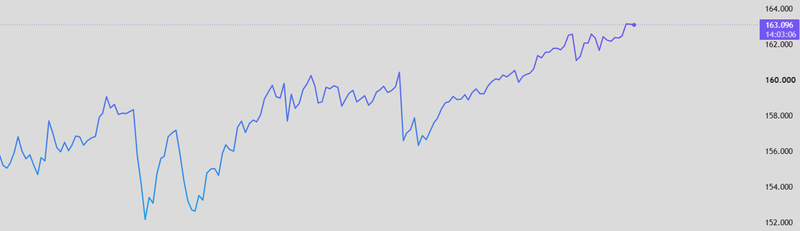
Source: Trading view


