Support
ADNOC Gas stock: dividend growth, earnings and 2027 outlook
ADNOC Gas returned to stronger earnings in the third quarter after a difficult three months for its processing and export operations. Net income recovered to $1.34 billion, prompting management to raise its full year forecast while keeping the company’s dividend plans unchanged.
Third-quarter net income rose 101% from the previous quarter to $1.34 billion, while EBITDA reached $2.03 billion.
The board approved a quarterly dividend of $940 million, with annual payments expected to increase by 5% through 2030.
ADNOC Gas plans to invest $28 billion between 2026 and 2030 as it works toward a 60% increase in EBITDA from 2023 levels.
What does ADNOC Gas do?
ADNOC Gas sits between the UAE’s gas fields and the customers that use the final products. The company receives gas from ADNOC’s onshore and offshore operations, processes it and then supplies power stations, industrial companies and overseas buyers.
Its facilities can handle around 10 billion standard cubic feet of gas per day, while a pipeline network of roughly 3,300 kilometers moves gas between processing plants and customers. Around 60% of the UAE’s sales gas demand is supplied by the company.
A large share of that gas stays inside the country
Power stations use it to generate electricity, while aluminum, steel, petrochemical and fertilizer producers depend on it for their operations. This gives ADNOC Gas a steady source of demand linked to the growth of the UAE economy.
The international side of the business behaves differently. ADNOC Gas also sells LNG, ethane, propane, butane and sulfur, with earnings affected by market prices and the company’s ability to move products through regional shipping routes.
The domestic business therefore provides the base, while exports can add more growth when prices and shipping conditions are favourable.
That mix became clear during 2026: demand inside the UAE remained relatively resilient, but disruptions at Habshan and in the Strait of Hormuz placed more pressure on processing and international sales.
Third-quarter earnings more than double from Q2
ADNOC Gas reported net income of $1.34 billion in the third quarter of 2026, compared with $665 million in the previous quarter. EBITDA also increased 70% to $2.03 billion, as sales recovered across several parts of the business.
Domestic gas sales increased 20% from the second quarter, helping lift EBITDA from that segment by 28%. The improvement was even larger in international sales, where EBITDA rose 106%. Sulfur EBITDA also increased 249% quarter-on-quarter.
The results followed a difficult second quarter, when operational and export disruptions affected the company's performance.
The latest figures therefore reflect a recovery from that weaker period rather than an entirely new level of earnings growth.
Following the results, ADNOC Gas raised its full-year 2026 net income guidance to at least $4 billion, compared with its previous forecast of $3.5 billion to $4 billion.
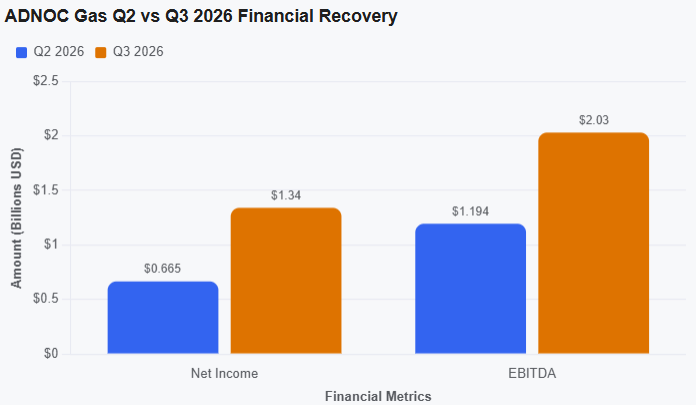
Source: Google
The size of the quarterly increase needs some context
Second-quarter earnings were affected by security-related incidents at the Habshan complex and disruption to shipping through the Strait of Hormuz.
The third quarter therefore represents a recovery from an unusually weak period rather than a doubling of the company’s normal earnings capacity.
Net income was broadly unchanged from the same quarter last year, which gives a better picture of the underlying performance.
Management raised its full-year net income guidance from a previous range of $3.5–$4 billion to at least $4 billion.
The forecast assumes that fourth-quarter export levels remain close to those achieved in the third quarter, leaving the outlook sensitive to maritime conditions.
Dividend growth remains central to shareholder returns
The board approved a quarterly dividend of $940 million, payable in December and 5% higher than the corresponding payment last year.
ADNOC Gas continues to target annual dividend growth of 5% through 2030, subject to the usual approvals.
The planned 2026 distribution of 18 fils per share represents a yield of around 5.34% based on the November 9 closing price of AED 3.37.
For the first nine months of the year, ADNOC Gas generated $3.82 billion in operating cash flow and paid $2.82 billion in dividends. That provides coverage of around 1.35 times.
Operating cash flow coverage is reassuring, but free cash flow will become the more useful measure as project spending increases.
The company must now finance a growing dividend alongside one of the largest investment programmes in the gas industry.
If capital expenditure rises faster than operating cash generation, ADNOC Gas may need to use more of its balance sheet even if reported earnings remain strong.
A $28 billion investment programme supports the long-term growth strategy
ADNOC Gas plans to invest approximately $28 billion between 2026 and 2030, targeting a 60% increase in EBITDA from its 2023 level.
The largest commitment is the Rich Gas Development project, with total investment of $13.2 billion across three phases.
Phase 2 will add another processing train at Habshan, while Phase 3 will build a natural gas liquids fractionation train at Ruwais with annual capacity of more than eight million tonnes.
Ruwais LNG will expand the UAE’s LNG capacity and give ADNOC Gas greater access to international demand. The first two main refrigeration compressor trains were installed during the third quarter.
The MERAM project is designed to recover more ethane from existing gas streams for industrial use, while Estidama will expand the pipeline and compression network used to supply the domestic market.
These projects are connected rather than separate investments
Additional gas processing at Habshan can increase the volumes available for liquids recovery, petrochemical feedstock and LNG exports.
Estidama then strengthens the network used to move sales gas across the UAE
The 60% EBITDA target will depend on this chain working as planned. Processing capacity alone will not deliver the expected return if upstream feedstock is delayed, export routes remain restricted or product demand fails to absorb the additional volumes.
ADNOC Gas outlook for 2027: Recovery and expansion
Restoring full capacity at Habshan is likely to be the first major test in 2027. The company says recovery work remains on schedule for completion by the second quarter.
A full restoration would return lost processing capacity and give ADNOC Gas more flexibility across its network. It would also make quarterly comparisons easier to read after the disruption distorted the 2026 results.
Domestic gas demand should continue to benefit from growth in UAE electricity generation, petrochemicals and industrial activity.
International earnings will be less predictable because they depend on export volumes, LNG demand and the prices achieved for gas liquids and sulfur.
Analyst estimates currently point to revenue rising from about $17.22 billion in 2026 to $22.12 billion in 2027. The increase assumes a recovery in volumes and fewer operational disruptions.
What risks could affect ADNOC Gas stock?
The Strait of Hormuz remains the most immediate risk. ADNOC Gas can adjust inventories and coordinate shipments with customers, but prolonged disruption would eventually restrict export volumes and increase logistics costs.
Commodity prices create another source of uncertainty. Domestic gas provides some stability, but LNG, natural gas liquids and sulfur earnings can still weaken when international prices fall.
The investment programme brings a different type of risk. Delays, cost overruns or slower project ramp-ups would push earnings further into the future while capital expenditure continues in the present.
Dividend investors also need to separate income from total return. A 5% dividend increase may support the stock, but it will not prevent the share price from falling if earnings weaken or the market becomes concerned about free cash flow.
What should investors watch in 2027?
The Habshan restoration should be watched first. Delays beyond the second quarter would affect processing volumes and raise further questions about the earnings recovery.
Quarterly results should then show whether international product sales can remain near third-quarter levels.
A rebound caused by inventory releases or temporary pricing would be less valuable than a sustained increase in volumes.
Capital expenditure and free cash flow will also become more relevant as construction moves forward.
ADNOC Gas needs enough cash to fund projects, maintain its balance sheet and continue raising the dividend without weakening any of the three.
The third-quarter results show that the company has recovered from the worst of the operational disruption. Whether the stock can move into a stronger phase will depend on what follows: full Habshan capacity, reliable exports and visible returns from the $28 billion being invested through 2030.
FAQs
Is ADNOC Gas a dividend-paying stock?
Yes. ADNOC Gas pays quarterly dividends and targets annual dividend growth of 5% through 2030. Its planned 2026 dividend is 18 fils per share, equivalent to a yield of approximately 5.34% based on the November 9 closing price.
How much did ADNOC Gas earn in Q3 2026?
ADNOC Gas reported third-quarter net income of $1.34 billion, an increase of 101% from the previous quarter. EBITDA reached $2.03 billion.
What is the ADNOC Gas stock price target?
The expectations are to have an average 12-month price target of AED 4.15; estimates can change as new earnings and market information become available.
What is ADNOC Gas's growth target for 2030?
The company aims to increase EBITDA by 60% from its 2023 baseline, supported by approximately $28 billion in planned investments between 2026 and 2030.