Support
 A trader’s guide to cocoa market moves
Cocoa futures are influenced by both supply conditions and technical contract details. With production concentrated in West Africa and the Americas, traders need to understand how climate, agricultural cycles and market reports can affect prices.
Cocoa futures are influenced by a mix of agricultural, macroeconomic, climate and supply factors
The International Cocoa Organisation (ICCO) reports provide important insight into cocoa production, grindings and stock levels.
As West Africa accounts for more than 60% of global cocoa supply, weather and seasonality can have a major impact on prices.
Traders need to understand contract naming, tick values and rollover costs to manage cocoa futures risk properly.
What is Cocoa futures trading?
Cocoa trading is usually conducted through futures contracts. This market is considered one of the most complex within the soft commodities group, as it incorporates supply and demand conditions, macroeconomic dynamics, and climatic events that alter the available supply—factors that directly influence the underlying behaviour of the price.
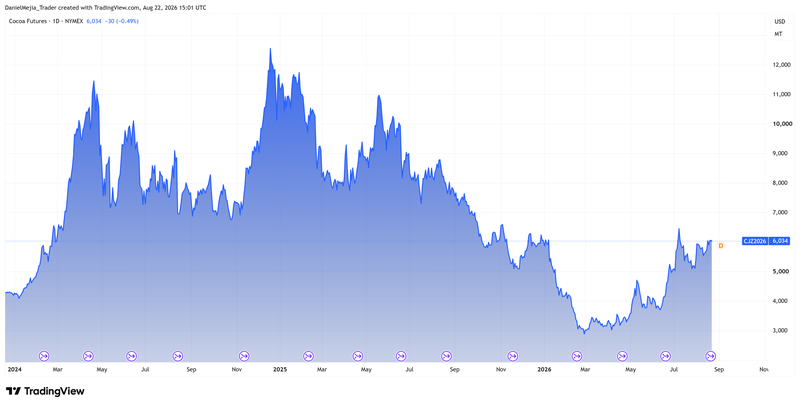
Figure 1. Cocoa Futures (2024-2026). Source: Data from the NYMEX Exchange; Figure obtained from TradingView.
What institutional sources provide information on Cocoa?
While there are various private and public sources that provide accurate information on cocoa price behaviour, the International Cocoa Organization (ICCO) publishes global benchmark reports essential for understanding the fundamentals of commodity prices. The ICCO systematically publishes production, grindings, and stocks data to construct the global cocoa balance sheet:
- Quarterly Bulletin of Cocoa Statistics (QBCS): A quarterly ICCO report consolidating historical data and revised estimates of global cocoa production, stocks, and grindings.
- Monthly Review of the Market: A monthly evaluation by the ICCO that analyses the evolution of futures contract prices, certified stocks in exchange warehouses, and macroeconomic or regulatory variables that impact cocoa prices.
- ICCO Daily Prices: A weighted index calculated daily, adjusted according to exchange rates with six-month terms on the respective stock exchanges.
What fundamental factors determine the price of Cocoa?
According to ICCO data on global cocoa production for 2024–2025, Africa continues to stand out as the primary global supplier, generating more than 60% of the total volume. The main producers are Ivory Coast, Ghana, Cameroon, and Nigeria. In the Americas, cocoa production is centralized in Ecuador, Brazil, Peru, Colombia, and the Dominican Republic. Meanwhile, in Asia and Oceania, the production of Indonesia, Papua New Guinea, and Malaysia remains notable.
Due to the high concentration of production in specific geographic regions, environmental, regulatory, and seasonal factors tend to have a considerable impact on the available supply, as well as the market price of cocoa.
Harvest cycles and seasonality
The cocoa production cycle is divided into two annual harvests that vary depending on the producing country: the main crop and the mid-crop. The main crop accounts for between 70% and 80% of the total annual volume, while the mid-crop yields smaller volumes. Monitoring seasonality, particularly in producing countries that command a greater weighting of the global volume, helps market participants infer the available global supply and anticipate probable price movements.
Climatic factors
Dry winds in West Africa can increase evapotranspiration and aggravate water stress in plantations. Periods of drought can severely impair flowering and fruit development, while excessively humid conditions favour fungal diseases such as Black Pod. In South America, periods of excessive rainfall tend to negatively impact crop productivity, thereby reducing the available global supply.
How are Cocoa-linked futures contracts analysed?
Futures contracts are derivative financial instruments whose price behaviour is determined by changes in the valuation of an underlying asset. Cocoa futures contracts are directly linked to the prevailing supply and demand conditions of this physical commodity.
What types of Cocoa contracts exist and how to read a contract?
The reference pricing of cocoa is primarily channelled through two main futures contracts: the contract issued by the ICE Futures US Exchange (New York) under the ticker CC, and the contract issued by the ICE Futures Europe Exchange (London) under the ticker C. While both instruments share the same underlying asset, each possesses specific characteristics that are highly relevant when executing trades. Additionally, the NYMEX Exchange issues a cocoa contract under the ticker CJ.
For trading operations, reading and interpreting the futures contract nomenclature correctly is essential. For example, in the CJU26 contract listed on the NYMEX Exchange, the nomenclature breaks down as follows: the market ticker (CJ), the expiration month letter (U, which designates a September expiration), and the year linked to the expiration month (26, indicating an expiration date in September 2026).
Knowing the maturity date is vital because it specifies when the obligation to buy or sell is exercised, or when a charge must be covered to extend the position to a later delivery month. This cost is referred to as the expiration rollover, allowing traders to keep a position open across consecutive expirations. This is a critical consideration in futures trading, as rollover expenses can become an extremely significant trading cost over time.
How to make profit or loss estimates in Cocoa trading?
Estimates linked to risk management in cocoa trading depend on the specific structural characteristics of each contract. For example, NYMEX's CJU26 contract specifies 10 metric tonnes in its total contract size; consequently, each tick (the minimum price variance) carries a value of $10.
Understanding the tick value in futures trading is crucial, as it allows traders to form precise estimates for target profits (take-profit levels) and potential risk (stop-loss placement). For instance, if a target take-profit level is set 20 ticks from the entry price, the expected monetary gain would be approximately $200 ($10 × 20). Conversely, if the stop-loss is placed 10 ticks away, the potential loss on the trade would be $100 ($10 × 10).
Notably, the definitive parameters of any futures contract—including contract size, tick value, and expiration schedules—are specified exclusively by the official exchange where the contract is listed. Therefore, before formulating any financial estimates or executing trading strategies, it is imperative to consult the official exchange portals to ensure all calculations are accurate.
Conclusion
Understanding the dynamics of the cocoa futures market demands a comprehensive approach that bridges fundamental analysis with the technical accuracy of derivative contracts. The high geographical concentration of production and its acute climatic sensitivity render cocoa a highly volatile asset class. Consequently, relying on institutional reports from the ICCO and thoroughly verifying contract specifications on official exchanges remain essential practices for designing effective trading strategies and managing financial risk.
If you're interested in trading indices, foreign exchange, shares, or commodities, consider exploring the CFD contracts offered by Equiti Group. Please note that trading leveraged derivatives involves a high level of risk and may not be suitable for all investors.
FAQs
What is cocoa futures trading and why is it considered a complex market?
Cocoa trading is primarily conducted through futures contracts within the agricultural soft commodities sector. It is considered one of the most complex markets because price behaviour is dictated not only by standard supply and demand forces, but also by macroeconomic factors, regulatory dynamics, and localized climatic phenomena. These elements can rapidly alter physical bean availability in key producing nations and trigger severe volatility in underlying market prices.
What fundamental and climatic factors determine the price of cocoa?
West Africa accounts more than 60% of world production (led by Ivory Coast and Ghana), followed by the Americas and Asia. Annual production is split into two harvests: the main crop (70%–80% of total volume) and the mid-crop. Due to this heavy geographical concentration, dry winds, droughts that ruin flowering, or excessive humidity that fosters fungal outbreaks such as Black Pod severely disrupt global supply, driving significant price fluctuations.
What key aspects should be considered when analysing a cocoa futures contract?
It is essential to identify the specific exchange where the contract is listed (ICE US "CC", ICE Europe "C", or NYMEX "CJ"), the expiration nomenclature, the total contract size, and the tick value. For instance, in the NYMEX CJU26 contract (10 metric tonnes), each tick represents $10. Knowing these parameters enables precise calculation of potential profits (take-profit) and risk limits (stop-loss). Furthermore, traders must account for rollover costs incurred when maintaining open positions across expiring contracts.