Support
Inducement, liquidity sweeps and power of 3: what retail traders should know
Retail traders can be drawn into buys after a clean high breaks, or into sells after a clean low gives way, only for price to reverse. These moves are commonly discussed in SMC and ICT-style trading through inducement, liquidity sweeps and Power of 3.
Inducement refers to a move that encourages traders to enter before the market turns.
A liquidity sweep happens when price pushes past a clear high or low to activate resting orders.
Power of 3 outlines three stages: accumulation, manipulation and distribution.
What is inducement?
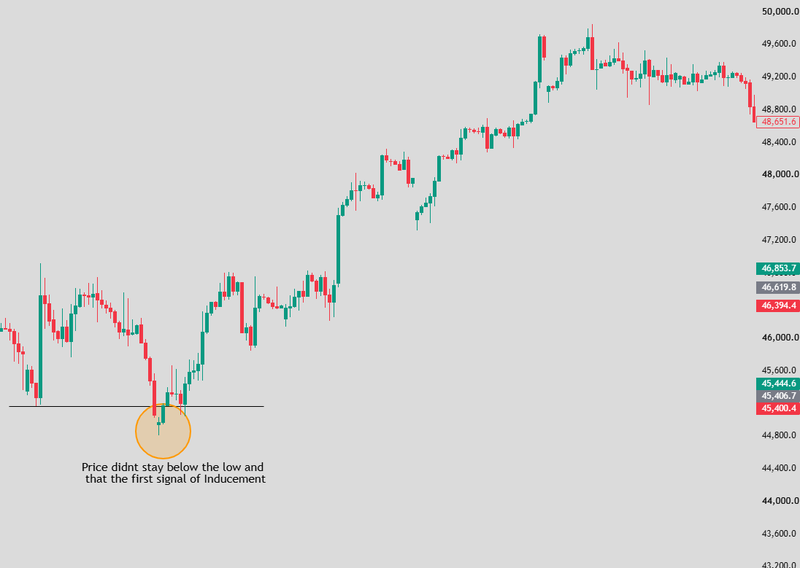
Inducement is a price move that pulls traders into the market before price moves against them.
It usually appears around a level that looks clean and easy to trade. For example, price may break above a short-term high. Many traders see that as a bullish breakout and enter long. Their stops often sit below the breakout area or under the recent low. If price then fails to hold above the level and reverses lower, that breakout acted as inducement.
The same thing can happen below a low. Price breaks support, sellers enter, and the move looks bearish. But instead of continuing to lower, price reverses higher. In that case, the break lower was not the real continuation. It was the move that pulled sellers in before price turned against them.
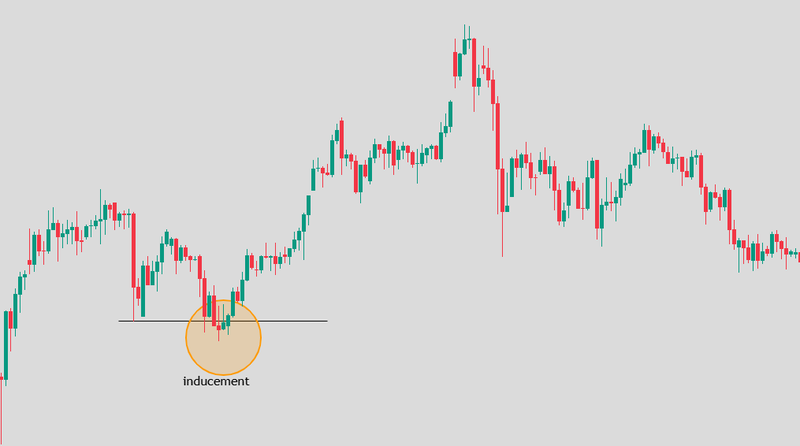
Source: Trading view
What is a liquidity sweep?
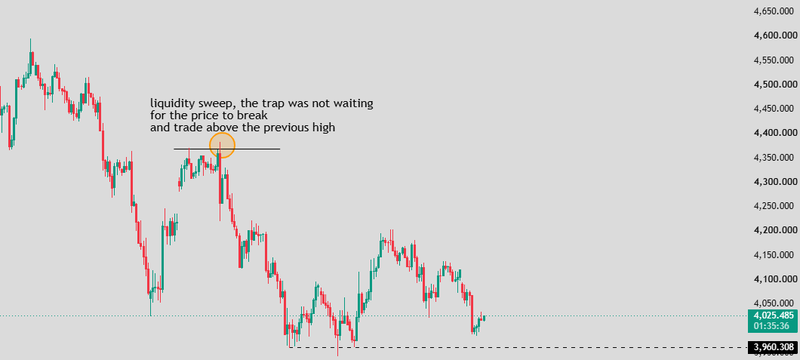
A liquidity sweep is when price moves beyond an obvious high or low, triggers orders around that level, and then often moves back inside the previous range.
Liquidity tends to build above highs and below lows because that is where many traders place their orders. Short sellers usually place stop losses above recent highs. Buyers often place stop losses below recent lows. Breakout traders may also place buy-stop or sell-stop entries around the same areas.
So, when price pushes above a clean high and quickly rejects, it may have swept buy-side liquidity. When price drops below a clean low and quickly reclaims it, it may have swept sell-side liquidity.
But a sweep does not automatically mean price must reverse
Sometimes price takes liquidity and continues in the same direction. The important part is what happens after the sweep. If price breaks the level, fails to hold, and returns with strength, the move may have been a liquidity event rather than a real breakout.
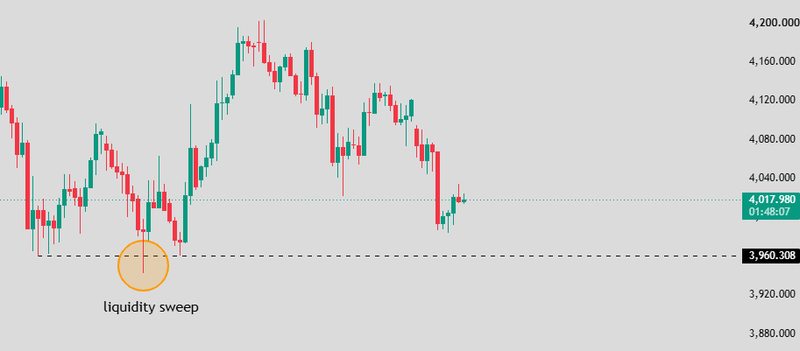
Source: Trading view
What is the difference between inducement and a liquidity sweep?
Inducement and liquidity sweeps are closely connected, but they are not the same thing.
Inducement is the setup that pulls traders into the market too early. It is the move that makes traders believe a breakout, breakdown, or structure shift is real before price turns against them.
A liquidity sweep is the actual move that takes orders above a high or below a low. It is when price pushes beyond an obvious level, triggers stop or breakout entries, and then either rejects or continues.
The simple difference is this: inducement attracts traders into a position, while a liquidity sweep attacks the orders around a level.
For example, prices may break above a small high and encourage buyers to enter. That move can be inducement. Later, price may push above a larger high, trigger buy stops and short stop-losses, then reverse lower. That move is the liquidity sweep.
They can also happen together. A breakout can induce buyers and sweep liquidity at the same time. This is why traders often confuse the two. The key is to focus on the role of the move. Is it pulling traders in early, or is it taking orders from an obvious high or low?
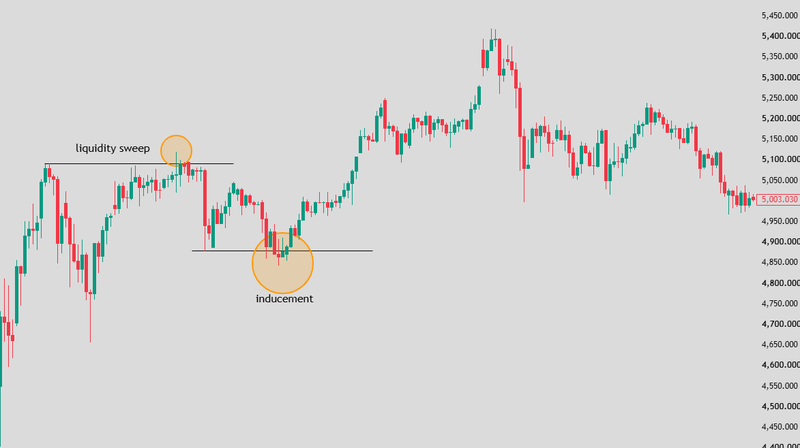
Source: Trading view
How inducement traps retail traders
Inducement traps traders by making the wrong trade look obvious.
Many retail strategies are built around simple confirmation. Buy the break above resistance. Sell the break below support. Follow the break of structure. Enter when momentum appears.
There is nothing wrong with that logic on its own. The problem is that obvious signals are also obvious to everyone else.
Imagine price is sitting near resistance. It pushes slightly above the level, prints a strong candle, and looks ready to continue. Buyers enter because they do not want to miss the move. For a moment, the trade feels right. But if price cannot hold above that level, those buyers are suddenly trapped. Their stops often sit below the breakout area, and price can move toward that liquidity.
The trader is not necessarily careless. They are reacting to something that looks valid. The problem is location. If the breakout happens directly into a liquidity area, a higher-timeframe level, or after price has already stretched, the chance of inducement becomes higher.
The better question is not only, “Did price break?” The better question is, “Did price accept the break?”
Source: Trading view
How liquidity sweeps trap traders
Liquidity sweeps trap traders because they can trigger stops and new breakout entries at the same time.
Above a clean high, there are usually two groups of orders. The first group is short sellers with stop losses above the high. The second group is breakout buyers waiting to enter if price breaks through the level.
When prices move above that high, both groups can be activated. Shorts are forced out, breakout buyers enter, and the candle can look bullish for a short time.
But if price fails to hold above the high, the picture changes quickly. The breakout buyers are now late. Price falls back below the level, and many of those buyers may place stops under the failed breakout. That can add fuel to the move lower.
Below a clean low, the same logic works in reverse. Long traders are stopped out, breakout sellers enter, and the move looks bearish. If price quickly reclaims the low, sellers become trapped and price can push higher.
Source: Trading view
What is power of 3?
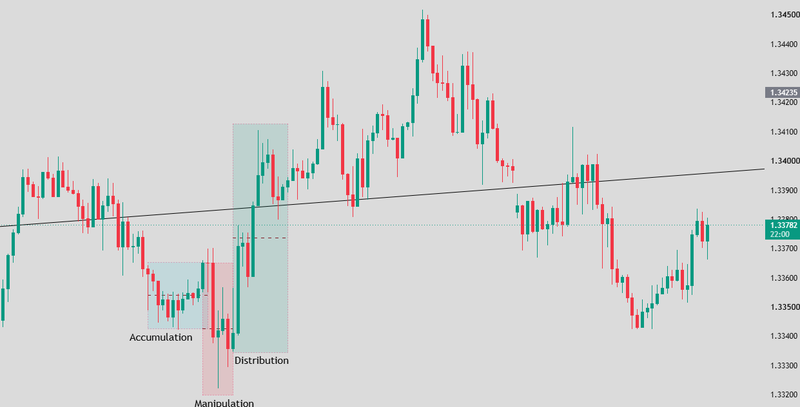
Power of 3 is three phases of price delivery: accumulation, manipulation, and distribution.
Accumulation is the quiet phase. Price often moves sideways or builds a range. The market may look undecided, but liquidity is building around the highs and lows of that range.
Manipulation is the trap phase. Price moves beyond one side of the range and creates the impression that a breakout has started. This move can trigger stops and pull traders into the wrong direction.
Distribution is the real directional move. After the manipulation phase, price moves toward the intended liquidity target. This is often the move traders wanted to catch, but many entered too early during the fake break.
Source: Trading view
How power of 3 traps retail traders
Power of 3 traps traders because the manipulation phase often looks like confirmation.
In a bullish example, price first accumulates inside a range. Then it breaks below the range. Sellers see the breakdown and enter shorts. Buyers get stopped out. Sell-side liquidity is taken. But if price quickly reclaims the range and starts moving higher, the breakdown was manipulated before the real move upward.
In a bearish example, price accumulates, then breaks above the range. Buyers chase the breakout. Shorts get stopped out. Buy-side liquidity is taken. But if price falls back below the range and starts selling off, the breakout was the manipulation before the real move lower.
The trap works because the manipulation phase feels convincing in real time
A trader sees price break out and assumes the market has chosen direction. But in a power of 3 setup, the first aggressive move outside the range can be the fake move. The real clue often comes after that, when price either accepts the break or reclaims the range.
When price sweeps one side and then returns through the range with strength, it often tells a clearer story than the first breakout itself.
How to avoid being the trap
The best way to avoid being trapped is to stop chasing the first obvious move.
A clean breakout is not enough on its own. Traders need to watch whether price accepts the level or rejects it. Acceptance means price breaks, holds, and continues with structure. Rejection means price breaks, fails, and moves back inside the range.
It also helps to mark liquidity before entering.
Where are the obvious highs and lows? Where would traders place stops? Where would breakout traders enter? If your entry is exactly where everyone else is reacting, the trade may be vulnerable.
Waiting for confirmation can help reduce many traps. That confirmation may come from a strong close back inside the range after a sweep, a shift in lower-timeframe structure, displacement away from the swept level, or a retest that holds after the reclaim.
FAQs
What is inducement in trading?
Inducement in trading is a price move that attracts traders into a position before the market moves against them. It often appears as a small breakout, a clean support or resistance break, or a move around an obvious high or low. In SMC and ICT, inducement is linked to liquidity because trapped traders usually place stops in predictable areas.
What is a liquidity sweep?
A liquidity sweep is a move beyond an obvious high or low to trigger resting orders before price often returns back inside the range. A sweep above a high may take buy-side liquidity. A sweep below a low may take sell-side liquidity. The key is what price does after the sweep, not only the break itself.
How does a liquidity sweep trap retail traders?
A liquidity sweep traps retail traders by triggering stops and breakout entries around obvious highs or lows. Price may push above resistance, attract breakout buyers, then fall back below the level. Those buyers become trapped. The same can happen below support, where sellers enter after a breakdown before price reverses higher.
What is power of 3 in ICT?
Power of 3 in ICT refers to accumulation, manipulation, and distribution. Accumulation is the range-building phase. Manipulation is the false move beyond the range that traps traders or sweeps liquidity. Distribution is the real directional move after the trap. Traders use the concept to understand how price may build, fake out, then deliver.