Support
Inverse fair value gap (IFVG): how to identify and trade the pattern
An Inverse Fair Value Gap (IFVG) forms when price breaks through an existing fair value gap, turning a former support or resistance zone into a potential trading opportunity in the opposite direction.

An Inverse Fair Value Gap is a failed Fair Value Gap where price breaks through the original imbalance and changes its role.
A bullish IFVG forms when price closes above a bearish FVG, while a bearish IFVG forms when price closes below a bullish FVG.
Liquidity sweeps, candle closes and market structure help traders distinguish stronger setups from ordinary price fluctuations.
Traders can use the gap's 50% midpoint, known as Consequent Encroachment, alongside breaker blocks to plan entries and manage risk.
What is an IFVG?
An Inverse Fair Value Gap is a price imbalance which fails to respect its original direction. It starts life as a normal Fair Value Gap (FVG) but rather than respecting that area as support or resistance, price breaks through it and closes on the other side.
To understand the inversion, start with how a standard FVG forms
A Fair Value Gap occurs across three consecutive candles when a strong move leaves a gap between the wicks of the first and third candles which doesn't overlap. Traders will note that area as a potential area of return prior to the price continuing in its original direction.
For instance, a bearish FVG will form in a downtrend
The sellers will be looking for the gap to provide resistance on a pullback. If, however, the buying pressure is strong enough to push price completely above the gap then the original bearishness is no longer in play.
That broken gap becomes a bullish IFVG
Instead of looking for buyers to come in and defend the area you now look for sellers to react when price comes back to it.
Source: Trading view
Bullish vs. bearish IFVG: how the reversal works
An IFVG can develop in either direction. What's important is the original gap, how price breaks it and whether the area holds on retest.
Bullish IFVG: from resistance to support
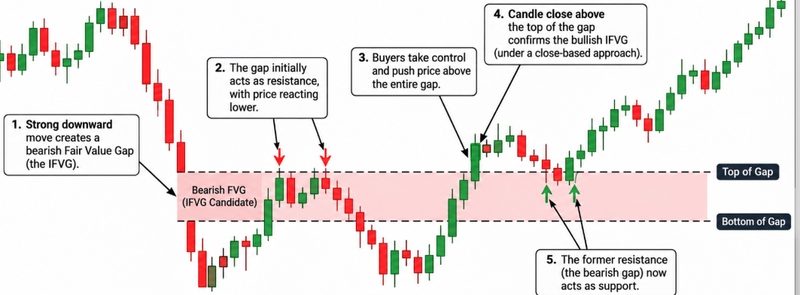
A bullish IFVG starts with a bearish Fair Value Gap (normally occurring during a period of strong downward movement). That gap initially acts as potential resistance and is where you'd expect selling to come back.
If the buyers take control and push the price above the entire bearish gap, then the original resistance has failed. A candle close above the top of the gap is the confirmation you'd need under a close based approach.
Source: Trading view
Bearish IFVG: From support to resistance
A bearish IFVG follows the reverse sequence. It starts with a bullish Fair Value Gap which is formed during an upward move and the gap initially provides potential support.
If sellers push the price all the way down through the entire gap and a candle then closes below the lower boundary of that gap, the original support has broken.
Suppose gold forms a bullish FVG between $4,000 and $4,020. Buyers come in and defend the area initially but then the price drops below $4,000 and we end up with a candle that closes at $3,992.
The gap is now considered a bearish IFVG under the close-based rule
A recovery to the $4,000–$4,020 area could be attractive to sellers, especially if the wider market structure has also turned bearish.
The gap is no proof that the reversal will continue, its importance is determined by what happens to the price after the break.
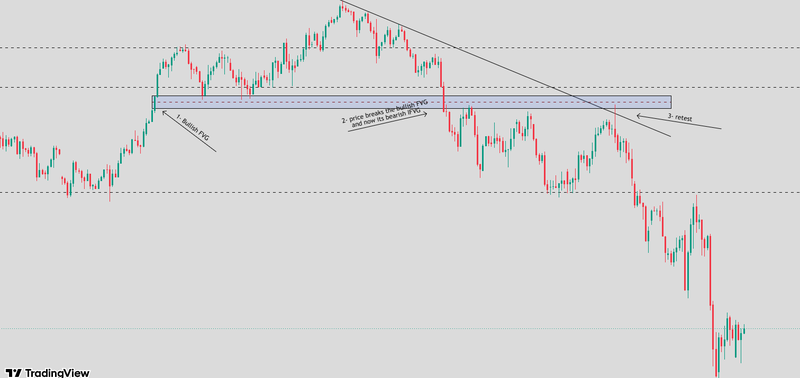
Source: Trading view
Why candle closes matter in IFVG confirmation
Not every move beyond a fair value gap should be regarded as a confirmed inversion. Price can move through support/resistance for a short period of time and then reverse back into the original range.
These are the sort of moves that will leave long wicks on the candles. Price has tested that level and not held it.
For that reason, a common conservative approach is to require the candle to close beyond the far boundary of the FVG before you'd even consider it inverted.
A wick through the boundary might just be a liquidity sweep
A close beyond the boundary is the sort of thing that would give you a good deal more confidence that the original zone has indeed failed.
There's a key difference between a wick crossing the gap and a candle closing outside the gap. Some IFVG methodologies will accept wick-based invalidation, others will require a close. Traders using mechanical rules should pick one definition and stick to it.
The strength of the move also matters
A decisive break with a wide range candle (displacement) will generally give the trader more of a reason to look at a change in direction than several small candles moving through the gap.
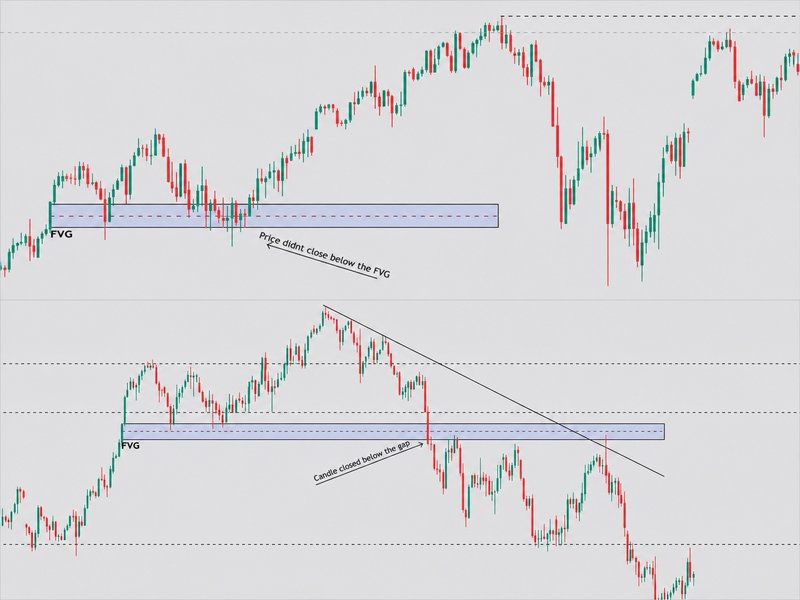
Source: Trading view
How to trade an IFVG using liquidity sweeps
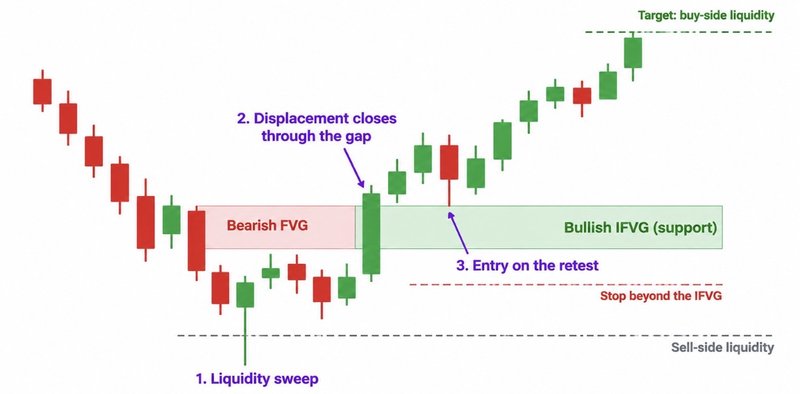
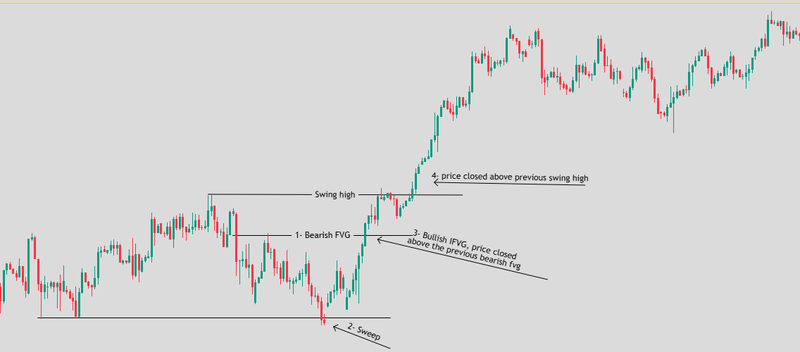
A situation that's often watched is a liquidity sweep and then a reversal through an existing gap.
Liquidity tends to build up around previous swing highs and swing lows (where people have placed their stop losses and breakout entries). A liquidity sweep is when price moves past one of those levels and then quickly reverses.
Imagine EUR/USD edging up towards a previous daily high at 1.1100. It briefly moves above that level to 1.1015, but the buyers can't hold the breakout. The sell side comes back in force, and the market is back below the adjacent bullish FVG.
The sequence provides traders with three distinct observations: price moves above a major high, fails to hold that high and then subsequently breaks through an area which was supposed to be support. If the decline also breaks the recent swing low, it could be indicative of a bearish market structure change.
A trader could then watch the inverted gap for a potential short entry on a retest
The same principle would apply in reverse if price had swept a big low and then closed above a bearish FVG.
Higher time frame levels (previous daily highs, previous weekly lows) can be used to establish context. A liquidity sweep doesn't guarantee a reversal though and an IFVG appearing after one would still need to be assessed in the context of the prevailing trend and the wider price structure.
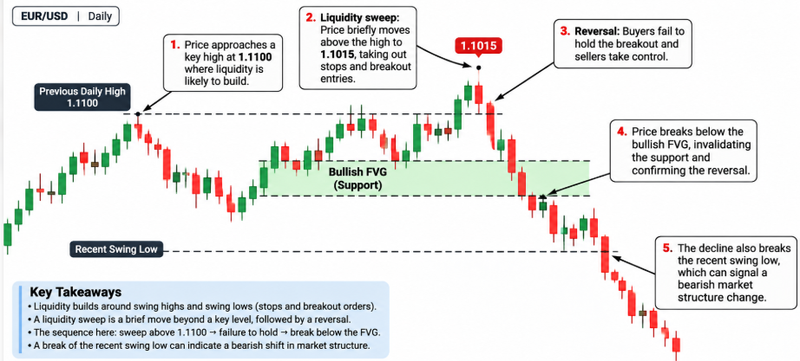
Source: ChatGPT – authors idea
Using Consequent Encroachment (CE) for IFVG entries
Consequent Encroachment is the 50% point of a Fair Value Gap. Rather than treating the whole of the gap as a single-entry area, it's the 50% point of the gap that is used to define the entry.
The calculation is:
(High + Low) / 2
Suppose a bullish IFVG runs from 1.0850 to 1.0870.
The midpoint is:
(1.0850+1.0870)2 = 1.0860
A trader looking at a bullish retest would presumably treat 1.0860 as either an entry level or an area to assess buyer reaction.
There are two ways of approaching the retest
You can enter right up against the first boundary of the gap which enables earlier participation, though the stop may well have to allow for movement through the rest of the zone.
Combining IFVGs with order blocks and breaker blocks
Another way of assessing an IFVG is to compare it with the nearby order blocks and breaker blocks.
Traders watch those areas as potential support or resistance. If the area fails and price breaks through it, the failed order block can be classified as a breaker block.
Suppose gold breaks through a bearish FVG and an earlier bearish order block
Both of those areas fail to contain the buyers and the market then goes on to set up a higher swing high.
If the inverted gap overlaps the new bullish breaker block, then you have two technical areas supporting the same bullish scenario.
A pullback into that shared zone may therefore be worth keeping an eye on for a possible entry.
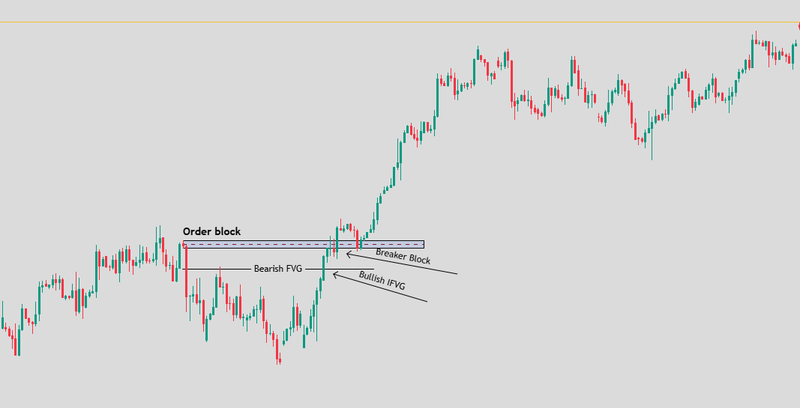
Source: Trading view
A practical IFVG trading checklist
Traders can turn these into a repeatable process by simply applying a few rules prior to entering a position.
Identify the original FVG
Mark the boundary of a clear three candle imbalance.
Check the higher timeframe
Look for the key swing highs and swing lows, or indeed the established support and resistance.
Look for a liquidity sweep
Work out whether price has just moved beyond a significant high or low and reversed.
Confirm the inversion
Under a close based approach, you'd require price to close beyond the opposite boundary of the original FVG, ideally with good displacement.
Assess market structure
Check whether the move has also broken a relevant swing point in the direction you'd expect.
Plan the entry and exit
Mark the IFVG boundaries and midpoint, identify a logical stop-loss level, and locate the next potential liquidity target.
Not every condition must appear in every trade, but traders should decide in advance which criteria are mandatory.
Changing the rules after seeing a price movement makes it difficult to evaluate whether the strategy works.
Source: Trading view
Risks when trading IFVGs
The main risk with IFVG trading is assuming that every failed imbalance represents a genuine change in market direction.
During sideways trading, price can move repeatedly through the same gap without establishing a sustained trend. These conditions produce frequent inversions but little directional follow-through.
One of the most common mistakes is entering before the setup is confirmed, as a wick through the gap is not enough when the strategy requires a candle close
The broader trend also matters because a bearish IFVG formed during strong higher-timeframe buying may lead to only a brief pullback rather than a full reversal.
Confluence should be genuine, so order blocks and breaker blocks should not be added simply to support a trade that has already been decided.
Stops placed inside the gap can be taken out by normal price movement and should instead be based on structural invalidation, current volatility and acceptable account risk.
Traders also need to check the economic calendar, as major releases can cause sudden price swings, wider spreads and slippage that override technical levels.
If price closes decisively through the far side of the inverted gap, the expected role reversal may have failed, which is why the invalidation point should be set before the trade is opened.
FAQs
What is the difference between an FVG and an IFVG?
A Fair Value Gap is a three-candle imbalance that may provide support or resistance when price returns to it. An Inverse Fair Value Gap forms when price breaks through that imbalance, potentially reversing its role.
Does an IFVG require a candle close?
Different trading methodologies use different definitions. Some accept a wick through the gap, while others require a completed candle close beyond its far boundary. A close-based rule provides a more conservative way to confirm the inversion.
What is the 50% level of an IFVG?
The midpoint is called Consequent Encroachment (CE). Traders calculate it by averaging the upper and lower boundaries of the gap and may use it as a potential entry or reaction level.
Can an IFVG be used on any timeframe?
IFVGs can appear on intraday, daily, and weekly charts. However, lower-timeframe signals can be more sensitive to short-term volatility, making higher-timeframe market context particularly important.