Support
A guide to average price in trading and how to calculate it
Average price is the combined average cost paid for each share, contract or coin in a position. Traders use it as a reference point to manage open positions, calculate potential returns and decide whether increasing exposure still makes sense.
Average price is the average cost paid for every unit in your current position.
It forms your cost basis and shows the level needed to break even.
Any additional purchase can change the overall average price.
Including fees and commissions gives a more accurate view of total cost.
What is average price?
Average price is the average amount you have paid for each share, contract or coin in your current position after combining all your purchases.
Imagine buying a stock at $100, adding more at $90, and then buying again at $110. At that point, none of those individual prices tell you whether you're making or losing money. The only figure that matters is the average amount you paid across the entire position.
That number is known as your average price or cost basis
It represents the price your investment must reach before you begin making a profit, assuming all trading costs have been included.
For long-term investors, average price provides a clear picture of how efficiently capital has been deployed over time. For active traders, it acts as the reference point for managing positions, calculating potential rewards and deciding whether increasing exposure still offers an attractive risk-to-reward profile.
Although trading platforms usually calculate this figure automatically, understanding how it is derived helps explain why your profit or loss changes every time you add to an existing position.
Why average price matters
Average price is much more than an accounting figure. It sits at the centre of almost every investment decision you make after entering a trade.
It determines your break-even level. The most immediate use of average price is identifying your break-even point.
If your average cost is $85 per share, the market must trade above that level before the position begins generating a profit. If the price remains below it, the investment is still showing an unrealized loss. Without knowing your average price, it's impossible to judge whether a position has genuinely recovered or simply moved above one of your individual purchase prices.
It measures unrealized profit and loss
Every trading platform continuously compares the current market price with your average cost.
The difference between those two numbers determines your unrealized profit or loss sometimes called your paper profit or paper loss because the gain or loss only becomes realized after the position is closed.
For example, if your average price is $50 and the stock trades at $58, your unrealized gain is $8 per share. If the market falls to $46, you're carrying an unrealized loss of $4 per share.
This is why experienced investors pay more attention to their average cost than to the price of their first purchase.
It improves risk management
Average price also plays an important role in managing risk. Suppose you're considering buying more shares after a pullback. Before increasing the position, you'll want to know how that purchase will affect your overall cost basis. Buying at a lower price may reduce your break-even level, while adding at a higher price may increase it.
Understanding that relationship helps traders decide whether adding capital genuinely improves the investment opportunity or simply increases exposure without providing a meaningful advantage.
Instead of reacting to every market move, investors can use their average price as an objective reference point when planning entries, setting profit targets and evaluating downside risk. The market may fluctuate every day, but your average price remains the foundation for measuring whether your investment decisions are working as intended.
How to calculate average price
Every time you add to an existing investment, your average cost changes. The size of that change depends on two factors: how many units you buy and the price you pay for them.
The calculation itself is straightforward. Rather than averaging the purchase prices, you calculate the total amount invested and divide it by the total number of units you own.
This is known as a weighted average because each purchase influences the result according to the number of units bought. Larger purchases have a greater impact than smaller ones, regardless of the price.
Understanding each part of the formula
Average Price, this is the average amount paid for each unit currently held. It becomes your cost basis and the reference point for calculating unrealized profit or loss.
Total Cost of Units Purchased
This is the total amount spent building the position. It includes every purchase you've made and should also include trading costs such as commissions, exchange fees and, where applicable, taxes or other transaction charges.
Total Units Purchased
This is simply the number of shares, contracts or coins you currently own after all purchases have been completed. Because every transaction contributes to the total investment, the calculation reflects the actual capital committed rather than treating every purchase equally.
Calculating total cost
Before calculating your average price, you first need to determine the total amount invested. The total cost is calculated by adding together the value of every purchase and then including any associated trading costs.
Example
Suppose you build a position gradually instead of investing all your money at once. You first buy 100 shares at $20, investing $2,000. Later, you add 50 more shares at $30, bringing another $1,500 into the position. Finally, you purchase 150 shares at $25, investing an additional $3,750.
Calculate the total investment
The first step is to add together the value of every purchase. $2,000 + $1,500 + $3,750 = $7,250, this represents the total amount invested before accounting for commissions, fees or other trading costs.
Calculate the total number of shares
Next, add together all the shares you own.
100 + 50 + 150 = 300 shares
Calculate the average price
Average Price = $7,250 ÷ 300 = $24.17 per share
Although none of the three purchases were made at exactly $24.17, this becomes the average cost of every share you own. In other words, $24.17 is now your cost basis and the price your investment must exceed before it begins generating a profit, assuming trading costs are excluded.
If the market later rises to $26, the position shows an unrealized gain because the price is above your average cost. If the stock falls to $22, you're still carrying an unrealized loss because the market remains below your break-even level.
Use a stock average calculator
If you've made multiple purchases over time, calculating your average price manually can become time-consuming. A stock average calculator simplifies the process by automatically combining all your buy prices, position sizes and, in some cases, trading costs to calculate your average cost basis. It's a useful tool for investors who regularly add to their positions, helping them quickly identify their break-even price and monitor unrealized profit or loss without repeating the calculations each time they trade.
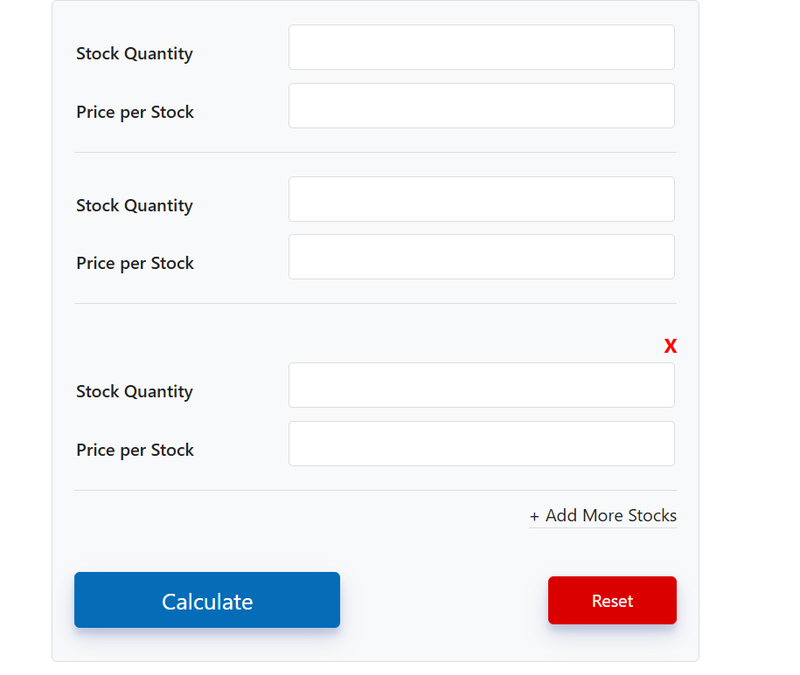
Source: Stock average calculator
Averaging down vs averaging up
Every additional purchase changes your average price, but not every purchase has the same purpose. Sometimes investors add to a position because the price has fallen and they believe the asset is undervalued. In other cases, they buy more after the price has risen because they want to increase exposure to a strengthening trend.
These two approaches are known as averaging down and averaging up. While both involve buying more of the same asset, they affect your cost basis and your risk in very different ways.
What is averaging down?
Averaging down means buying additional shares or contracts after the market price has fallen below your existing average cost.
The objective is to lower the overall cost basis of the position, reducing the price required to break even if the market eventually recovers.
For example, imagine you own 100 shares purchased at $50, giving you an average price of $50. The stock later declines to $40, and you decide to buy another 100 shares.
Your position now consists of 200 shares with a total investment of $9,000, giving you a new average price of $45 per share.
Although the market is still below your original entry price, your break-even level has fallen from $50 to $45. Instead of needing a $10 recovery to return to profit, the stock now only needs to recover by $5.
What is averaging up?
Instead of buying after prices fall, investors increase their position after the asset has already moved higher. This raises the average cost basis because the additional shares are purchased above the existing average price.
At first glance, paying more for an investment may seem counterintuitive. Yet many professional investors and trend-following traders deliberately average up, believing that strong momentum often reflects improving fundamentals and increasing institutional demand.
Consider an investor who buys 100 shares at $40. As the company continues to deliver strong earnings, the share price climbs to $48, prompting the investor to buy another 100 shares.
The new average price is $44
Although the break-even point has increased, the investor has expanded exposure to an asset that is already proving its strength instead of trying to predict when a falling market will reverse.
Neither approach is inherently better than the other. The appropriate strategy depends on the quality of the investment, the market environment and the investor's overall risk management plan.
Why trading costs matter
Commissions, exchange fees and other transaction costs are part of the investment and should be included when calculating the true cost basis.
Ignoring those expenses can make a position appear more profitable than it actually is and create a misleading break-even level.
Imagine you purchase 200 shares at $25, investing $5,000.
If your broker charges a $25 commission, your actual investment is not $5,000, but $5,025.
Instead of calculating your average price using only the purchase value, you should divide the total amount paid including the commission by the number of shares owned.
Your average cost therefore becomes $5,025 ÷ 200 = $25.13 per share
Average price vs average traded price
Your average price is your personal cost basis. It reflects the average amount you paid for the assets you currently own and is used to calculate your unrealized profit or loss.
Average traded price (ATP), however, refers to the average execution price of trades in the market or the average price at which an order is filled. It measures trading activity rather than your own investment cost.
A related metric is the Volume-Weighted Average Price (VWAP), which calculates the average market price throughout a trading session after weighting each trade by its volume. Institutional traders often use VWAP to assess execution quality, while investors use average price to evaluate their own positions.
What happens when you sell?
If you sell your entire position, the average price is effectively reset. Any future purchase starts with a new cost basis based only on the new trade.
If you sell only part of your holdings, the outcome depends on your broker's accounting method. Under the average cost method, the average price of the remaining shares usually stays the same. However, some brokers use methods such as FIFO (First In, First Out) or Specific Identification, which can affect how realized gains and taxes are calculated.
Because these rules differ across brokers and jurisdictions, it's always worth checking which method applies to your account.
FAQs
What is average price in trading?
Average price is the weighted average amount paid for all the units in your current position. It represents your cost basis and determines your break-even level.
How do you calculate average price?
Add together the total cost of every purchase, including applicable fees and commissions, then divide that amount by the total number of units owned.
Does selling shares change the average price?
Selling an entire position resets the average price because the position no longer exists. Partial sales usually leave the average cost unchanged under the average cost method, although this depends on your broker's accounting rules.
Is average price the same as VWAP?
No. Average price reflects your personal cost basis, while VWAP measures the average market price during a trading session and is commonly used as an execution benchmark.