Help
Help 
Trump institutes a blockade and 20% tariff on the Strait of Hormuz
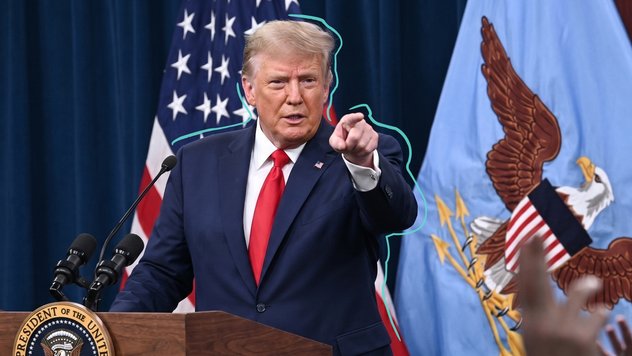
President Donald Trump has reinstated a US blockade on Iranian shipping through the Strait of Hormuz while proposing that other vessels pay a 20% charge for US protection. The move pushed Brent crude above $85 a barrel, surprised shipping companies and raised questions over enforcement, international law and the risk of further Iranian attacks on commercial vessels.
The US blockade on ships entering or leaving Iranian ports resumes Tuesday.
Trump proposed a 20% charge on all other cargo moving through Hormuz.
The fee could add about $32 million to the cost of a fully loaded supertanker.
Brent crude rose above $85 a barrel in its biggest advance since May 2020.
Trump reinstates Iran’s shipping blockade
President Donald Trump has reinstated a US blockade targeting Iranian ships and customers moving through the Strait of Hormuz, escalating the dispute over control of one of the world’s most important energy routes.
The blockade will apply to traffic entering or leaving Iranian ports and coastal areas. US Central Command said enforcement would resume Tuesday at 4 p.m. New York time.
Trump said ships from other countries would continue to receive access to the strait, arguing that the waterway would remain open regardless of Iran’s position. But he also said the US should be reimbursed for the cost of protecting commercial traffic.
Under the proposal, cargo moving through Hormuz would face a charge equal to 20% of its value.
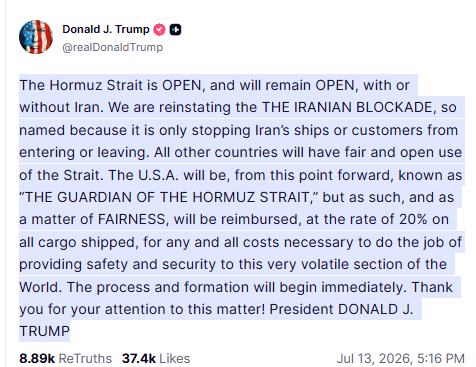
Source: Truth Social
The White House has not provided details explaining how that charge would be calculated, collected or enforced.
A 20% charge could add millions to tanker costs
The proposed fee would be extremely expensive for oil shippers.
At current crude prices, a 20% charge could add roughly $32 million to the cost of a fully loaded very large crude carrier. That compares with about $2 million in charges Iran has reportedly imposed on some ships.
Such a cost would have major consequences for tanker economics.
Shipping companies would need to decide whether to absorb the charge, pass it on to buyers or avoid the route. The additional expense could raise delivered oil prices, lift freight rates and widen the gap between Gulf crude and barrels produced outside the region.
The market may also need to determine whether the charge applies to the full value of a ship’s cargo or only to services provided by the US military.
Until those questions are answered, the announcement introduces a new layer of uncertainty into global energy trade.
Brent jumps above $85
Oil prices rose sharply after Trump’s announcement.
Brent crude moved above $85 a barrel for the first time in a month and recorded its biggest gain since May 2020.
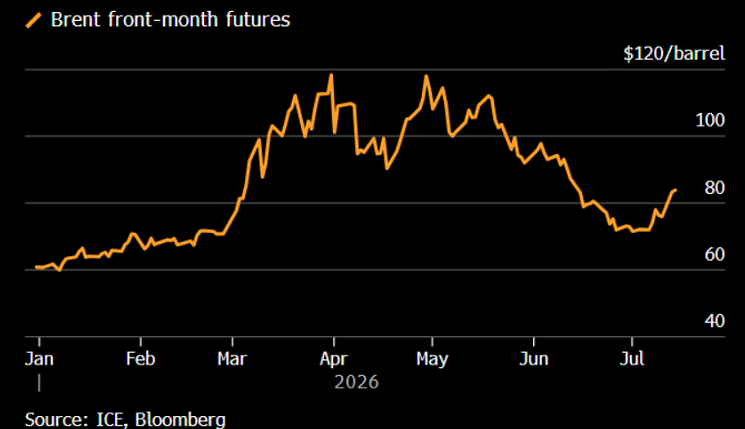
Source: Bloomberg
The rally reflected two separate risks.
The first is the possibility that blocking Iranian exports removes barrels from the global market. The second is that Iran retaliates by attacking commercial vessels or restricting access through the strait.
Before the war, Hormuz carried around one-fifth of global oil flows. Even a partial disruption can affect physical supply, tanker availability, insurance costs and inflation expectations.
The proposed fee also adds a direct cost to moving oil through the waterway, even if shipping volumes continue.
US launches another wave of strikes
The blockade announcement followed another round of US strikes against Iran.
US Central Command said it completed a five-hour mission targeting Iran’s ability to attack commercial shipping. The strikes were part of a broader military campaign conducted over the previous week.
Trump said the attacks focused on capabilities linked to the strait.
The operation signals that Washington is trying to establish control over commercial access to Hormuz while limiting Iran’s capacity to threaten passing vessels.
But greater US involvement also increases the risk of a wider military confrontation.
Shipping industry caught off guard
The proposed cargo charge surprised companies operating in the region.
Shipping-market participants said they had received little warning and lacked basic information on how the system would work. Those uncertainties could affect decisions over whether to enter the Persian Gulf, wait for clearer rules or seek alternative supplies.
Transit volumes were already weakening before the new announcement. Ship movements through Hormuz fell to their lowest level in a month on Sunday.
The fee could suppress traffic further if shipowners conclude that the financial and security costs are too high.
For oil markets, reduced tanker traffic may matter almost as much as a formal closure. A waterway can technically remain open while actual commercial flows fall sharply.
Iran says the peace deal is in crisis
Iran views the renewed blockade as a violation of the interim peace agreement signed with the US in June.
That agreement created a 60-day negotiating window and called for toll-free commercial shipping, while requiring Iran to ensure safe passage.
Tehran has continued to insist that vessels obtain permission and use approved routes. It also argues that Iran retains authority over security in the strait.
Iran’s government said the agreement had entered a crisis phase and that it would no longer follow its terms while the US continued to violate its commitments.
That raises the risk of additional attacks on commercial vessels, especially if Tehran attempts to challenge the US blockade or the proposed charge.
The ceasefire’s economic benefit is disappearing
The latest confrontation comes only weeks after the interim peace agreement briefly improved energy flows and helped lower oil prices.
The ceasefire had raised hopes that Hormuz traffic would normalize, Iranian exports would recover and US gasoline prices would ease before the November midterm elections.
Those benefits are now at risk.
Higher oil prices could quickly feed into fuel costs and inflation expectations. That would create pressure on consumers, bond markets and central banks.
Trump had presented the peace agreement as a way to reduce energy prices and support the economy. Reinstating the blockade creates the possibility of the opposite outcome.
Legal obstacles could complicate the proposal
The 20% fee may also face serious legal challenges.
International law generally guarantees vessels a right of transit through waterways used for international navigation. Coastal states typically cannot charge ships simply for passage.
Fees may be permitted for specific services provided to individual ships, such as direct assistance or escort operations. But a broad charge on all cargo could be difficult to justify, particularly if it applies to vessels that did not request US protection.
The International Maritime Organization has reiterated its opposition to fees for passage through international straits.
The proposal could therefore generate resistance from allies, energy importers, shipping companies and US industries exposed to higher freight and oil costs.
Military control would require greater resources
US forces have already escorted ships along a southern route farther from the Iranian coastline.
But maintaining lasting control over the strait would require a much larger military commitment. Protecting ships, enforcing the blockade, monitoring Iranian movements and responding to attacks would involve significant costs and operational risks.
Some assessments suggest full control could eventually require forces beyond naval and air operations, potentially including a greater presence on the ground.
That would be a major escalation and one the Trump administration has so far appeared reluctant to pursue.
This creates an enforcement challenge. The US can declare the strait open and block Iranian traffic, but maintaining that arrangement over time may be difficult if Iran continues to challenge it militarily.