
 Help
Help 
Bitcoin technical analysis: can BTC break above $88,000?
Bitcoin's institutional demand recovered in the third quarter, but renewed outflows underline how quickly investor positioning can change. Meanwhile, a proposed US regulatory framework could reshape the market structure for leveraged crypto trading.

Third quarter in which the funds attracted approximately $6.3 billion.
US Commodity Futures Trading Commission proposed a federal framework for crypto exchanges offering leveraged or margined spot trading.
A sustained breakout above $87,000–$88,000, would strengthen the case for an ongoing Wave III advance.
ETF inflows tell a more complicated story
US spot Bitcoin funds recorded net outflows on Monday, interrupting the recent improvement in institutional flows. The move came after a third quarter in which the funds attracted approximately $6.3 billion, pointing to a meaningful return of capital following substantial withdrawals earlier in the year.
The distinction matters. Third-quarter inflows were strong, but they did not fully reverse the first half weakness. Net flows for 2026 remained close to $985 million through the end of September, according to reported fund-flow data. The recovery therefore looks more like a rebuilding of demand than an uninterrupted wave of institutional accumulation.
For Bitcoin, sustained ETF inflows can provide an important source of demand by allowing investors to gain exposure through regulated investment products. But daily withdrawals show that institutional participation does not eliminate short-term selling pressure. The next signal will be whether capital continues returning over several weeks or whether the third-quarter improvement begins to fade.
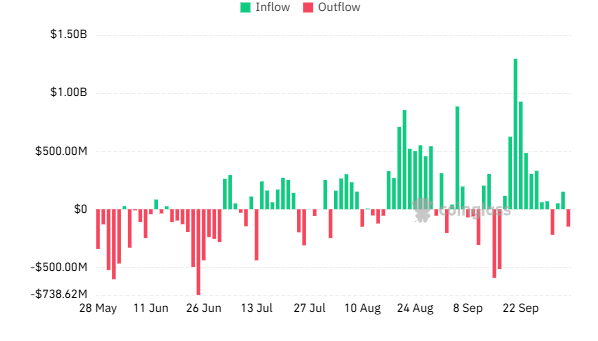
Source: Coinglass
The CFTC proposal could change the US market structure
A separate development emerged on October 5, when the US Commodity Futures Trading Commission proposed a federal framework for crypto exchanges offering leveraged or margined spot trading. Under the proposal, eligible platforms could opt into federal oversight rather than relying primarily on differing state-level licensing requirements.
The framework would establish a new category of regulated trading venues, with requirements including anti-manipulation controls and proof of reserves. Customer trades would also need to be intermediated through registered futures commission merchants. The proposal does not establish a universal federal regime for every spot crypto transaction, nor does it specify general leverage limits.
The potential benefit is greater regulatory consistency for participating in exchanges. A clearer federal route could reduce uncertainty around operating requirements and make it easier for platforms to develop products within a defined supervisory framework.
However, the proposal follows the failure of broader crypto legislation to advance in Congress, leaving questions about the durability and scope of the regulatory approach. Its ultimate impact will depend on the final rules, implementation and whether exchanges choose to participate
Technical outlook: Bitcoin tests the next stage of its recovery
Bitcoin is trading around $86,240, with the recovery from $58,000 approaching a critical resistance zone. The Elliott Wave structure suggests that the previous five-wave advance ended near $126,000, followed by an ABC correction that may have completed at the November low. If that count is correct, the latest rebound could mark the beginning of a new bullish impulse, potentially placing BTC in Wave III, typically the strongest phase of an Elliott Wave advance.
The structure is improving, but confirmation remains incomplete. Bitcoin has reclaimed the $73,749 resistance level and moved above the blue moving average near $69,985. Both now provide important reference points for the recovery. The immediate test is whether buyers can push the price through $87,000–$88,000, where the next leg higher would gain technical credibility.
A break above $88,000 opens the way higher
A sustained breakout above $87,000–$88,000, while holding above $82,837, would strengthen the case for an ongoing Wave III advance. The next resistance zone sits around $92,000–$94,000, followed by the principal chart target at $97,660.
A move toward $97,660 would bring Bitcoin closer to the psychologically important $100,000 level. If the impulsive structure remains intact, a subsequent Wave IV correction could return BTC toward $77,000–$79,000 before a potential final Wave V advance toward $100,000–$104,000.
Resistance exposes a weaker recovery
Failure to clear $87,000–$88,000 would leave the recovery vulnerable to another pullback. A break below $82,837 would weaken the immediate bullish structure and put $77,000–$79,000 back in focus.
The most important test lies at $73,749. A sustained move below this former resistance would undermine the breakout and expose the moving average near $69,985. A deeper decline would bring the $58,000 low back into focus.
What if the Elliott Wave count is wrong?
The main risk is that the rebound from $58,000 represents a corrective recovery within a broader bearish trend, rather than the start of a new five-wave advance. Under this interpretation, the $87,000–$88,000 zone could act as a ceiling before sellers regain control.
A rejection followed by breaks below $82,837 and $73,749 would strengthen that alternative. Conversely, a decisive move above $88,000, followed by sustained higher highs and higher lows, would make the bearish interpretation less convincing.
The next move above $88,000 or below $82,837 should help determine whether Bitcoin's recovery is developing into a sustained bullish impulse or losing momentum beneath resistance. Until one of these levels gives way, the Elliott Wave count remains a working scenario rather than a confirmed trend reversal.
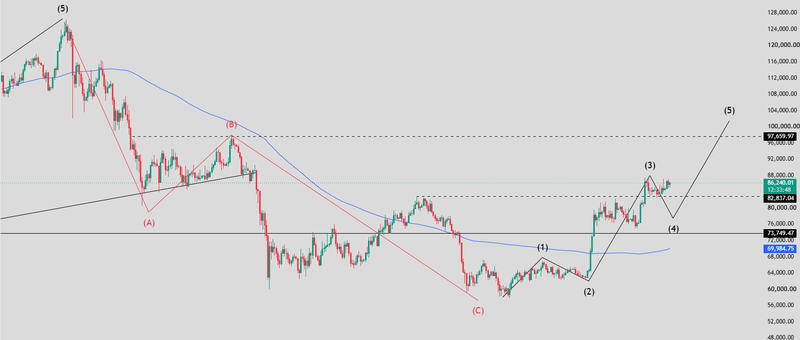
Source: Trading view


