
 Help
Help Crypto market cap nears $2 trillion amid risk-asset weakness
Crypto market capitalisation hovered near $2 trillion as risk aversion, inflation concerns, and expectations of tighter central bank policy pressured digital assets globally. Bitcoin retained 58% dominance, while altcoins represented around 42%.

Total crypto market capitalisation stood near $2.02 trillion, repeatedly testing the $2 trillion threshold amid persistent selling pressure.
Bitcoin accounts for approximately $1.18 trillion, holding 58% dominance, while altcoins represent roughly $845 billion, or around 42%.
Crypto market value is down by around 52% from its October 2025 peak of $4.22 trillion, highlighting significant weakness across risk assets.
Inflation, tighter central banks, ETF outflows, rotation into AI-related stocks, and regulatory uncertainty are weighing on crypto sentiment.
Total crypto market value approaches $2 trillion as risk assets come under pressure
Total crypto market capitalisation is nearing the $2 trillion mark amid rising selling pressure, driven by risk aversion among market participants. At market close, total market capitalisation stood at $2.02 trillion, while intraday movements have repeatedly tested the $2 trillion threshold over the past week.
Within this performance, Bitcoin’s market capitalisation accounts for approximately $1.18 trillion, while altcoin market capitalisation represents around $845 billion. This indicates that Bitcoin dominance represents approximately 58% of total market capitalisation, while altcoins account for roughly 42%. Furthermore, compared with the highest level reached in October 2025, when total market capitalisation stood at $4.22 trillion, the current level implies a drawdown of approximately 52%.
Although cryptocurrency market capitalisation is a complex phenomenon influenced by multiple factors, several aspects are particularly relevant amid rising geopolitical and economic risks. On the one hand, rising inflation and potentially restrictive stances from central banks are reducing appetite for high-risk assets, such as cryptocurrencies. During periods of economic deterioration, market participants tend to seek defensive or safe-haven assets in order to protect capital against volatility. This phenomenon can be observed in crypto spot ETF outflows and relative drawdowns, which reflect strong selling pressure.
In turn, artificial intelligence (AI)-related and technology companies have gained investors’ attention, as these shares have offered solid capital returns despite the risks associated with such investments. A greater need for liquidity to reallocate capital has affected cryptocurrencies and benefited technology company valuations, notably the market capitalisation of SpaceX, which has fluctuated around the $2 trillion level since its initial public offering (IPO).
On the other hand, regulatory developments in the crypto market may generate several long-term benefits while also contributing to short-term market instability. Greater regulatory clarity could strengthen institutional investors’ confidence in digital assets by improving transparency, investor protection, and market integrity. However, stricter regulation may also reduce speculative activity, particularly among market participants primarily seeking short-term gains rather than long-term investment exposure. In addition, the growing adoption of tokenisation and the development of central bank digital currencies could represent an emerging source of competition for existing crypto assets.
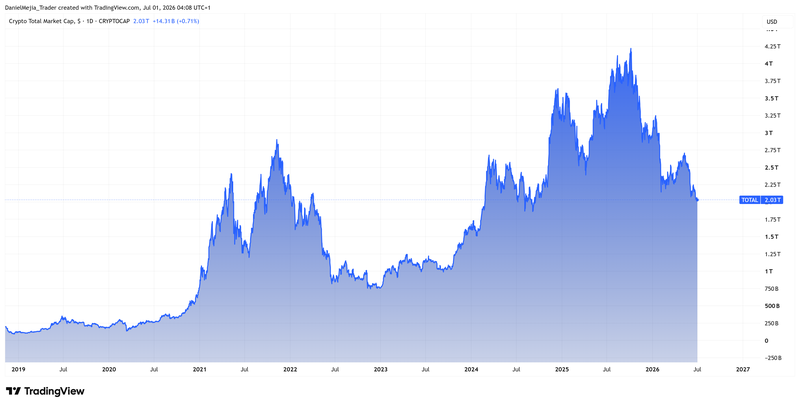
Figure 1. Total Crypto Market Cap (2019–2026). Source: Figure obtained via TradingView.


