
 Help
Help 
Digital assets enter Q4 with momentum
Spot Bitcoin ETFs have helped drive bullish momentum in recent months, supported by strong institutional demand and positive regulatory developments. Greater regulatory clarity is helping bridge the gap between digital assets and traditional finance. However, rising bond yields and geopolitical tensions remain key risks that could drive capital outflows and renewed volatility in Q4.

Between July and September 2026, net flows averaged approximately $93.85 million per day.
Bitcoin remains exposed to broader macroeconomic and geopolitical risks, which continue to limit upside momentum.
Moves by the SEC and FCA could mark a turning point for crypto oversight and influence how other jurisdictions approach regulation.
Renewed inflows into spot Bitcoin ETFs
Interest in spot Bitcoin ETFs picked up again in Q3. Between July and September 2026, net flows averaged approximately $93.85 million per day, supporting Bitcoin’s price appreciation. Over the same period, Bitcoin rose by approximately 43%, marking a strong recovery following a months-long bearish trend.
BlackRock’s iShares Bitcoin Trust (IBIT) remains the largest fund by assets, followed by the Fidelity Wise Origin Bitcoin Fund (FBTC) and Grayscale Bitcoin Trust (GBTC). Alongside other Bitcoin index funds, their cumulative performance has continued to trend higher, suggesting institutional investors could be maintaining structural exposure to and sustained interest in Bitcoin.
Total assets held across spot Bitcoin ETFs rose from $72.17 billion at the early-July trough to $106.89 billion by the end of September – an increase of approximately $34.72 billion, or 48%. While these holdings represent only a proportion of Bitcoin’s total market capitalisation, ETF flows can have a considerable influence on wider market sentiment by signalling institutional positioning, making them an important reference point for traders and retail investors.
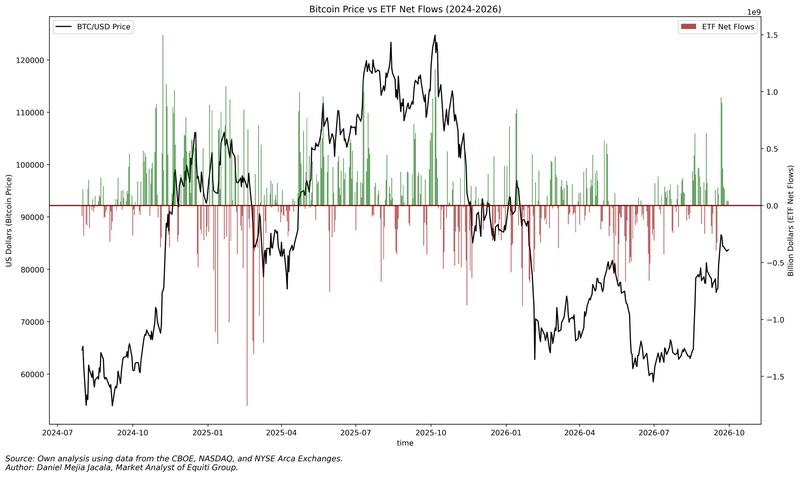
Source: Data from the CBOE, NASDAQ and NYSE Arca Exchanges.
Current regulatory landscape for crypto markets
Crypto regulation has shifted meaningfully in recent months, supporting asset valuations as the gap between digital assets and traditional finance continues to narrow.
In the US, the Securities and Exchange Commission (SEC) announced in mid-September that financial institutions and platforms would be allowed to facilitate trading in blockchain-based stocks and other securities. The initiative, known as the ‘Innovation Exemption’, is not permanent statutory law but a flexible exemption designed to adapt as the technology develops.
At the same time, the UK’s Financial Conduct Authority (FCA) announced a regulatory framework for crypto-assets at the end of September. Under the new regime, crypto firms will be able to apply for full regulatory authorisation, subject to rigorous operational and capital assessments. The framework aims to strengthen market integrity and investor protection across the digital asset ecosystem.
As two of the world’s most influential financial regulators, moves by the SEC and FCA could mark a turning point for crypto oversight and influence how other jurisdictions approach regulation.
Is bitcoin bullish or bearish?
Bitcoin spent much of the past year under pressure, falling as much as 53% from its previous high by late June. It then rebounded by around 43% in Q3, although it remains 32% below its October 2025 peak. Heading into Q4, the key question is whether this recovery can continue as part of the longer-term bull market, or whether it is simply a temporary rally within a broader downtrend.
Technical indicators suggest the long-term uptrend remains intact. Despite the mid-year contraction, Bitcoin maintained a pattern of higher highs and higher lows, while the $60,000 level held as structural support. The price also remained above its 200-week simple moving average (SMA), a key long-term benchmark historically associated with major bull cycles. BTC/USD also held above the 61.8% Fibonacci retracement level of its previous rally, adding further support to the view that the structural bull market remains intact.
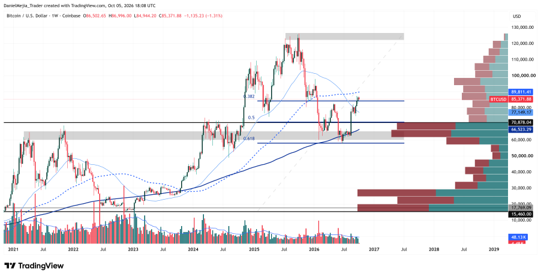
Source: Data from Coinbase Exchange; author's own analysis conducted via TradingView.
However, Bitcoin still faces pressure from broader macroeconomic and geopolitical risks. Tensions in the Middle East, particularly around key shipping routes such as the Strait of Hormuz and Bab el-Mandeb Strait, continue to put upward pressure on energy prices amid concerns over supply disruptions. In response, global central banks, led by the Federal Reserve, are taking an increasingly restrictive stance.
Tighter monetary conditions could drive capital away from risk assets, including cryptocurrencies, as higher risk-free bond yields become more attractive, and investors seek better risk-adjusted returns.


