
 Help
Help Is Bitcoin’s volatility remaining contained despite market uncertainty?
Bitcoin's implied volatility remains near all-time lows despite a 30% price surge, signalling cautious sentiment as US debt risks and pro-crypto regulatory efforts drive institutional interest in digital assets.
Bitcoin's 30-day BVIV index remains near record lows of around 38 points, despite recent 30% price gains.
Unlike the VIX, the BVIV measures expected volatility strength across both upward and downward trends.
Low BVIV levels suggest traders remain cautious and hesitant to price in strong directional conviction.
Gains have been supported by US pro-crypto legislative proposals, such as the CLARITY Act, alongside hedging against US sovereign debt risks.
Date: 29 September 2026
Bitcoin’s implied volatility remains contained despite market uncertainty
Implied volatility in Bitcoin prices remains contained despite an appreciation of close to 30% over the last two months. This is reflected in the Bitcoin Volmex Implied Volatility (BVIV) index, which remains near its all-time low, currently trading at approximately 38 points.
The BVIV measures expected 30-day forward volatility derived from Bitcoin-linked options. In terms of interpretation, a rising BVIV signals that market participants anticipate accelerating price movements in subsequent periods, whereas a low BVIV indicates that implied volatility in the underlying asset remains muted.
Notably, unlike equity volatility indicators—such as the CBOE Volatility Index (VIX) linked to S&P 500 options, which typically spikes during market downturns—the BVIV index can rise significantly during both upward and downward price movements. That is, BVIV levels expand when Bitcoin prices experience sharp gains or steep declines alike.
In this context, the BVIV serves as a highly effective metric for evaluating market sentiment surrounding Bitcoin. When an upward or downward price swing is accompanied by a surge in implied volatility, the momentum behind the movement is likely to be substantial, indicating a clearer directional consensus among market participants.
However, under current conditions, despite Bitcoin’s 30% cumulative gain over the past two months, the BVIV remains near historical lows. This suggests that market participants remain cautious and reluctant to price in aggressive conviction or sustained momentum behind the rally.
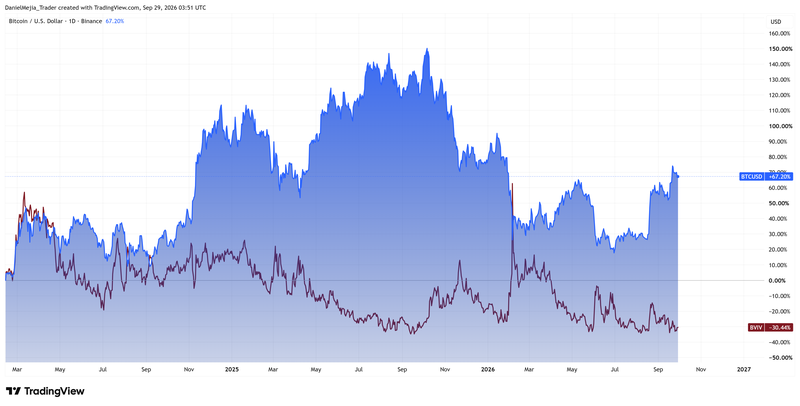
Figure 1. Bitcoin Price vs. BVIV Index (2024–2026). Source: Data from Volmex and Binance; author's own analysis conducted via TradingView.
What has driven Bitcoin prices higher?
Recent bullish momentum in Bitcoin has been supported by regulatory developments reflecting efforts to narrow the gap between traditional finance and blockchain technology in the United States. A prominent example is the CLARITY Act, which has been introduced in the US Congress, although the bill has yet to be formally enacted into law.
Additionally, escalating risks associated with US sovereign debt have stimulated renewed institutional interest in digital assets. Investors are increasingly considering cryptocurrencies as strategic portfolio diversifiers, particularly as rising net interest payments on expanding fiscal deficit heighten underlying risks within the US federal budgetary landscape.


