
 Help
Help USDT market capitalisation holds its uptrend despite increasing regulatory scrutiny
USDT market capitalisation remains in an uptrend near $184.72 billion, supported by the growing adoption of stablecoins across digital assets.
USDT market capitalisation reached around $184.72 billion, supported by rising stablecoin adoption over the past decade.
Stablecoins offer speed, flexibility, and operational transparency, helping to strengthen their role across the digital asset ecosystem.
JPMorgan warned that stablecoins may compete with bank deposits and create risks without bank-like safeguards.
The current USDT consolidation reflects caution as markets await clearer US digital asset and stablecoin regulation.
USDT market cap remains in an upward trend while consolidating on regulatory concerns
USDT adoption has risen markedly over the last ten years. This trend is mainly explained by the multiple benefits offered by stablecoins, including greater flexibility, on-chain traceability, and transaction speed. Consequently, USDT’s market capitalisation has reached around $184.72 billion, supported by solid upward momentum in its adoption across the digital asset ecosystem. However, regulatory pressures are increasing in key markets, particularly in the United States, where the Digital Asset Market Clarity Act has become a relevant factor for the future development of crypto assets and stablecoins.
According to information cited in a CoinDesk article, banking giant JPMorgan supports the innovation associated with cryptocurrencies and tokenisation, but has also called for safeguards from the US Congress in order to protect the financial system against significant risks. JPMorgan indicates that, while cryptocurrencies and tokenisation could make payments faster, reduce settlement times, and improve the movement of money across borders, they could also generate systemic risks that have traditionally been addressed through strict rules in the financial system, or create new regulatory challenges.
Notably, JPMorgan emphasises the risks surrounding stablecoins, as this type of product could increasingly act as a competitor to traditional bank deposits, especially when rewards or yield-like incentives are offered. The concern is that stablecoins may attract funds without being subject to the same capital, liquidity, supervisory, and consumer protection requirements applied to banks. This could reduce the availability of resources for banks to lend to households and companies, thereby creating frictions within the financial system and affecting the broader functioning of the economy.
Consequently, the current consolidation pattern exhibited in USDT market capitalisation could be related to a certain level of caution among market participants, who are awaiting further information on how the US regulatory framework will treat digital assets, as well as their scope and limitations.
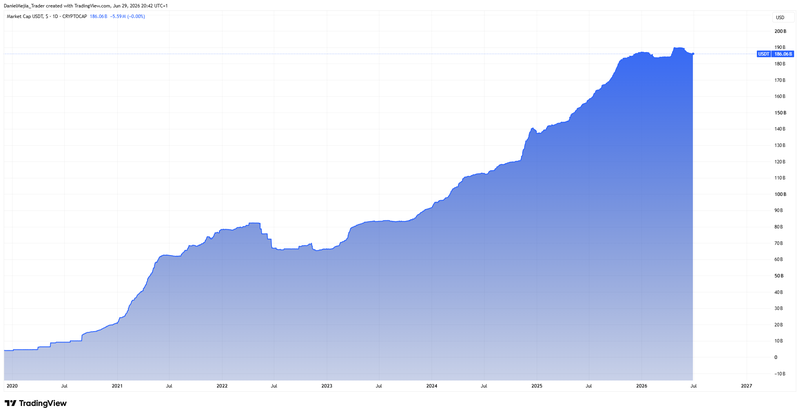
Figure 1. USDT Market Cap (2020–2026). Source: Figure obtained from TradingView.


