
 Help
Help 
What the CLARITY Act means for Bitcoin, banks, and the next market catalyst
The CLARITY Act has become one of the most important crypto bills being discussed in Washington because it aims to answer a question that has frustrated investors, exchanges, and banks for years: Who regulates digital assets in the United States? The market reaction has been driven less by the details of the bill and more by the possibility that the United States could finally move toward a clearer set of rules for crypto.

The CLARITY Act seeks to define when a digital asset is a security and when it is a commodity.
Some traders are comparing the current Bitcoin structure with the 2021 cycle and watching Q4 as a possible turning point.
The House vote was postponed until September, leaving regulatory uncertainty unresolved for several more weeks.
What the CLARITY Act is trying to do
The bill is designed to reduce the overlap between the SEC and the CFTC. Under the proposal, certain digital assets that become sufficiently decentralized could fall under CFTC oversight rather than being regulated as securities by the SEC. Supporters argue that this would give exchanges, token issuers, and institutional investors a clearer set of rules.
For the crypto industry, the appeal is straightforward. A clearer distinction between securities and commodities could make it easier to launch products, list assets, and attract institutional capital without constantly worrying that regulatory interpretations may change.
The market is not viewing the CLARITY Act as a short-term stimulus. Investors are treating it as a possible step toward a more predictable regulatory framework.
Why many banks are pushing back
The resistance from large banks is not simply anti-crypto. Traditional financial institutions argue that parts of the bill could weaken the SEC’s authority over assets that still carry significant investment risk. They also worry that creating a separate regulatory pathway for digital assets could allow some crypto businesses to operate under a framework that is less demanding than the one banks must follow.
There is another, less visible reason for the opposition: competition
If crypto firms gain clearer access to payment networks, custody, trading, and tokenized financial products under a lighter framework, banks could face stronger competition in businesses they have long dominated. Stablecoins are particularly important in this debate. As more dollar-backed stablecoins begin offering yield-bearing products or become integrated into investment and payment platforms, they could compete directly with traditional bank deposits, money-market products, and other short-term savings vehicles.
That is why many banks are watching the stablecoin market as closely as the broader crypto market. The concern is not only about trading activity. It is about the possibility that part of the yield and liquidity business that has historically belonged to banks could gradually shift toward digital-dollar products.
Why the September delay matters
Markets had started treating the vote as a possible catalyst. Instead of getting a decision before the August recess, investors now face several more weeks in which the regulatory picture remains unresolved. The Senate is also not expected to provide much clarity during the summer break, leaving the market in a familiar position: waiting for policy rather than reacting to policy.
Crypto markets are heavily influenced by expectations
A successful vote could improve sentiment toward US crypto businesses and strengthen the broader institutional adoption story. Another delay, major amendments, or signs of weakening political support could quickly hurt sentiment.
The 2021 comparison is attracting attention
Some traders see a familiar pattern. In 2021, Bitcoin peaked in the first quarter, fell roughly 55% during the summer, spent months consolidating, and then surged to a new all-time high in the fourth quarter before entering a deep bear market.
The current cycle is not identical, but the comparison has become popular because Bitcoin also experienced a sharp correction after a major bull phase and is now trading through a period of weaker sentiment and macro uncertainty.
The key point is not that history will repeat exactly. Traders are watching for the possibility that a summer shakeout could be followed by a stronger fourth quarter if sentiment improves.
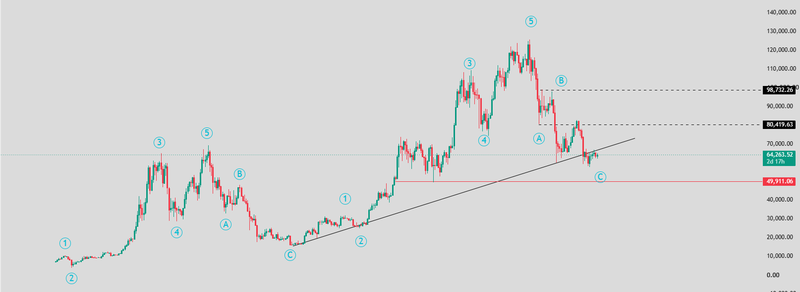
Source: Trading view
Why traders keep watching October and November
Bitcoin has historically performed well during the final quarter of the year, particularly in October and November.
Part of that tendency is seasonal, but part of it is psychological. After extended summer consolidation, markets often become more sensitive to new catalysts, especially if positioning has already been reduced and weaker holders have exited.
That is why some traders view the current period less as a confirmed bear market and more as a potential transition phase. The argument is that if selling pressure exhausts itself during August and September, a positive catalyst could have a larger impact than it would during a crowded euphoric rally.
Is the CLARITY Act really the catalyst?
It could become an important catalyst for the crypto market but calling it the catalyst is probably going too far. For Bitcoin to move into a sustained new uptrend, traders are still watching a much broader set of forces. Federal Reserve policy and overall liquidity conditions remain critical, as they continue to shape risk appetite across global markets. Spot Bitcoin ETF flows are another key factor because they provide a direct measure of institutional demand.
Investors are also paying close attention to corporate and sovereign buying, the growth of stablecoin activity, and the wider direction of US crypto regulation, of which the CLARITY Act is only one piece. The bill matters because it has the potential to influence investor psychology. A credible move toward clearer US regulation could help shift sentiment from caution to confidence after years of uncertainty around how digital assets will be treated by regulators.


