Help

US Treasuries face a 3% inflation trap as the stock-bond hedge breaks down
Inflation above 3% may be changing the role of Treasuries from an equity hedge into another source of portfolio risk, with potentially major consequences for long-term bond demand.

The historical stock-bond relationship tends to change when the 10-year Treasury yield rises above roughly 5.25% to 5.50%.
A similar regime shift appears when core PCE inflation moves above about 3%, with stocks and Treasuries becoming more likely to fall together.
That threatens the diversification logic behind 60/40 portfolios and risk-parity strategies, which collectively hold an estimated $1 trillion to $1.5 trillion of Treasuries.
Risk-parity strategies have already reduced their sensitivity to Treasuries to around 15-year lows, suggesting investors may be adjusting to a structural change.
Weaker hedging demand could reduce Treasury liquidity, raise the term premium and keep long-term yields higher.
The Treasury market may be facing more than a temporary yield shock
The most important question facing the US Treasury market may no longer be how high yields rise. It is whether Treasuries still perform the role investors have relied on for much of the past quarter-century.
For most of the period between 2000 and 2020, stocks and government bonds tended to move in opposite directions. When equities fell because growth expectations deteriorated, Treasury prices frequently rose as investors sought safety and anticipated lower interest rates. That negative correlation turned bonds into one of the most effective hedges available to multi-asset portfolios.
The relationship looks increasingly unstable.
Historically, once the 10-year Treasury yield moves above roughly 5.25% to 5.50%, the correlation between stocks and bonds has tended to turn positive. In that environment, equities and Treasuries can lose value simultaneously.
The underlying driver may not be the level of yields itself. The deeper explanation appears to be inflation.
The real threshold may be 3% core PCE inflation
A similar dividing line appears when looking at core PCE inflation, the Federal Reserve's preferred underlying inflation measure.
Historically, the stock-bond correlation has been overwhelmingly positive when core PCE inflation is above roughly 3%.
That matters because 3% may represent more than an arbitrary number on an inflation chart. It may be the point at which inflation begins behaving differently.
When inflation is low, investors, households and businesses tend to treat individual price increases as temporary noise. A sudden increase in petrol, food or rent does not necessarily change long-term expectations because people assume broader inflation will eventually return to normal.
Once inflation becomes persistently high enough, behavior changes.
Businesses become more attentive to costs. Workers pay greater attention to real wages. Consumers change purchasing decisions. Companies become more willing to pass cost increases through to prices. Wage negotiations increasingly reference recent inflation.
The inflation process then becomes more persistent because expectations begin responding to inflation itself.
That is the central problem around the 3% threshold.
Why inflation becomes harder to control above 3%
Research on previous US inflation episodes suggests the relationship between economic pressure and inflation is nonlinear.
When unemployment falls sufficiently below the level associated with stable inflation, price pressures can accelerate disproportionately. A Federal Reserve paper published in 2016 argued that US history offers little evidence that a stable inflation regime can be maintained for long at an average level materially above 3%.
There is also an important difference between low and high inflation shocks.
When underlying inflation is below roughly 2%, temporary shocks are more likely to reverse. A rise in one category can fade without materially affecting broader pricing behavior.
In a high-inflation environment, shocks are more likely to accumulate.
The economy has experienced several major price shocks in recent years, from the pandemic and supply-chain disruptions to geopolitical conflicts and energy-market disturbances. When underlying inflation is already elevated, every additional shock has a greater chance of reinforcing the previous one rather than disappearing independently.
The result can be an inflation process that is both more persistent and more volatile.
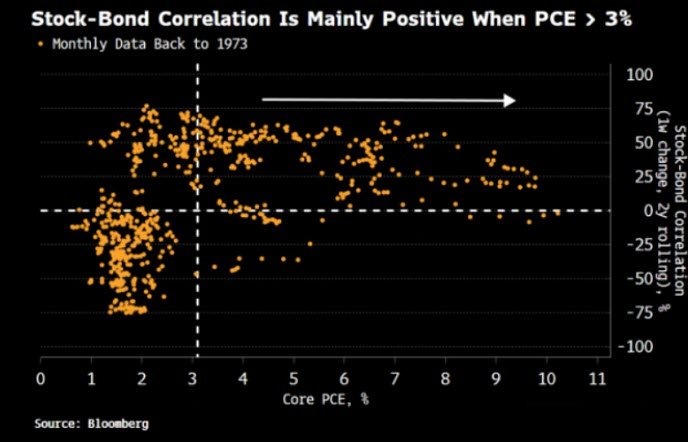
Source: Bloomberg
Inflation becomes more dangerous when people start paying attention to it
One explanation for the importance of the 3% threshold comes from behavioral economics.
Research into inflation attention found that internet searches related to inflation rise sharply once headline CPI reaches roughly 3.5%, approximately consistent with core PCE near 3% based on the historical relationship between the two measures.
That shift in attention can matter economically.
When inflation is 1.5% or 2%, most households do not constantly monitor it. Businesses may not change prices frequently, and employees may not frame wage negotiations around expected inflation.
When inflation rises toward 3% to 4% and remains there, it becomes visible.
Consumers notice grocery bills. Workers notice purchasing power. Companies notice transportation, energy and wage costs. Those observations begin affecting future decisions.
Inflation expectations can then become tied more closely to recent inflation, creating a feedback mechanism that makes price stability harder to restore.
Why higher inflation changes the stock-bond relationship
The connection to markets follows from monetary policy.
When inflation is low and growth deteriorates, the Federal Reserve normally has considerable room to cut interest rates. Investors anticipate those cuts, Treasury yields decline and bond prices rise.
That is precisely why bonds historically protected portfolios during equity selloffs.
Persistently high inflation restricts that mechanism.
If growth weakens while inflation remains above 3%, the Fed cannot automatically respond with aggressive rate cuts. Policymakers may have to tolerate economic weakness because easing monetary policy too quickly could reignite inflation.
Bonds therefore provide less protection when stocks fall.
A recession scare that would once have produced a powerful Treasury rally may instead generate only a modest decline in yields, particularly if investors remain worried about inflation.
As that protection disappears, the stock-bond correlation rises.
Why 5.25% on the 10-year Treasury is not an arbitrary level
The historical relationship between inflation and yields helps explain why the stock-bond correlation appears to shift when the 10-year yield approaches 5.25%.
Periods when core PCE has been around or above 3% have often coincided with 10-year Treasury yields near that level.
The yield threshold may therefore be an observable symptom of the underlying inflation regime rather than the cause of the correlation shift.
A 5.25% Treasury yield signals that investors are demanding substantial compensation for inflation, duration risk and uncertainty over the future path of monetary policy.
The higher yield itself then begins affecting portfolio construction.
If Treasuries no longer rally reliably when equities decline, investors have less reason to hold them solely for diversification.
That is where the feedback loop begins.
The 60/40 portfolio faces a structural challenge
Traditional 60/40 portfolios are built on the assumption that stocks generate long-term growth while bonds stabilize returns during periods of equity weakness.
That relationship worked exceptionally well when inflation was low and central banks had substantial room to ease policy during downturns.
A persistently positive stock-bond correlation weakens the model.
If equities fall 10% and Treasuries also decline because inflation remains elevated, the bond allocation is no longer cushioning the portfolio in the way investors expected.
This does not make bonds useless. Treasuries still provide income, liquidity and high-quality collateral.
But the reason for holding them changes.
Investors may demand more yield because they are no longer receiving the same diversification benefit.
That matters because traditional balanced portfolios represent a significant source of structural Treasury demand.
Risk-parity funds may already be adapting
The shift is particularly important for risk-parity strategies.
These portfolios allocate capital based on the risk contribution of different assets and often use significant Treasury exposure to balance the greater volatility of equities.
The strategy works best when government bonds diversify equity risk.
Estimates suggest 60/40 and risk-parity strategies together may hold around $1 trillion to $1.5 trillion of Treasuries, making their behavior relevant for the broader market.
Evidence suggests risk-parity funds are already becoming less dependent on US government bonds. Their sensitivity to Treasury returns has fallen toward 15-year lows, even as the stock-bond correlation has risen again.
That suggests portfolio managers may increasingly view the change in market behavior as structural rather than temporary.
Why weaker Treasury demand can become self-reinforcing
This is where the inflation problem can turn into a Treasury demand problem.
Suppose investors conclude that government bonds no longer provide reliable protection against equity losses. They reduce Treasury allocations and search for alternative hedges.
Lower structural demand makes the Treasury market more dependent on price-sensitive buyers.
Those investors require additional compensation.
The result is a higher term premium, the extra return investors demand for holding long-duration bonds instead of repeatedly owning short-term securities.
Higher term premiums push long-term Treasury yields upward.
Higher yields can then reinforce the same inflationary regime associated with positive stock-bond correlation, making investors even less enthusiastic about using Treasuries as portfolio hedges.
What begins as an inflation problem therefore creates a portfolio-allocation problem, which creates a demand problem, which can keep yields elevated.
Treasury yields could stay high even without another Fed hike
This mechanism also explains why the Federal Reserve does not need to raise rates repeatedly for long-term yields to remain elevated.
The 10-year Treasury yield consists of more than expectations for future Fed policy. It also reflects inflation expectations and the term premium investors demand for locking up money for a decade.
If inflation uncertainty remains high and structural Treasury demand weakens, long-term yields can remain elevated even if the Fed eventually stops tightening.
That would have major implications for the economy.
Mortgage rates would remain high. Corporate borrowing costs would stay elevated. Equity valuations would face continued pressure from higher discount rates. Government interest expenses would rise as debt is refinanced.
The Treasury market could therefore continue tightening financial conditions without additional action from the central bank.
Inflation volatility may matter as much as average inflation
Another important distinction is between the level of inflation and uncertainty around inflation.
Investors can manage moderately high inflation more easily if they believe it will remain stable.
Volatile inflation is harder.
A bond investor purchasing a 10-year Treasury must estimate what inflation will look like over a decade. If the range of possible outcomes widens substantially, the investor will demand additional compensation.
That increases the term premium.
This is why repeated supply shocks can be particularly damaging to bonds. Even if each shock eventually fades, a sequence of pandemic disruptions, geopolitical conflicts and energy shocks can convince investors that inflation itself has become less predictable.
The consequence can be structurally higher long-term yields.
A return below 3% inflation could change the equation
The negative Treasury outlook is not irreversible.
If core PCE falls decisively below 3% and remains there, inflation could gradually lose some of its influence over household and corporate behavior.
Expectations could become better anchored. The Fed would regain greater freedom to cut rates during economic weakness. Treasuries could recover some of their traditional role as an equity hedge.
The stock-bond correlation could then move lower again.
For bond investors, this means the inflation trend matters more than a single CPI or PCE release.
Markets need evidence that the economy has genuinely returned to a lower-inflation regime.
A few months below 3% would help, but a sustained period would provide much stronger evidence that the structural change is reversing.
Why the Treasury market’s 3% inflation trap matters
With core PCE again above 3% and its 12-month average still close to that threshold, the Treasury market remains vulnerable to a difficult feedback loop.
Persistent inflation limits the Fed's ability to rescue markets during downturns. That makes Treasuries less reliable as an equity hedge. Weaker diversification benefits reduce demand from 60/40 and risk-parity portfolios. Lower structural demand can raise the term premium and keep Treasury yields elevated.
Higher yields then reinforce the environment in which bonds and stocks are more likely to fall together.
This is why the debate around the 10-year Treasury yield moving above 5% should not focus only on whether bonds have become cheap enough to buy.
The more important question is what investors are buying them for.
If Treasuries still provide yield, safety and liquidity but no longer provide reliable protection when equities fall, the market may require a permanently higher yield to compensate for the lost diversification benefit.
For a US government that must continue selling enormous quantities of debt, that would be a significant structural change.
The escape route is straightforward in theory and difficult in practice: core inflation needs to move convincingly below 3% and stay there long enough for investors to trust Treasuries as a hedge again.