Help
Help 
A 5.2% Treasury yield is complicating Trump tax-cut story
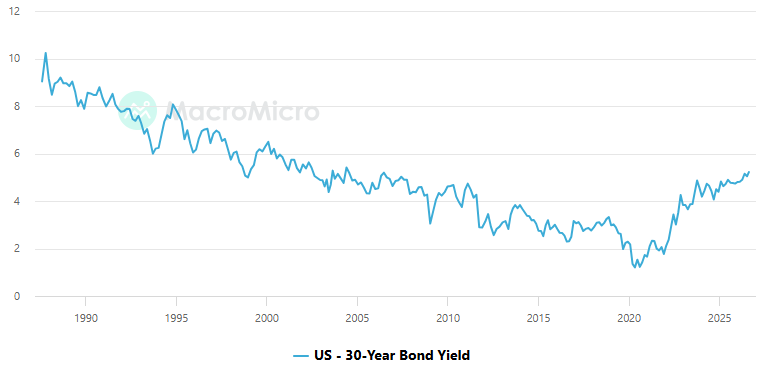
Washington sold $25 billion of 30-year Treasuries at a yield of 5.216%, the highest long-term borrowing cost since 2001. That is not just a technical milestone for the bond market. It is a reminder that the cost of capital across the entire financial system is moving higher at the same time policymakers are discussing measures designed to support investment and risk-taking.

Washington sold $25 billions of 30-year Treasuries at a yield of 5.216%.
When the Treasury can borrow at 5.216% for 30 years, every corporate borrower must compete with that benchmark.
Lower capital gains taxes could support risk appetite, encourage investment and help sustain equity valuations.
Why the bond market is demanding more
The move in long-term yields is not simply a reaction to one auction. Investors are looking ahead to the possibility of larger federal deficits and heavier debt issuance if tax cuts are financed through more borrowing rather than spending reductions.
When the supply of government debt rises, investors demand greater compensation, especially when inflation risks have not fully disappeared. Energy prices remain volatile, fiscal policy is becoming more expansionary, and election-year uncertainty is making investors less confident about the long-term direction of public finances.
This is why the phrase “bond vigilantes” has returned to market discussions. The point is not that investors are trying to punish the government; it is that they are becoming less willing to lock up money for decades at yields they no longer consider sufficient compensation for inflation, fiscal and policy risk.
The money may not flow where equity bulls expect
Supporters of capital gains tax cuts argue that lower taxes encourage investors to realize gains, freeing up capital that can be reinvested in productive assets. Historically, that argument has merit.
30-year Treasury yielding more than 5% offers something that has been largely absent for years: a relatively high nominal return by the U.S. government. For pension funds, insurance companies, retires and many institutional investors, that changes the opportunity set.
Consider an investor selling appreciated real estate or stocks under a lower capital gains rate. When Treasury yields were 1–2%, the incentive to move that money back into equities was overwhelming. At 5% plus, the choice becomes far less obvious.
Some of the cash may still flow into AI and technology stocks, but a larger part of the shares could be attracted to long-term Treasuries because they now offer both income and safety.
Source: MacroMicro
Higher Treasury yields raise the hurdle for the AI boom
When the Treasury can borrow for 30 years at more than 5%, every corporate borrower must compete with that benchmark. Companies issuing debt to fund data centers, semiconductor purchases, acquisitions or infrastructure projects will need to offer investors a higher return than the government. For the largest hyperscalers, this is not an immediate funding problem. Microsoft, Amazon, Alphabet and Meta still generate enormous cash flows.
The pressure is more subtle
Every additional percentage point in borrowing costs reduces the expected return on future projects. A data center that looked highly attractive when long-term capital cost 3% looks considerably less attractive when the benchmark is above 5%.
This is where the bond market connects directly to the AI debate. The rally has been supported not only by expectations of extraordinary future earnings, but also by the assumption that capital would remain relatively abundant and reasonably affordable. Rising Treasury yields challenge that assumption.
Why 2026 is being compared with 1981 and 2018
The current bond-market selloff is being viewed through the lens of two earlier periods: 1981 and 2018. The comparison is not that the economy is repeating either episode exactly. Rather, investors see a familiar mix of tax-cut proposals, rising deficits and tighter financial conditions appearing at the same time.
In 1981, the Reagan administration introduced major tax cuts while inflation and interest rates were still elevated. In 2018, the Trump administration’s tax reductions expanded fiscal deficits even though the economy was already growing and the Federal Reserve was continuing to normalize policy.
Today’s situation contains elements of both episodes
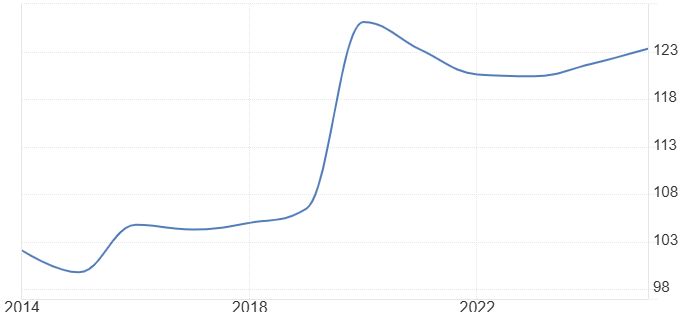
2017 tax cuts and adding new capital-gains exemptions would likely require additional borrowing if they were not accompanied by meaningful spending reductions. The crucial difference is the starting point of the federal balance sheet. In 1981, U.S. debt was roughly 32% of GDP. Today, it is above 123% GDP.
That changes how investors interpret fiscal policy
Current environment as a collision between 1981-style inflation concerns and 2018-style deficit worries. The bond market is demanding a higher premium for holding long-term Treasuries because investors are becoming less confident that borrowing can keep expanding indefinitely without putting additional pressure on inflation, interest rates and the long-term sustainability of public finances.
Source: Trading economics