Help
Help 
August CPI could decide whether the Fed hikes in September
Friday’s CPI report may be the final piece of data separating a September Fed hold from another rate hike.
August headline CPI is expected to rise 0.4% month on month and 3.4% year on year.
Core CPI is forecast at 0.2% monthly and 2.4% annually.
The Fed meets on September 15-16, making CPI the final major inflation report before the decision.
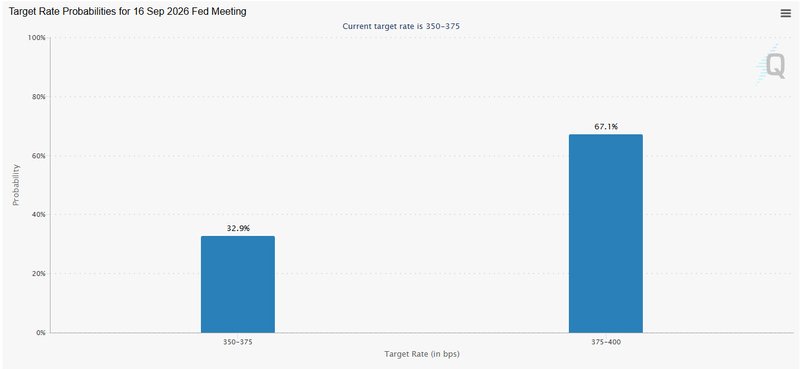
Futures markets have recently put the probability of a 25-basis-point hike between roughly 65% and more than 70% as expectations swing with incoming data.
A core monthly reading around 0.3% could leave the decision finely balanced, while 0.4% would strengthen the case for tightening significantly.
August CPI has become the Fed’s most important data point
Friday’s U.S. inflation report arrives at an unusually sensitive moment for the Federal Reserve.
The August consumer price index will be released at 8:30 a.m. ET, just days before policymakers meet on September 15-16 to decide whether to keep rates unchanged or resume tightening.

Source: Bloomberg
Consensus expectations point to a relatively sharp increase in headline prices but a more moderate underlying reading.
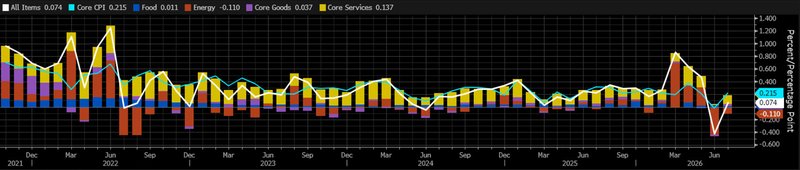
Headline CPI is forecast to rise 0.4% from July, leaving annual inflation at 3.4%. Core CPI, which excludes food and energy, is expected to increase 0.2% on the month and 2.4% from a year earlier.
Normally, one inflation report would be only one piece of a much larger policy picture.
This time, the margin between a hold and a hike appears narrow enough that a few hundredths of a percentage point could materially change the outcome.
The Fed is heading into the meeting without a clear consensus
Interest-rate expectations have shifted repeatedly in recent weeks.
Futures markets have moved from leaning toward no change to placing the probability of a quarter-point increase somewhere between roughly 65% and above 70%, depending on the timing of the latest inflation and market data.
Source: CME Group
That volatility tells its own story.
Investors do not see September as a settled decision. They see a central bank that remains deeply concerned about inflation but is also confronting signs of softer economic activity.
The August CPI report may therefore determine which side of the Fed’s mandate receives greater weight next week.
A benign core reading would provide policymakers with an argument for patience.
A stronger print could remove much of that flexibility.
Core CPI may matter more than the headline number
The headline CPI figure is expected to accelerate to 0.4% monthly, but part of that increase is likely to reflect energy and other volatile components.
Source: Bloomberg
That means the core number will probably carry more weight.
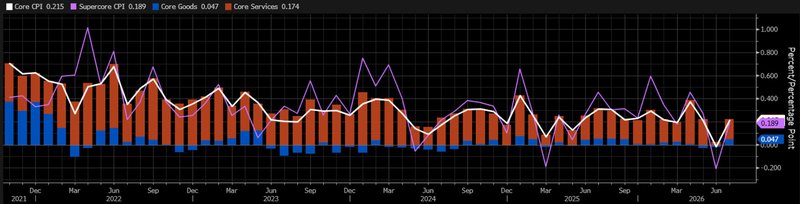
A 0.2% monthly core reading would support the argument that underlying inflation is still cooling gradually, even if headline inflation remains uncomfortable.
Source: Bloomberg
A 0.4% core increase, on the other hand, would be difficult for the Fed to dismiss. It would suggest broader inflation pressures remain strong enough to justify additional tightening.
The hardest outcome for markets may be 0.3%.
That would neither clearly confirm disinflation nor provide an overwhelming case for a hike.
At that point, investors could find themselves debating not only the rounded headline figure but the underlying unrounded number.
A core increase of 0.251% and one of 0.349% would both appear as 0.3% after rounding, yet they would convey materially different inflation momentum.
It is an unusually narrow distinction for a decision affecting the world’s most important interest rate.
Why CPI matters even though the Fed prefers PCE inflation
The Fed formally targets inflation using the personal consumption expenditures price index, not CPI.
But many components of the PCE report are derived from data contained in CPI and producer-price statistics.
That makes Friday’s report highly informative for policymakers trying to estimate the next PCE reading before it is officially released at the end of the month.
The August producer price report has already pushed markets toward a higher probability of a September hike.
CPI now completes much of that inflation picture.
If the CPI components feeding into core PCE are stronger than expected, policymakers could enter next week’s meeting with considerably less confidence that inflation is continuing to moderate.
Warsh’s communication strategy is making the data more powerful
The stakes are also higher because Fed Chair Kevin Warsh has deliberately tried to reduce reliance on explicit forward guidance.
Warsh has argued that monetary policy should respond to economic trends rather than individual data points and has resisted giving markets a clear map of future interest-rate decisions.
In principle, that approach should reduce the importance of any one report.
In practice, the opposite has happened.
Because the Fed’s reaction function remains unclear, investors are placing even more weight on individual releases in an attempt to infer how policymakers will respond.
That is why August CPI has become so important.
Markets understand the data.
What they understand less clearly is how much inflation is enough to make Warsh and the FOMC vote for another hike.
A 0.2% core reading could keep the Fed on hold
If core CPI rises 0.2%, the Fed would have a credible argument for waiting.
Underlying monthly inflation at that pace would be consistent with continued gradual disinflation, particularly if the labor market shows additional signs of cooling.
Policymakers could argue that interest rates are already high enough to keep pressure on demand and that another hike risks tightening unnecessarily before the full effect of existing policy has worked through the economy.
Such an outcome would not eliminate the possibility of a later rate increase.
It could simply delay it.
That distinction matters because markets have already been pricing a substantial probability of additional tightening before year-end even when September itself remained uncertain.
A hotter reading could make a hike difficult to avoid
The situation changes considerably if core inflation comes in at 0.4% or higher.
A reading at that level would suggest price pressures are broader and more persistent than policymakers would like.
It would also reinforce the argument that the recent pause in tightening has not produced enough progress toward the Fed’s 2% inflation objective.
Several policymakers have already signaled that a sufficiently strong inflation number could justify another increase.
If labor conditions remain relatively firm at the same time, the hurdle for another hold would become much higher.
The question would then shift from whether the Fed should hike to how it could justify not doing so.
Energy prices create a problem beyond the August data
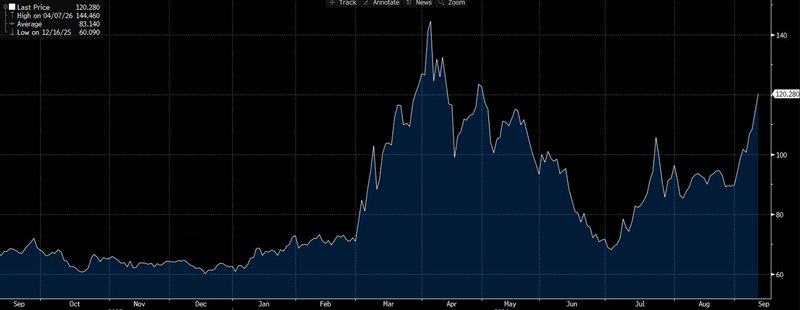
The CPI report also arrives as energy markets create a new inflation risk.
Oil prices have risen sharply amid renewed geopolitical tensions, adding pressure to gasoline and transportation costs.
Most of that move will not be fully visible in August CPI.
But the Fed cannot ignore it simply because it falls outside the reporting period.
Monetary policy is forward-looking. If policymakers believe higher energy prices will lift future headline inflation or eventually feed through into broader goods and services prices, the outlook itself becomes more hawkish.
This means even a reasonably soft August CPI print may not completely settle the September debate.
A sharp deterioration in the energy outlook could still push policymakers toward tighter policy.
Source: Bloomberg
The Fed is trying to judge whether inflation is sticky or merely noisy
The core challenge is separating persistent inflation from temporary shocks.
Tariffs, energy prices and other supply-driven factors can lift headline inflation without necessarily creating the kind of sustained demand pressure that monetary policy is designed to combat.
But the Fed cannot assume every price increase is temporary.
Inflation has remained above the 2% target for years, and repeated upside surprises increase the risk that businesses and households begin adapting to higher inflation as a permanent feature.
That is why the composition of Friday’s report will matter as much as the headline number.
Housing, services and other persistent categories could carry more policy significance than volatile energy components.
A broad acceleration would be considerably more concerning than a headline increase concentrated in a handful of categories.
Bonds, the dollar and gold could all react sharply
The market response is likely to extend well beyond short-term rate futures.
A hotter-than-expected core CPI reading would probably push Treasury yields higher as investors price a greater probability of a September hike and potentially a higher path for rates beyond that meeting.
The dollar could benefit from the same repricing.
Gold would face a more difficult environment if real yields and the dollar rise simultaneously, although persistent inflation could continue supporting demand for the metal as a longer-term hedge.
A softer CPI print would likely produce the opposite initial reaction: lower Treasury yields, reduced September hike expectations and pressure on the dollar.
With the policy decision only days away, markets may respond more aggressively than they normally would to relatively small deviations from forecasts.
Why Friday’s CPI could decide the September Fed meeting
The Federal Reserve has spent months arguing that policy should respond to trends rather than isolated economic releases.
Yet the September decision has evolved into one where Friday’s CPI number could carry extraordinary weight.
The consensus is straightforward: 0.4% headline inflation, 0.2% core inflation, 3.4% headline year on year and 2.4% core.
The implications are less straightforward.
A core reading near 0.2% would strengthen the case for giving disinflation more time. A 0.4% increase would make another rate hike significantly harder to avoid.
Anything around 0.3% could leave policymakers debating fractions of a percentage point only days before they vote.
That may be uncomfortable for a Fed chair who has argued that monetary policy should focus on broader trends.
But with markets already placing a high probability on a September hike, inflation still above target and energy prices rising, Friday’s CPI report has become the last major obstacle between the Fed and its next decision.