Help
Help 
China’s Golden Week puts physical gold demand back in focus
China’s Golden Week could provide an important test for physical gold demand after the recent sharp correction in prices.

Gold plunged to $4,110.55/oz on Monday, its lowest level since early August, before recovering toward $4,140 on Tuesday.
US 10-year Treasury yields climbed above 5.24%, their highest level since 2007, while the dollar remained close to a two-month high.
The $4,100 area is now the immediate focus, with the broader $4,000-$3,943 zone becoming the next major support if selling resumes.
China’s Golden Week begins on 1 October and could provide an important test of physical gold demand after weak jewellery consumption earlier this year.
Gold attempts to recover after plunge to seven-week low
Gold steadied on Tuesday after suffering one of its sharpest daily declines in recent months, with rising US Treasury yields and renewed expectations for Federal Reserve rate increases putting significant pressure on the precious metal.
Spot gold fell as much as 4% on Monday and touched $4,110.55 per ounce, its lowest level since 5 August. Prices recovered modestly on Tuesday, rising toward $4,140, although the rebound has so far recovered only a small portion of the previous session's losses.
The decline represents a significant deterioration from Friday's close around $4,285 and has pushed gold well below several technical levels that had previously provided support.
Monday's move also extended the broader correction that began after gold reached its 2026 peak of around $5,595 per ounce.
Treasury yields become the dominant pressure on gold
The strongest pressure continues to come from the US bond market.
The benchmark 10-year Treasury yield climbed to around 5.24% on Monday and remained close to 5.25% on Tuesday, reaching levels last seen in 2007. The 30-year yield has also moved toward 5.56%, around its highest level since 2002.
This marks a further acceleration from the 5.16% level recorded at the end of last week.
The move is particularly important for gold because rising yields increase the opportunity cost of holding a non-yielding asset. Expectations for additional Federal Reserve tightening have strengthened at the same time, adding another layer of pressure.
Markets are now assigning around a 70% probability to another Fed rate increase in October and a 96% probability to a hike by December.
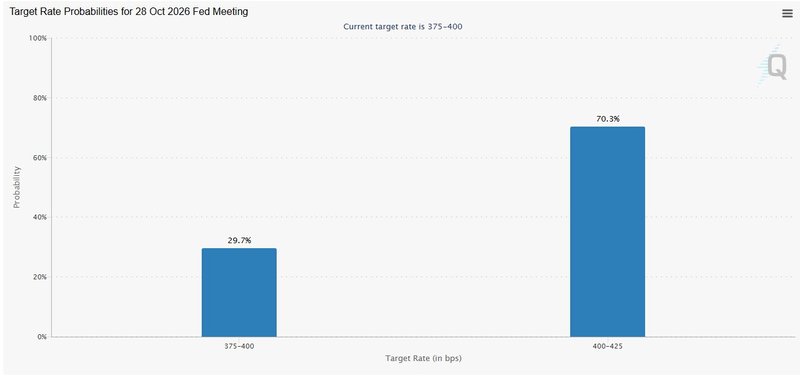
Source: CME Group
Oil prices have contributed to that repricing. Persistent US-Iran tensions have kept crude elevated, reinforcing concerns that higher energy costs could feed through into inflation and force the Fed to maintain a more restrictive policy stance.
The dollar has benefited from the same dynamic and remains close to a two-month high, creating an additional headwind for dollar-denominated gold.
Investor positioning adds pressure to the selloff
The recent decline has also been accompanied by softer investor positioning.
Global gold ETFs recorded their first weekly outflow since mid-July last week, interrupting a period of relatively steady investment demand.
Futures positioning has weakened as well.
Managed-money net long exposure fell to approximately 426 tonnes in the week ending 22 September, down from 434 tonnes one week earlier and more than 470 tonnes at the beginning of September.
The reduction is significant because gold is now experiencing pressure from several directions simultaneously: rising nominal yields, higher real yields, a stronger dollar and declining speculative exposure.
Options positioning has also become more defensive over the near term, suggesting investors have become increasingly cautious following the recent correction.
China’s Golden Week could offer the next demand test
Attention will also turn toward China as Golden Week begins on 1 October.
The National Day holiday traditionally marks the beginning of China's peak gold-buying season, when jewellery demand strengthens, retailers rebuild inventories and local premiums can rise.
Chinese gold jewellery demand has struggled during 2026 as historically high prices and weak consumer confidence discouraged purchases.
The recent correction could therefore become particularly important.
Gold is now trading almost $1,500 below its 2026 high, and the combination of lower prices and holiday spending could encourage some previously postponed jewellery purchases.
The strength of Chinese physical demand over the coming weeks may offer an early indication of whether lower prices are beginning to attract consumers again as the market enters the traditionally stronger year-end period.
US data could decide whether $4,100 holds
The immediate direction for gold is likely to remain closely tied to US interest-rate expectations.
Markets will focus first on the August PCE inflation report, followed by September employment data later this week.
Core PCE inflation is expected to remain around 3.3% year-on-year, while non-farm payroll growth is forecast to slow to approximately 90,000 from 162,000 previously. The unemployment rate is expected to remain near 4.1%.
These releases arrive after recent US economic data continued to show considerable resilience. The S&P Global Composite PMI reached a 62-month high of 58.4 in September, while weekly initial jobless claims fell to 197,000.
Another strong inflation or employment surprise could reinforce expectations for further Fed tightening and keep Treasury yields elevated.
For gold, the market has therefore moved into a different phase following Monday's selloff.
The previous battle around $4,231 has already been decided. Attention has shifted toward whether buyers can defend the $4,100 area and rebuild momentum above $4,200, or whether persistent pressure from US yields opens the way toward the psychologically important $4,000 level.