Help
Gold price forecast: why inflation and rising yields are weighing on gold
Higher energy prices are keeping inflation concerns alive, but gold’s weakness also reflects the returns available elsewhere, the behaviour of futures investors and the reasons behind rising Treasury yields.

Inflation can pressure gold when investors expect monetary policy to remain restrictive.
Real yields help explain the competition between bullion and interest-bearing assets.
ETF buying and falling futures exposure suggests investors are responding differently to the same risks.
The outlook could change if higher yields increasingly reflect concerns about government finances.
Why rising inflation has offered gold little protection
Gold should have plenty to respond to. Energy costs are elevated, geopolitical uncertainty persists and investors face renewed questions about purchasing power. Yet bullion has struggled, falling toward $4,085 as higher oil prices reinforced expectations of prolonged monetary restraint.
The tension comes from the way inflation reaches the gold market
Higher prices can encourage investors to protect their wealth. They can also persuade central banks to keep interest rates elevated, improving the income available on competing assets. Gold receives support from the first response and pressure from the second.
The oil price is nearly $100 therefore tells only part of the story. What matters is how long investors expecting the shock to last, how far it spreads into other prices and how forcefully policymakers respond.
Gold can remain under pressure while inflation rises if investors believe holding interest-bearing assets offers a better way to preserve purchasing power.
A Fed pause may offer less relief than expected
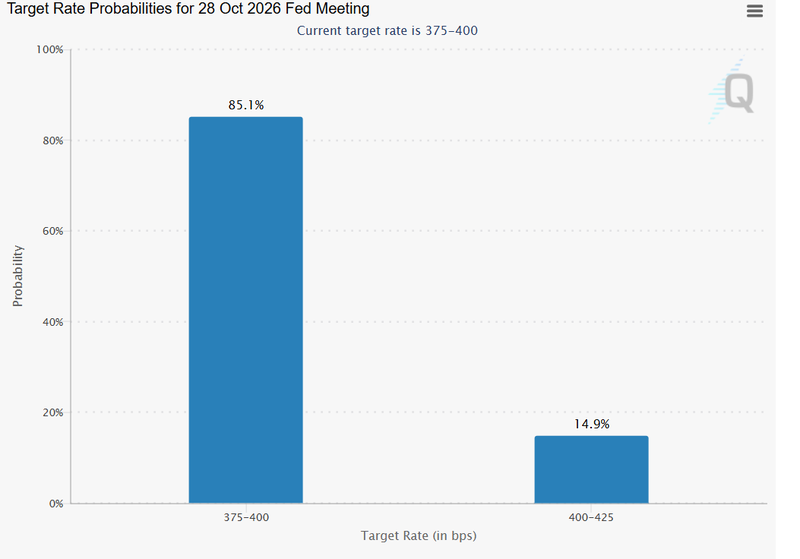
That helps explain why expectations of an October pause have provided limited reassurance.
Current probability is roughly 15% to an increase at the upcoming meeting, while the probability of a December hike stood at 91%. The market was largely pricing a delay in tightening.
For gold, the difference matters. Leaving rates unchanged for one meeting does little to reduce the cost of holding bullion if investors still expect restrictive policy to continue.
The more consequential change would be evidence that inflation is easing enough to alter the expected path of rates. Until then, a pause can give policymakers time to assess the data without giving investors much reason to abandon the returns available in interest-bearing assets.
Source: CME Group
The yield that matters is the return after inflation
Even so, describing every increase in Treasury yields as negative for gold misses an important distinction.
Investors care about what their money will buy when it is returned. A higher nominal yield becomes more attractive when it represents an improvement in the expected return after inflation. If inflation expectations rise alongside it, that improvement may be much smaller.
This is why real yields are central to the analysis
They help measure the return investors give up when they hold an asset that pays no income. PIMCO identifies real yields as a major influence on gold valuation, while recognizing that other forces also affect prices.
The question is therefore how much of the rise in bond yields reflects stronger real returns, and how much compensation reflects for inflation and uncertainty. Those explanations can lead to different conclusions about gold.
The dollar adds another layer of pressure
A stronger dollar raises the cost of bullion for buyers using other currencies. When it strengthens alongside Treasury yields, gold faces pressure through both its purchase price abroad and the income investors can earn elsewhere.
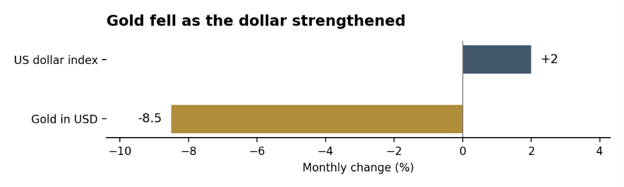
September showed that combination clearly. Gold declined 8.5%, the dollar index gained 2% and the US 10-year Treasury yield increased by 53 basis points to 5.3%. The World Gold Council identified yields and dollar strength as major contributors to the monthly decline.
Source: World Gold Council
Investors have not all been leaving gold
The selling has another complication: investment demand has remained substantial in parts of the market.
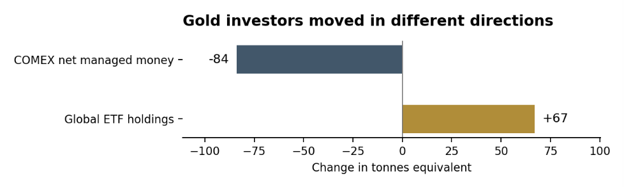
Global gold ETF holdings increased by 67 tonnes in September, even as COMEX net managed-money positioning fell by 84 tonnes. The World Gold Council suggests futures liquidation contributed to the price decline.
Divergence matters because it challenges the idea that falling prices necessarily represent a broad loss of confidence in gold.
Investors adding physical exposure through ETFs can coexist with futures participants reducing their positions. Their decisions may reflect different time horizons, financing conditions and tolerance for short-term losses.
Those measures cannot simply be added together to calculate net demand. They do, however, reveal a market in which buying in one segment was insufficient to prevent prices falling. Updated positioning will be needed to establish whether that pattern has continued through October.
Source: World Gold Council
Higher yields can eventually carry a different message
There is a limit to treating higher government bond yields as evidence that gold has become less attractive.
Investors may demand more income because real returns are improving. They may also demand it because they are less comfortable with the borrower’s finances or the future purchasing power of their repayment.
The World Gold Council has suggested that fiscal concerns could help explain unusually strong UK gold ETF demand. That interpretation remains tentative, but it raises a relevant question about what investors believe rising yields are signalling.
If higher yields increasingly reflect concerns about government finances, some investors could become more interested in gold despite the income available on bonds. The same yield increase could attract one buyer while making another seek diversification.
This is a possible change in the market’s interpretation, rather than evidence that a reversal is already underway.
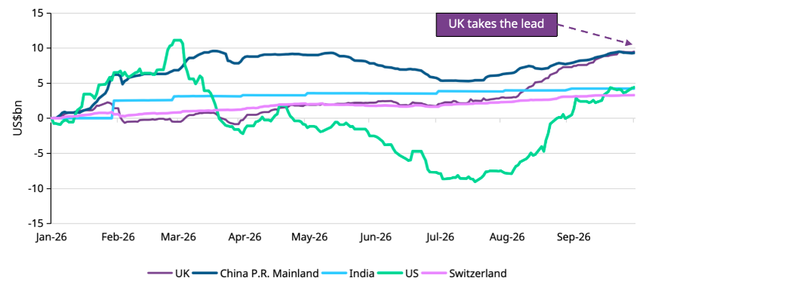
Source: Bloomberg
What would change the pressure on gold?
Lower oil prices would ease one source of inflation concern. Whether that produces lasting relief for gold would depend on what follows.
A retreat in real yields would reduce the income investors sacrifice by holding bullion. A softer dollar would ease the currency pressure. More stable futures positioning would suggest that one source of selling was losing force.
Alternatively, gold could find support if investors became less convinced that elevated interest rates would deliver lasting monetary stability.
For now, the weakness reflects a difficult balance between demand for protection and the returns available elsewhere. Oil influences that balance, but it does not determine it alone.
Gold’s direction will depend increasingly on whether investors see higher yields as sufficient compensation for the risks ahead or as a reason to seek protection from them