Help
Help 
Iran talks resume: oil market shift focus away from conflict
Oil prices have retreated sharply after President Donald Trump said the United States would hold off on a planned strike against Iran, citing what he described as agreed "parameters" for a rapid diplomatic deal. The announcement eased fears of an immediate military escalation, prompting traders to unwind much of the geopolitical premium that had been built into crude prices during recent weeks.

Oil has fallen roughly 15%, sliding back toward the $80 a barrel level.
Trump said the U.S. would delay military action while negotiations with Iran continue.
Lower U.S. oil imports suggest domestic supply conditions have also become less supportive for prices.
Markets are reassessing the risk
The recent rally in oil was built largely on uncertainty rather than actual supply disruptions. As tensions between Washington and Tehran escalated, investors began pricing in the possibility that the conflict could spread across the region, threatening shipping routes or disrupting exports from one of the world's most important energy-producing areas. Oil moved higher because markets were preparing for a potential shock, not because global supply had already tightened.
Trump's latest comments have changed that calculation
By indicating that diplomacy remains the preferred path for now, the immediate risk of a supply disruption has eased. That doesn't mean geopolitical tensions have disappeared, but it does suggest traders see a lower probability of an event severe enough to disrupt global oil flows in the near term. The reaction in crude prices reflects that shift in expectations more than any sudden change in physical supply.
A market driven by expectations
Oil is often one of the first assets to react when geopolitical risks increase because traders’ price in future possibilities long before they appear in official supply data.
The reverse is also true
Once the perceived risk begins to fade, prices tend to adjust quickly as investors unwind positions that were built to hedge against a worst-case scenario. That is exactly what has happened over recent sessions.
The roughly 15% decline suggests a large part of the geopolitical premium has now been removed from the market. Investors are no longer paying the same premium to protect against an immediate escalation, choosing instead to wait for clearer signals from the diplomatic process. For the time being, headlines alone may no longer be enough to drive another sustained rally unless negotiations deteriorate or supply is directly affected.
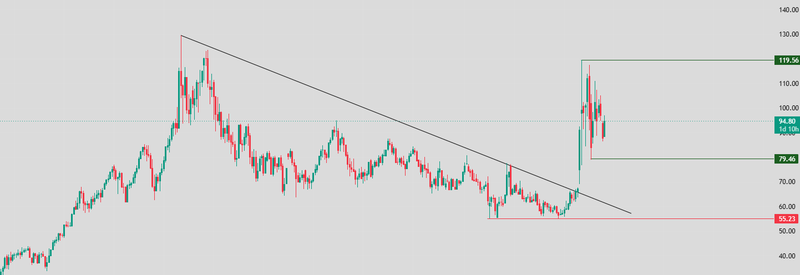
Source: Trading view
Fundamentals are back in focus
As geopolitical concerns ease, the market is returning to the fundamentals that typically drive oil prices over longer periods.
Recent data showed net U.S. oil imports fell to 3.961 million barrels per day in July, down from 4.984 million barrels per day in June. The decline points to a domestic market that appears better supplied than it did only a month earlier, reducing one of the factors that had supported higher prices.
On its own, the data are unlikely to dictate the direction of crude. Combined with easing geopolitical fears, however, they reinforce the view that the market is no longer facing the same level of immediate supply risk that investors were pricing just weeks ago. As a result, supply-and-demand fundamentals are beginning to carry more weight than geopolitical headlines.
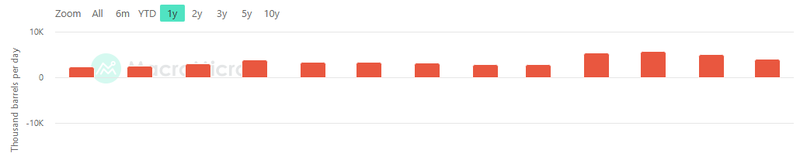
Source: MacroMicro
The market is shifting back to economics
Another noticeable shift is where investors are looking for the next catalyst. Only a few weeks ago, almost every move in crude was driven by developments in the Middle East. Today, markets are once again debating global growth, interest rates and fuel demand. That change matters because these factors tend to influence oil over a much longer period than geopolitical headlines.
If central banks keep borrowing costs elevated and economic activity continues to slow, demand expectations could soften, making it harder for crude to regain the highs seen during the recent rally. On the other hand, stronger global growth or a meaningful improvement in fuel consumption would provide a more durable source of support than a temporary geopolitical premium. In other words, the market is gradually shifting from pricing political risk to assessing the underlying balance between supply and demand.
Any setback in negotiations could quickly bring risk back into prices. For now, however, investors appear more interested in whether the global economy can support higher oil prices once the fear premium has faded.