Help
Help 
Why Japan 30-year bond yield matters more than the BoJ rate hike
Takaichi’s administration is pursuing an unusually ambitious investment strategy, with a long-term 370 trillion Yien roadmap covering 17 strategic industries, including AI and semiconductors. The government sees investment-led growth to raise productivity and strengthen Japan’s industrial base.
Japan’s public debt remains above 200% of GDP.
The IMF estimates that the effective interest rate on existing public debt was only around 0.7% last year.
Takaichi’s investment programme is designed to increase productive capacity in sectors such as AI.
Japan bond market is questioning fiscal expansion
Japan is pursuing fiscal expansion at the same moment that investors are becoming more sensitive to the cost of government borrowing.
Japan’s public debt remains above 200% of GDP, and although the debt ratio is expected to decline gradually under current assumptions, rising interest rates are changing the calculation at the margin.
Markets do not need to believe Japan is heading toward default to demand a higher yield. They only need to believe that future governments will have to borrow more, refinance at higher rates and compete more aggressively for domestic and foreign savings. That risk is now increasingly visible at the long end of the JGB curve.
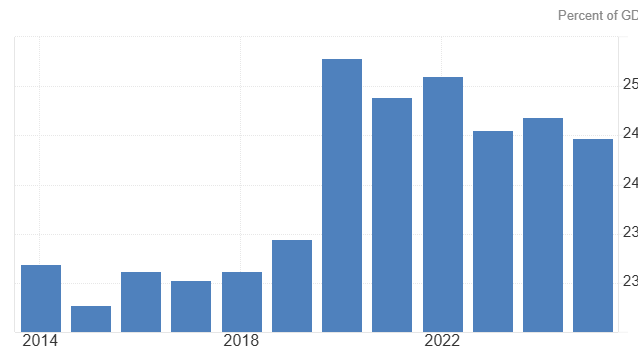
Source: Ministry of Finance, Japan
Why the 30-year yield matters more than the policy rate
The BOJ controls the overnight policy rate. It does not directly control the 30-year yield. That distinction is becoming critical.
A 25-basis-point rate increase to 1.25% is important because it signals that Japan is moving further away from the emergency monetary settings of the past. But the rise in ultra-long yields reflects something broader: investors are reassessing the long-term price of carrying Japanese fiscal and inflation risk.
The 30-year bond essentially asks a simple question
What return should an investor demand today to lend money to Japan for three decades? The answer is increasingly higher. That is the market's warning label on government spending.
The debt-servicing problem is real, but it will not arrive overnight
The sharp rise in long-term yields does not immediately translate into an equivalent jump in Japan’s interest bill. Japan benefits from a relatively long average maturity of government debt, around nine years, which slows the transmission of higher market yields into the budget. The IMF estimates that the effective interest rate on existing public debt was only around 0.7% last year. That buffer matters.
It means Japan has time to adjust. But time is not the same thing as immunity. If long-term yields remain elevated and newly issued debt gradually replaces older bonds carrying extremely low coupons, the government's average financing cost will rise.
That creates a potential feedback loop
Higher borrowing costs increase debt-service spending. Higher spending makes fiscal consolidation harder. Greater borrowing requirements increase bond supply. More supply can then require even higher yields. The process is slow. But once the market begins pricing it, it can become self-reinforcing.
Takaichi’s growth strategy could either solve the problem or deepen it
This is where the debate becomes more interesting than a simple “Japan debt is too high” argument. Takaichi’s investment programme is designed to increase productive capacity in sectors such as AI, semiconductors, energy and advanced technology.
If those investments successfully lift productivity, wages and nominal GDP, the higher growth rate could make Japan’s debt burden easier to manage.
That outcome is possible
The IMF itself expects Japan's debt ratio to decline over the coming years partly because nominal growth is expected to remain above the effective interest rate on government debt.
But the opposite outcome is also possible. If government spending raises demand without generating enough additional productive capacity, inflation and bond yields could rise faster than economic growth.
Then the policy becomes increasingly expensive. The bond market would effectively be asking whether Japan is investing to grow out of its debt problem or borrowing its way into a larger one.
The BOJ now faces an uncomfortable trade-off
The expected hike to 1.25% is significant, but the bigger question is what comes after it. Reuters polling suggest markets are increasingly expecting the BOJ to continue tightening, with the policy rate potentially reaching 1.75% by the second quarter of 2027.
That would represent a substantial shift for an economy that spent decades near zero. Higher rates could support the yen, reduce imported inflation and bring monetary policy closer to normal.
But they also make government financing more expensive
This creates tension between monetary normalization and fiscal expansion. The BOJ cannot ignore inflation simply because higher rates are uncomfortable for the government's budget.
Nor can it allow the bond market to become disorderly without considering financial stability. That is why the central bank's communication around the September decision may matter as much as the hike itself.
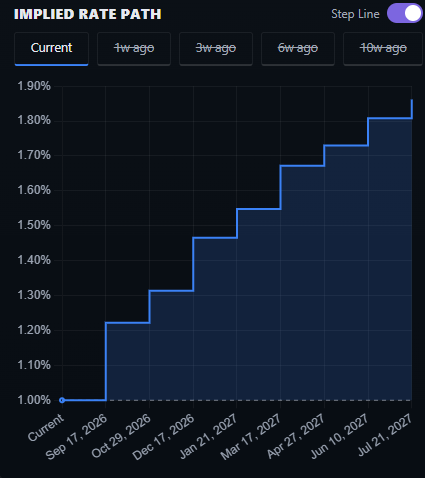
Source: Rate probability
The yen and JGBs are now telling the same story
The recent yen rally provides another piece of the puzzle. USD/JPY has fallen from above 160 toward the 153 area as expectations for BOJ tightening have strengthened.
Normally, a stronger currency and higher domestic yields would be seen as a straightforward positive.
But the combination also has a second effect
Higher JGB yields can encourage Japanese investors to keep more capital at home rather than reaching abroad for yield. That could reduce some of the capital outflows that have supported global bond and equity markets for years.
The consequences therefore extend well beyond Japan
A sustained rise in Japanese yields could eventually alter global capital allocation, particularly if domestic bonds become increasingly attractive relative to hedged US and European debt.
The real test is what happens after 1.25%
The BOJ meeting will likely produce the expected hike. The market reaction will depend on everything around it.
If Governor Kazuo Ueda signals that further increases will be gradual and data-dependent, the yen could consolidate while long-term bond yields stabilise.
If the BOJ signals that another two or three moves are plausible, the market may begin repricing the entire Japanese curve.
That would be a much bigger development. The 30-year yield is already around 4.06%. A sustained move higher would increasingly challenge the assumption that Japan can finance large fiscal programmes at historically cheap rates.