Help
Help 
Middle East oil exports rebound near pre-war levels as Hormuz risks remain
Middle East oil exports have recovered sharply, yet Brent remains above $100 as markets continue to price the risk of renewed disruption around the Strait of Hormuz.

Middle East crude shipments have recovered to about 17.5 million barrels a day, roughly 98% of pre-war levels.
Refined-product flows, including diesel and gasoline, remain much weaker at around 3 million barrels a day, or 58% of pre-war levels.
Flows through the Strait of Hormuz have returned to nearly 13 million barrels a day, led mainly by Saudi Arabia.
Persian Gulf oil exports, including opaque or “dark” flows, reached around 23.3 million barrels a day over the past week.
Brent remains above $100 a barrel and is heading for a third consecutive monthly gain despite the recovery in exports.
Middle East oil exports are flowing again
Oil shipments from the Middle East have recovered far more quickly than many investors expected, bringing crude exports close to levels seen before the conflict disrupted one of the world’s most important energy corridors.
Crude shipments have rebounded to around 17.5 million barrels per day, equivalent to roughly 98% of pre-war levels.
That is a remarkable recovery given that the regional conflict is now in its eighth month and shipping through the Strait of Hormuz continues to operate under significant security risk.
The picture is less encouraging for refined products.
Flows of diesel, gasoline and other products are running at approximately 3 million barrels per day, only about 58% of pre-war levels.
Taken together, total exports have recovered to roughly 89% of 2025 levels.
Hormuz flows are nearly back to late-June highs
The Strait of Hormuz remains the most important variable for the global oil market.
Recent estimates suggest oil flows through the waterway have recovered to almost 13 million barrels per day, near the highs seen in late June.
Saudi Arabia has played the biggest role in that rebound.
That improvement helps explain why physical supply conditions have stabilized despite the broader conflict.
But higher volumes do not mean shipping risks have disappeared.
Tankers continue operating in an environment of persistent security threats, while attacks and military tension around the Gulf have kept insurance, logistics and routing risks elevated.
The recovery therefore reflects a growing ability by the energy industry to operate under sustained risk rather than a return to normal conditions.
Saudi Arabia has become central to the recovery
Saudi exports have increased sharply in September.
Estimated shipments more than doubled during the month and rose above their 2025 average, helping offset weaker flows from Iran.
That divergence has become increasingly important.
Iranian exports have fallen as sanctions, military pressure and port restrictions limit shipments.
Other Gulf producers, particularly Saudi Arabia, have compensated by increasing exports through both Hormuz and alternative routes.
This is one reason global supply has not tightened as much as feared earlier in the conflict.
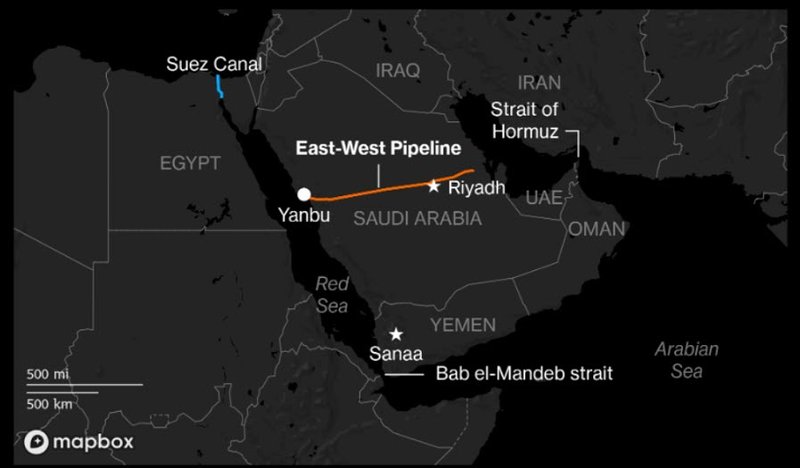
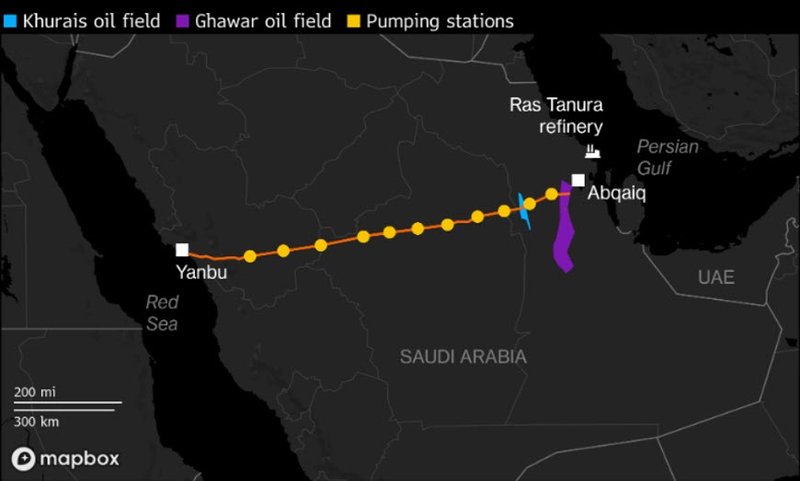
Saudi Arabia has also partially restored its East-West pipeline, which transports crude across the country to Red Sea terminals and reduces dependence on Hormuz.
Around half of the pipeline’s flows have reportedly been restored after damage earlier this month.
Source: Bloomberg
The oil market looks roughly balanced
Despite the geopolitical backdrop, supply and demand conditions appear much less tight than the level of oil prices might suggest.
Persian Gulf oil exports, including less transparent shipments, have recovered to around 23.3 million barrels per day over the past week.
That is broadly in line with the 2025 average.
On that basis, the global oil market appears to be roughly balanced in September.
This is important because the risk premium in Brent is now being supported less by an immediate shortage of barrels and more by the possibility that supply could be disrupted again.
The distinction matters.
A physically tight market tends to remain supported as inventories fall.
A balanced market driven by geopolitical risk can react much more sharply if the probability of disruption changes.
Why Brent is still above $100
Brent crude remains above $100 a barrel even though exports have recovered substantially.
Front-month futures traded around $103.43, leaving the benchmark on course for a third consecutive monthly gain of roughly 14% in September.
The resilience of oil prices shows that traders are still unwilling to price the region as fully normalized.
Several risks remain.
Shipping through Hormuz is still vulnerable.
Energy infrastructure remains exposed to attack.
Saudi Arabia’s alternative pipeline capacity has only been partially restored.
And any renewed escalation could quickly remove several million barrels per day from global markets.
That means oil continues to carry a significant geopolitical premium.
Source: Bloomberg
More barrels do not mean lower risk
One of the most important signals from recent shipping data is that volumes and security conditions are moving in different directions.
More ships are successfully crossing Hormuz.
That does not mean the route has become safer.
Operators have adapted.
Companies have adjusted schedules, security procedures and insurance arrangements to keep cargoes moving.
Governments have also increased support for commercial transits.
This has allowed oil exports to recover despite persistent military risk.
But adaptation has limits.
A significant attack on tankers, terminals or pipelines could quickly change the supply picture again.
That possibility explains why prices remain elevated even as physical flows improve.
Refined products remain the weak point
The recovery in crude exports has been much stronger than the rebound in refined products.
Diesel and gasoline flows remain at only around 58% of pre-war levels.
This is particularly important for inflation.
Refined fuels affect transportation and industrial activity more directly than crude alone.
Diesel prices influence trucking, agriculture, construction and freight costs.
If refined-product supply remains constrained even while crude flows recover, consumers and businesses may continue facing elevated fuel prices.
That can keep inflation pressures alive even without another major increase in Brent.
This helps explain why central banks remain sensitive to developments in the Middle East energy market.
The Fed still has reason to watch oil closely
Energy prices have already become an important part of the U.S. inflation outlook.
Brent above $100 and elevated diesel prices can feed into transport and production costs, making it harder for inflation to move sustainably lower.
That matters because the Federal Reserve has restarted its tightening cycle and remains focused on preventing temporary price shocks from spreading into broader inflation.
A sustained improvement in Middle East exports could eventually reduce that risk.
But supply must remain stable long enough for oil and refined-product prices to move materially lower.
So far, the recovery in flows has prevented an even more severe price spike.
It has not yet removed the inflation problem.
Alternative routes are becoming more valuable
The conflict has also increased the strategic importance of infrastructure that bypasses Hormuz.
Saudi Arabia’s East-West pipeline has become one of the most important examples.
The pipeline allows crude to move from fields in the east of the country toward Red Sea export terminals, giving the kingdom an alternative route if Hormuz becomes more difficult to use.
Other Gulf producers are also investing in storage, pipelines and export infrastructure that reduce dependence on the strait.
This does not make Hormuz irrelevant. Its scale is too large to replace completely.
But every additional barrel that can bypass the waterway reduces the potential impact of a future disruption.
What happens next depends more on security than supply
The current supply picture is considerably healthier than it was earlier in the conflict.
Crude exports are near pre-war levels.
Persian Gulf shipments are close to the 2025 average.
The global oil market is roughly balanced.
Those numbers would normally argue for lower prices.
The reason Brent remains above $100 is that traders are still pricing the possibility that the recovery could reverse quickly.
That makes geopolitical developments more important than marginal changes in production.
A durable decline in oil prices likely requires evidence that shipping risks are genuinely falling, not simply that exporters have learned how to operate around them.
Why oil can stay expensive even as Middle East exports recover
The recovery in Middle East oil flows has removed one of the most extreme supply risks from the market.
Crude shipments are back to around 17.5 million barrels per day, roughly 98% of pre-war levels, while Gulf exports have reached approximately 23.3 million barrels per day.
Yet Brent remains above $100 and is heading toward another strong monthly gain.
The reason is straightforward.
The oil market is no longer pricing only today's supply.
It is pricing the risk that tomorrow’s supply could be disrupted again.
Hormuz remains exposed.
Refined-product flows remain weak.
Alternative pipelines are still operating below full capacity.
And the conflict has not ended.
For now, stronger exports are helping prevent an outright shortage.
They have not removed the geopolitical premium keeping oil above $100.