Help
Help 
G7 oil release targets the diesel crisis, but energy risks are far from resolved
G7 has agreed to release 100 million barrels of crude and refined products over four months, with a substantial volume of diesel released within the first 20 days. The move may ease the immediate fuel shortage, but it also exposes a deeper problem in the global oil market: crude is returning faster than refining and logistics capacity.
VLCC freight rates from the Gulf to Asia have surged to around $1.2 million.
Saudi Aramco's selling price of Arab Light for Asian buyers to $5 below the Oman-Dubai benchmark.
The 100-million-barrel release should provide immediate relief, particularly if diesel stocks are released quickly.
Crude is flowing, but the system is still constrained
The recovery in Middle Eastern crude exports should normally reduce the geopolitical premium in oil. Instead, the market is discovering that higher crude flows do not automatically translate into cheaper fuel.
War-related damage disrupted trade routes, higher tanker costs and reduced refining availability have created bottlenecks further down the supply chain. Reuters estimate that VLCC freight rates from the Gulf to Asia have surged to around $1.2 million per day from roughly $30,000 earlier this year.
That changes the economics of the entire market
A barrel can be available physically and still become expensive at the refinery, on the tanker or at the fuel pump. This is why diesel has become the critical pressure point.
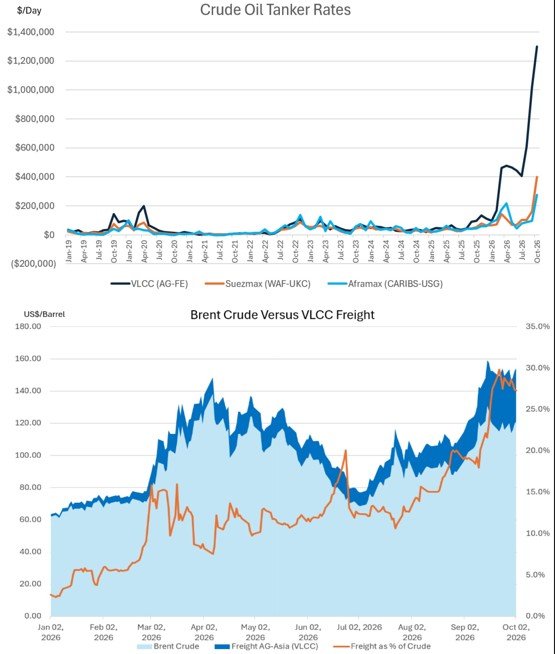
Source: Maritime
Saudi Arabia is already signaling a different oil market
Saudi Aramco's decision to cut the November official selling price of Arab Light for Asian buyers to $5 below the Oman-Dubai benchmark is another important signal.
The discount is the deepest since 2020 and comes despite exceptionally high freight costs. Aramco is effectively making its crude cheaper for Asian buyers to compensate for the extraordinary cost of moving it.
That tells us something important
Saudi Arabia is trying to preserve market access at a time when the physical movement of oil has become unusually expensive. So, the weakness is not necessarily demand. It is the efficiency of the global supply chain.
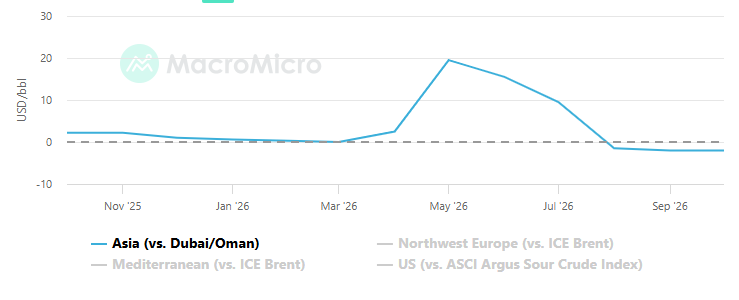
Source: MacroMicro
The diesel export threat exposed Europe's vulnerability
The United States has also become central to the story. US diesel prices have reached around $6.52 a gallon, placing enormous pressure on farmers, trucking companies and other fuel-intensive industries ahead of the November midterm elections.
Trump's administration considered the possibility of restricting diesel exports, although the White House denied that it was preparing a 90-day blanket ban.
The threat alone was enough to expose how dependent Europe has become on American refined fuel. The United States has supplied roughly half of Europe's diesel imports in recent months, while the region faces reduced refining capacity and additional disruption from the war.
A genuine export ban would therefore not simply lower American fuel prices It would redistribute to the shortage toward Europe and potentially drive global diesel prices even higher. That is precisely why the G7's commitment to avoid energy export restrictions matters.
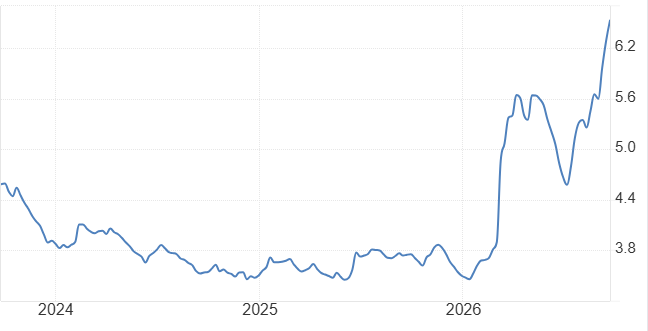
Source: Trading economic
The emergency release buys time, not a solution
The 100-million-barrel release should provide immediate relief, particularly if diesel stocks are released quickly. But the scale needs to be viewed against the structural disruption.
The G7 is releasing inventories because commercial supply cannot currently move through the global system with its normal efficiency.
That means the key question is not whether the release can push prices lower over the next few weeks. It is whether the underlying logistics and refining constraints improve before those emergency barrels are consumed.
If Hormuz flows continue recovering, Saudi alternative routes return to greater capacity and refinery operations normalize, the release could accelerate a meaningful decline in fuel prices. If those improvements fail to materialize, strategic reserves will only postpone the pressure.
Energy is becoming a central inflation risk again
That distinction matters far beyond the oil market. Diesel is embedded across transportation, agriculture, construction and manufacturing. A sustained rise in diesel costs can therefore spread through the economy much more aggressively than a temporary move in crude prices.
For central banks, that creates an uncomfortable problem
Crude exports are recovering, yet the cost of delivering and refining those barrels remains elevated. The result could be slower growth alongside persistent energy inflation. That is a much more difficult environment for monetary policy than a straightforward supply shock.
Oil market may be closer to a turning point, but not yet normal
The G7 release, stronger Middle East exports and Saudi Arabia's aggressive Asian pricing all suggest that physical crude availability is improving.
But diesel shortages, refining constraints and extraordinary freight costs are preventing that improvement from fully reaching consumers.
That is why the next move in oil may depend less on how many barrels are produced and more on how efficiently those barrels can be transported and refined.
For now, G7 has bought market time
It has not fixed the system, the real test will come when emergency inventories begin to fall, and the market must stand on its own again. Until then, crude supply may look increasingly comfortable while diesel remains the weak point capable of keeping the entire energy complex under pressure.