
 Help
Help 
SpaceX falls below IPO price as post-listing rally unwinds
SpaceX shares briefly fell below their $135 IPO price for the first time, marking a sharp reversal from the rally that once pushed the company’s valuation above $2.6 trillion. The stock recovered to close just above the offer price, but concerns over debt-funded AI spending, possible Fed rate hikes and an approaching lock-up expiry continue to pressure sentiment.
SpaceX fell as low as $132.28 before closing at $135.27.
The stock is down about 13% since joining the Nasdaq 100.
Market value has fallen from above $2.6 trillion to around $1.78 trillion.
Investors are awaiting earnings, the IPO lock-up expiry and the next Starship test.
SpaceX falls below its IPO price
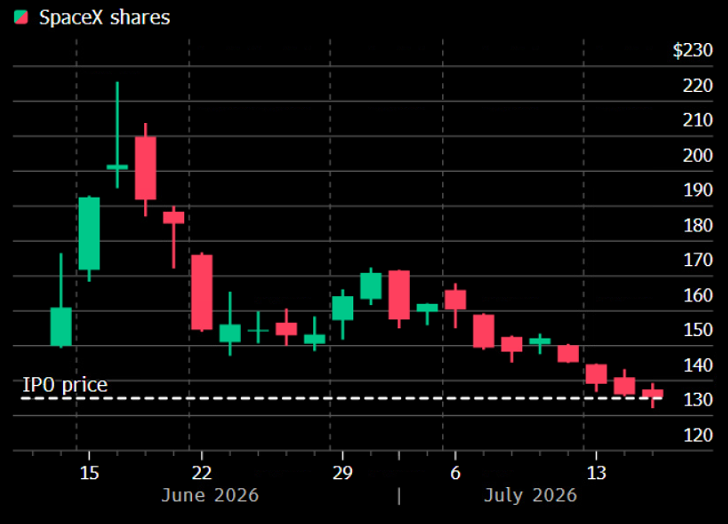
SpaceX shares dropped below their initial public offering price for the first time on Wednesday, just over a month after the company completed the largest IPO in history.
The stock fell as low as $132.28 during the session, below the $135 offer price, before recovering to close at $135.27. That left the shares down 0.6% on the day but narrowly above the IPO level by the closing bell.
Source: Bloomberg
The move marked an important psychological test. Investors who bought shares at the offering price briefly moved into losses for the first time, while the post-IPO rally that once made SpaceX one of the world’s most valuable companies continued to unwind.
The decline does not by itself signal a collapse in the investment case. Newly listed stocks frequently trade below their offer prices. But SpaceX’s scale, valuation and importance to the wider AI and technology narrative make the move more significant for market sentiment.
Valuation falls sharply from its peak
SpaceX’s market value has declined substantially since its early trading high.
The company’s valuation briefly moved above $2.6 trillion last month, overtaking established technology companies such as Microsoft and Amazon. By Wednesday, its market capitalization had fallen to roughly $1.78 trillion.
That represents a major repricing in only a few weeks.
The earlier valuation relied heavily on expectations that SpaceX would become much more than a rocket and satellite company. Investors were also pricing growth from Starlink, artificial intelligence infrastructure, orbital data centers and future space services.
The latest pullback shows that markets are becoming less willing to value those ambitions without clearer evidence on profitability, cash flow and execution.
Debt-funded AI spending weighs on sentiment
One of the biggest concerns is the cost of SpaceX’s expansion into artificial intelligence.
The company raised $25 billion in the bond market last month to help finance its infrastructure plans. That borrowing came shortly after the IPO, which raised about $85 billion.
The combination of large equity and debt fundraising has increased scrutiny over how much capital SpaceX will need before its AI investments begin producing attractive returns.
The company is joining a broader group of technology businesses spending heavily on data centers, computing capacity and AI infrastructure. Investors have become increasingly cautious about these projects because the eventual returns remain difficult to estimate.
SpaceX’s position is especially sensitive because the company lost about $4.9 billion last year. Its long-term projects may carry significant potential, but many have not yet been proven commercially.
Fed rate hikes create another valuation risk
The possibility of additional Federal Reserve rate hikes has added pressure to SpaceX and other expensive technology stocks.
Higher interest rates reduce the present value of profits expected many years into the future. This tends to weigh most heavily on companies whose valuations depend on ambitious long-term growth assumptions.
SpaceX entered the market with one of the strongest growth narratives in recent history. But that also made the stock vulnerable when investors began reassessing stretched technology valuations.
The stock’s retreat appears to reflect a combination of profit-taking, the unwinding of extremely bullish post-IPO positions and growing caution around the cost of financing AI expansion.
Nasdaq 100 inclusion fails to stop the decline
SpaceX’s addition to the Nasdaq 100 has not provided the support some investors expected.
The shares have fallen roughly 13% since joining the technology-heavy benchmark. Inclusion typically generates buying from passive funds that track the index, but those flows were not enough to reverse the broader decline.
This suggests that fundamental and valuation concerns are currently outweighing the mechanical demand created by index inclusion.
The underwriters also have limited room to provide further stabilization. The IPO’s overallotment, or green shoe, option has already been fully exercised.
Without that support, the stock may remain more exposed to shifts in investor demand and new selling from existing shareholders.
Wall Street remains divided on valuation
The stock’s decline has not eliminated long-term optimism on Wall Street.
Morgan Stanley has set a $300 price target, while JPMorgan expects the shares to reach $225 by the end of 2027. Those forecasts imply substantial upside from current levels.
Morningstar has taken a much more cautious position, valuing SpaceX at only $63 per share.
The gap between $63 and $300 highlights the difficulty of valuing the company. SpaceX combines mature businesses such as commercial launches with rapidly growing operations like Starlink and far more speculative projects including orbital data centers.
A bullish valuation assumes SpaceX can successfully turn those businesses into a highly profitable global infrastructure platform. A cautious valuation places greater weight on capital requirements, execution risk and the company’s current losses.
First earnings report becomes the next test
Investor attention is now turning to SpaceX’s first earnings report since becoming a public company.
The results are expected in the first week of August. Markets will focus on revenue growth, profitability, cash flow and management’s plans for capital spending.
Investors will also look for more detail on how SpaceX intends to use the money raised through its IPO and bond sale.
Strong results and clearer guidance could help rebuild confidence after the recent selloff. Disappointing numbers or another increase in spending expectations could renew pressure on the shares.
The report will be important because investors have so far been trading mainly on expectations. Earnings will offer the first major opportunity to compare those expectations with actual financial performance.
Lock-up expiry could add selling pressure
The first phase of the IPO lock-up period is expected to expire after the earnings report.
That would allow eligible employees and some early shareholders to begin selling portions of their holdings. The arrival of additional shares in the market could create further pressure, especially if demand remains weaker than it was during the IPO.
Lock-up expiries do not always produce large declines, but they can increase volatility when a stock is already trading near its offer price.
Investors will watch closely to see whether insiders choose to hold their shares or use the opportunity to take profits.
Starship test remains a major catalyst
The company’s 13th Starship test flight is another key event.
Starship is critical to SpaceX’s ability to lower launch costs and expand the scale of its operations. Its development supports many of the company’s most ambitious plans, including lunar missions, expanded satellite deployment and orbital data centers.
A successful test could remind markets of the technological advantages that drove the initial enthusiasm around the IPO.
Another setback could intensify concerns about execution and the time required for SpaceX’s long-term projects to generate financial returns.


