Help
Help 
SpaceX valuation split: growth story or market excess?
SpaceX is entering one of its most important weeks since going public, with investors weighing a massive share at the same time, the company is targeting Thursday for Starship Flight 13, a mission that could influence investor confidence in one of SpaceX's most ambitious long-term projects.

$116 billion in shares are expected to become eligible for sale after lock-up restrictions begin to expire.
SpaceX is targeting Thursday for the launch of Starship Flight 13.
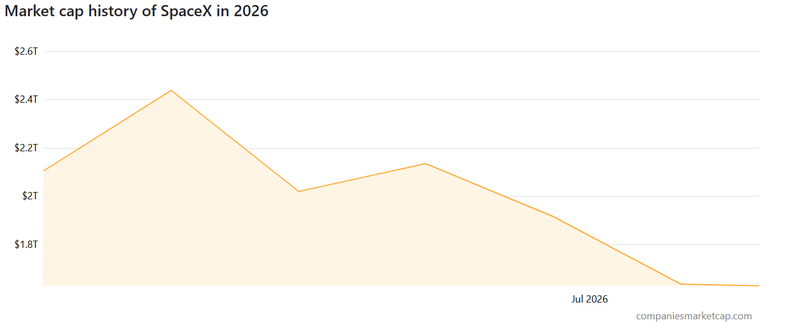
The company is now valued at roughly $1.63 trillion, down from its post-IPO peak near $2.5 trillion.
The share unlock shifts the focus to real demand
The expiry of lock-up restrictions doesn't necessarily mean a flood of selling is about to hit the market. Many early shareholders may decide to keep their positions.
The bigger change is that the stock will no longer be supported by a limited public float. Since the IPO, relatively few shares have been available for trading, helping to keep supply tight. As more stock enters the market, prices will increasingly reflect genuine buying interest rather than scarcity.
That usually brings more volatility. Some shareholders will lock in profits; others may see the pullback as an opportunity to add exposure. How the stock behaves after the unlock may say more about underlying demand than the lock-up itself.
If SpaceX absorbs the additional supply without a meaningful decline, it will reinforce the view that institutional demand remains strong despite the premium valuation. A weaker reaction would suggest investors are becoming more disciplined after the excitement surrounding the IPO.
Starship remains the biggest test of the long-term thesis
Flight 13 is far more than another rocket launch. Starship sits at the centre of SpaceX's long-term strategy. While launch services and Starlink generate most of today's revenue, Starship is expected to lower launch costs, expand commercial opportunities and support businesses that are still years away from becoming meaningful contributors.
Every successful mission removes another layer of execution risk. Every delay reminds investors that developing breakthrough technology rarely follows a predictable timeline. That is why this week's test matters. The market isn't expecting perfection, but it does expect steady progress.
The valuation debate has become harder to ignore
Even after falling from its $2.5 trillion peak, SpaceX still commands a market value of around $1.63 trillion. Few investors question the quality of the business. The real discussion is whether future earnings can grow fast enough to justify a valuation of that size.
Today's share price already reflects years of expansion across Starlink, launch services and businesses that have yet to mature. Those expectations leave very little margin for disappointment. At this stage, simply meeting forecasts may not be enough. Investors want evidence that the next phase of growth is becoming more tangible rather than remaining a long-term promise.
Source: Companies market cap
Can Starlink keep funding the next generation of projects?
Starlink has become much more than a satellite internet provider. It is now the financial engine supporting much of SpaceX's expansion. Instead of returning excess cash to shareholders, the company continues to reinvest heavily in programmes such as Starship, betting that today's spending will create much larger opportunities in the future.
That strategy has helped SpaceX stay ahead technologically, but it also carries risk. Many of those investments remain years away from generating meaningful returns, and public shareholders are often less patient than private investors. As the company adjusts to life in the public markets, the balance between ambitious investment and financial discipline is likely to come under closer scrutiny.
Expectations are replacing excitement
The excitement surrounding the IPO hasn't disappeared, but the market is beginning to ask different questions. Early investors were buying into a vision. Public shareholders will increasingly judge the business on earnings, cash flow, margins and execution.
The coming weeks bring the first real test
The share unlock will reveal how much demand exists at current prices. Earnings will offer the first detailed look at the business behind the valuation. Starship Flight 13 will provide another measure of operational progress. If all three developments reinforce the investment case, the recent decline in the company's peak valuation may come to be seen as a healthy correction after an explosive rally. If not, the conversation is likely to shift from how big SpaceX can become to whether the market moved too far, too fast.