Help
Help US Treasury yields top 5% as inflation and oil risks keep markets on edge
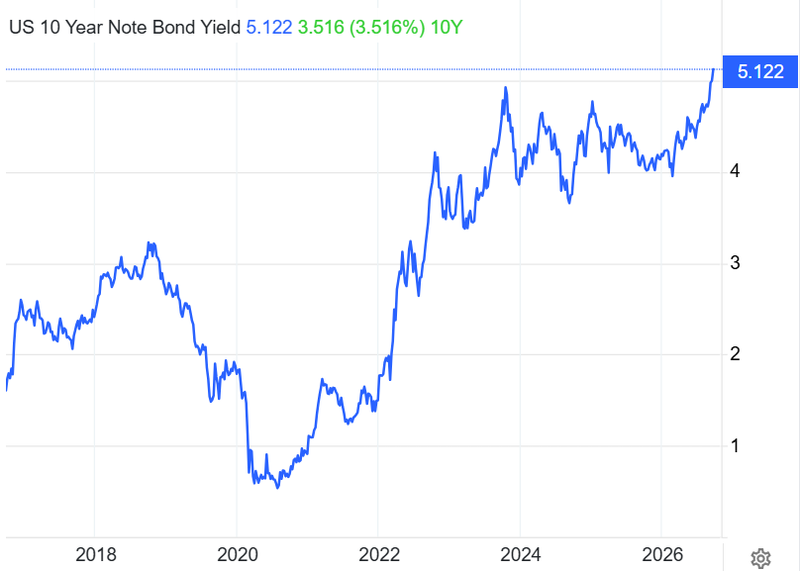
The U.S. bond market is starting to set the tone for markets again. The 10-year Treasury yield climbed to 5.13%, its highest level since 2007, while the 2-year reached 4.95% and the 30-year moved to about 5.42%. The move came after stronger U.S. activity data, higher oil prices and a weak five-year Treasury auction.

10-year Treasury yield reached 5.13%, highest since 2007.
2-year yield climbed to about 4.95%
October Fed rate-hike pricing rose to 70%.
The Fed had already hiked. Why are yields still rising?
This is the first question the bond market is asking. The Fed delivered the expected 25-basis-point increase in September, lifting the federal funds target range to 3.75%–4.00%. More importantly, 16 of 18 policymakers projected at least one additional hike before the end of 2026, making it clear that the September move was not necessarily the end of the tightening cycle.
Yet Treasury yields continued moving higher
That tells us the market is looking beyond the September decision. Investors are reassessing not only the next rate increase, but how restrictive monetary policy may need to remain if inflation continues to prove sticky while economic activity stays strong.
The repricing accelerated after Michael Barr said further policy adjustments are likely to be needed to bring inflation back to the Fed’s 2% target in a timely manner. Barr has argued that inflation remains too high, core non-housing services inflation is still elevated and the risk of broader price pressures becoming entrenched has increased.
Markets responded quickly. Expectations for another 25-basis-point hike at the October meeting rose to around 70%, according to market pricing on September 23. At the same time, stronger-than-expected US business activity reinforced the view that the economy may still be running too hot for inflation to fall comfortably back toward target.
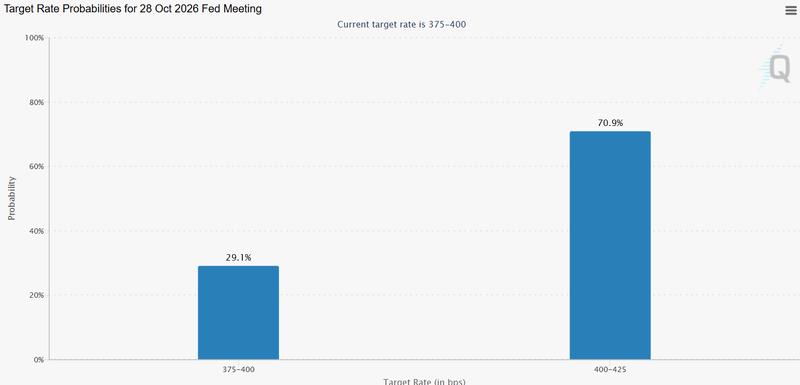
Source: CME Group
Strong growth is making the inflation problem harder
The September S&P Global composite PMI jumped to 58.4 from 56.0, its strongest reading since July 2021. Services activity accelerated sharply, manufacturing also strengthened, and employment growth increased. At the same time, firms reported higher input costs and supply constraints linked partly to the recent energy shock.
This changes the Fed's calculation
An oil shock hitting an already weak economy can be treated mainly as a supply problem but an oil shock hitting an economy with strong demand is more complicated.
Businesses have greater ability to pass higher costs through to customers, while workers and consumers have more capacity to absorb higher prices. That raises the risk that an energy shock becomes broader inflation rather than remaining isolated to fuel.
This is why policymakers are increasingly focused on inflation expectations and domestic demand, not oil alone.
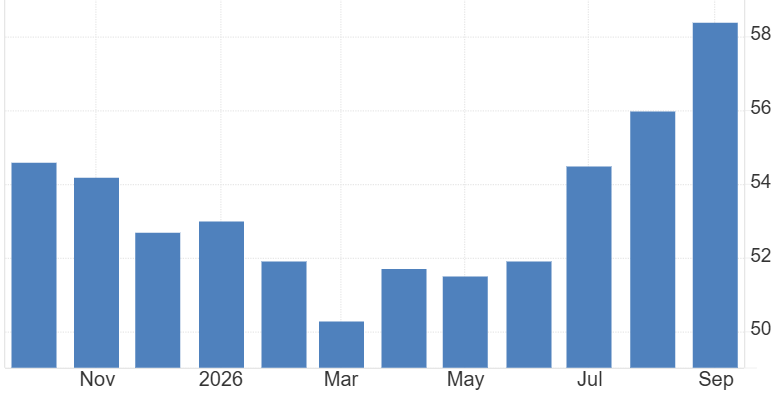
Source: S&P Global
Oil and Diesel is adding a second inflation channel
WTI settled around $92.16. The move followed renewed uncertainty surrounding the Iran conflict and reduced confidence in a quick diplomatic resolution.
For the Treasury market, the significance goes beyond petrol prices
Higher crude prices affect transportation, refining, chemicals, manufacturing and logistics. They therefore create a chain of higher production costs that can appear in business prices with a lag.
That matters when the Fed is already concerned that inflation is taking too long to return to 2%. The market is effectively asking whether the energy shock will pass through quickly or become embedded in broader pricing.
The idea of restricting US diesel exports matters
The objective would be straightforward: keep more diesel at home and push domestic prices lower. But the mechanics could work in the opposite direction. US Gulf Coast refineries produce more diesel than the region consumes, and exports provide an outlet that allows refineries to maintain high utilisation.
Exports cuts could therefore reduce refinery runs, tightening supplies of diesel, gasoline and jet fuel rather than creating a lasting surplus. The US Energy Secretary has explicitly argued that a blanket export ban would not work for this reason.
The weak Treasury auction is revealing a demand problem
The five-year auction provided a second warning. Treasury sold $70 billion of five-year notes at a 5.033% yield, more than 3 basis points above the pre-auction market level. The bid-to-cover ratio fell to 2.212, while indirect bidders received a smaller share and dealers absorbed 15.8% of the sale.
That does not mean investors are abandoning Treasuries
It means they are becoming more price sensitive. The distinction matters because the US government must continue issuing large quantities of debt regardless of market conditions. If buyers require higher yields to absorb that supply, Treasury borrowing costs rise across the curve. And unlike a temporary oil move, fiscal supply does not disappear next month.
The 10-year yield contains more than Fed expectations
This is where the move above 5% becomes more significant. The 2-year yield mainly reflects expectations for the Fed's policy rate over the next few years.
The 30-year yield carries additional information
The 30-year yield near 5.4% shows that the market is demanding particularly high compensation for taking duration risk.
That is why the Fed cannot simply promise eventual rate cuts and assume long-term yields will follow. If investors believe inflation will remain volatile, deficits will remain large or Treasury supply will increase faster than demand, the term premium can keep the long end elevated.
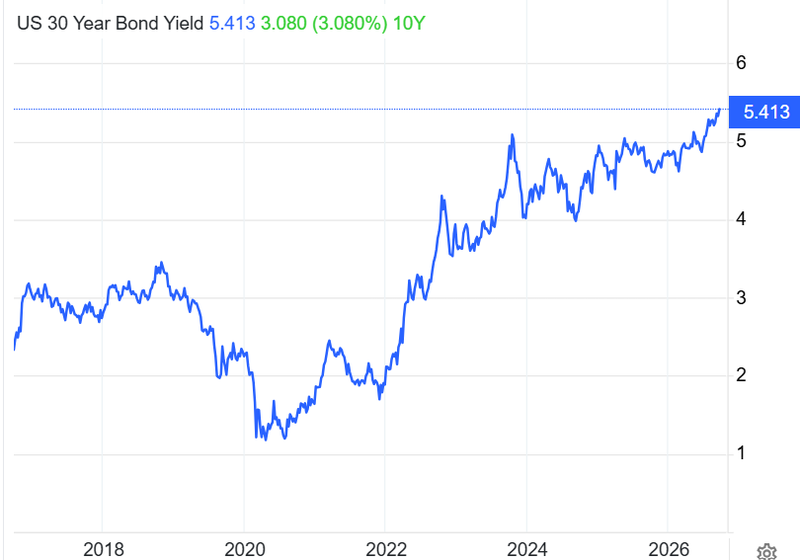
Source: Trading economic
This creates a difficult feedback loop for Washington
Higher yields are not just market statistics. They increase the government's cost of refinancing debt.
That raises interest expenditure, which can add to the deficit and increase future borrowing requirements. The result is a familiar feedback mechanism: more borrowing creates more supply, more supply requires greater investor compensation, and higher yields increase the cost of carrying the existing debt.
The United States has substantial advantages, including issuing debt in its own currency and benefiting from the dollar's reserve-currency status. But those advantages do not guarantee that long-term yields remain low.
The bigger risk is that 5% becomes normal
The market does not need the 10-year yield to collapse after crossing 5%. The more important question is whether investors begin treating 5% as a new equilibrium. A temporary move can reverse if oil prices fall, economic activity weakens or inflation data improve.
A sustained period above 5% would be more consequential
Mortgage rates would remain elevated, corporate financing would become more expensive and equity valuations would face a higher discount rate. Companies building capital-intensive AI infrastructure would also have to justify projects against a materially higher cost of capital.
Source: Trading economic