Help
USD/JPY forecast: why is the Yen still weak as Japan's inflation rises?
Tokyo's inflation accelerated to its highest level in 16 months, strengthening expectations that the Bank of Japan will raise interest rates in December. Yet the yen remains near 160 against the dollar, raising questions about whether tighter monetary policy can reverse currency weakness when US interest rates are also expected to rise.

Tokyo core CPI increased to 2.9% in November from 2.6% in October, driven largely by higher electricity and gas prices.
Markets are pricing a 78% probability of a 25-basis-point BoJ rate hike in December
BoJ board member Naoki Tamura believes interest rates should move toward a neutral level of around 2%, with faster tightening possible if inflation accelerates.
USD/JPY remains near 160 despite Japan spending 15.4 trillion on currency intervention during July and August.
Tokyo inflation is rising, but the source matters for the BoJ
Tokyo's core consumer inflation accelerated to 2.9% annually reaching its highest level since July 2025 and remaining above the Bank of Japan's 2% target for a third consecutive month.
However, the acceleration was largely driven by energy prices and electricity costs increased 9.5%, while city gas prices surged 13.7%, partly reflecting the withdrawal of government utility subsidies.
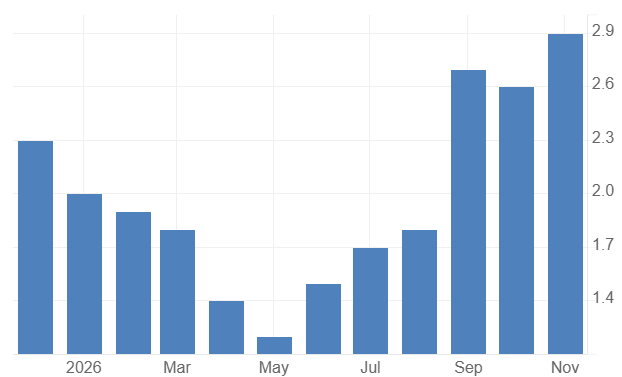
Source: Statistics Bureau of Japan
More importantly, inflation excluding both fresh food and energy slowed to 2.5% from 2.6%
Headline price pressures are increasing, but the measure that more closely reflects underlying inflation has not accelerated at the same pace.
Japan's dependence on imported energy adds another problem, as a weaker yen raises the domestic cost of oil, gas and other imported products, increasing prices for households even when domestic demand remains relatively subdued.
If businesses pass those higher costs to consumers, inflation could spread beyond energy into transportation, services and manufactured goods.
But higher import prices also reduce household purchasing power, so companies may eventually face weaker consumption as households allocate more income toward essential expenses.
The risk for policymakers is that Japan could experience persistent inflation without the stronger domestic demand normally associated with a sustainable increase in prices.
Can the BoJ accelerate rate hikes without weakening growth?
BoJ board member Tamura also spoke about the potential for accelerating monetary policy and he thinks the neutral interest rate is around 2% and suggested that large 50 basis point increases may also be warranted in certain circumstances.
However, markets are pricing in a 25-basis point increase at the December meeting, Tamura also expects increases in the policy rate to around 2% from the current level of 1.25%, if inflation expectations are not sufficiently controlled.
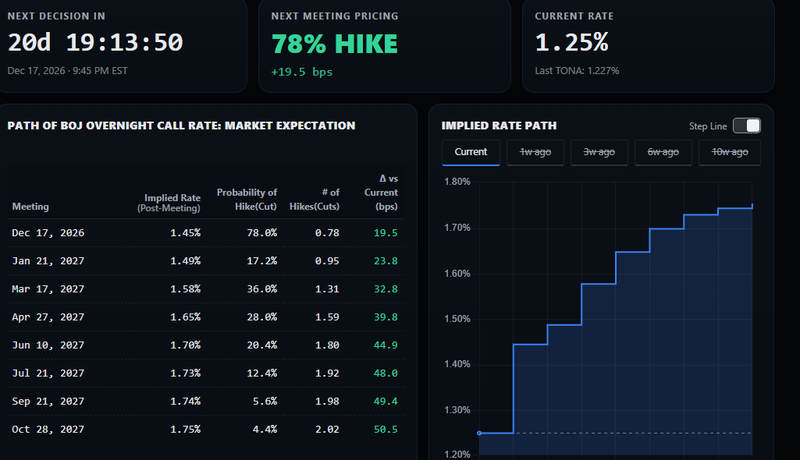
Source: Rate probability
On the other hand, economy does add another dimension to the decision as Japan’s economy contracted slightly during the third quarter with declining household consumption.
Inflation is high and expected to stay that way so further hikes are likely to rein in expectations of inflation and strengthen the yen but increases in interest rates would negatively affect economic activity.
The bond market introduces another constraint
10-year Japanese government bonds had a yield of 2.6% and the expectations of further increases in interest rates and inflation increase the risk to the government’s debt service cost, as bonds with lower yields mature and are replaced with new, higher yield bonds.
For Japan, which already has a high level of government debt, rising yields increases the cost of rolling over the debt, this creates a tough situation for the BoJ because raising interest rates too quickly could weaken the economy and increase the strain on the public finances.
Why is the yen still weak despite expectations of higher rates?
USD/JPY traded near 159.27, remaining close to the psychologically important 160 level despite growing expectations of a December BoJ hike, the reason lies partly in the interest-rate differential between Japan and the United States because even if the BoJ raises rates by 25 basis points in December, the yen may receive limited support if the Fed delivers a similar increase.
So, in that case, the nominal policy-rate differential would remain broadly unchanged, and what complicate the issue is investors can still borrow relatively cheaply in yen and invest in higher-yielding dollar assets, supporting demand for the dollar through carry-trade activity.
However, if the BoJ adopt Tamura idea about the 50bps that could encourage investors to unwind yen-funded positions, forcing them to buy back yen and potentially accelerating its appreciation.
Can another currency intervention stop the yen's decline?
Japanese Finance Minister Satsuki Katayama has previously expressed concerns about excessive, one-way movement in foreign exchange markets and Katayama has continued to speak with the U.S. Treasury, but the recent warnings take on added significance given Japan’s foreign exchange intervention earlier this year.
The beginning of July and August of this year, the Japanese authorities spent approximately 15.4 trillion yen to buy yen and sell dollars, including interventions done in conjunction with the U.S.
Intervention can help set a floor for the yen, and, in the short-term, force some traders to cover their short positions.
Using the IMF’s exchange rate classification framework, Japan would be allowed to intervene in the foreign exchange market to defend the value of the yen against downward pressure for a limited period and Japan have used it twice this year leave them with only one time left.
One possibility is that the BoJ raises interest rates by 25 basis points in December, partly to contain the inflationary pressure caused by yen weakness, while Japanese authorities postpone further currency intervention until the first quarter of 2027.
This would allow policymakers to assess whether higher Japanese yields and expectations of further tightening can stabilize the yen without another round of direct intervention.
What could change the outlook for USD/JPY?
The December policy meetings will provide an important test, with both central banks expected to tighten, investors will focus on which institution signals a more aggressive path into 2027.
If the BoJ raises rates but provides limited guidance on further increases, while the Fed continues emphasizing persistent US inflation, the interest-rate differential could remain wide enough to sustain pressure on the yen.
Under those conditions, another move toward or above 160 could renew speculation about Japanese intervention.
However, if the BoJ signals that rates may approach 2% faster than previously expected, Japanese yields could rise relative to US Treasury yields, encouraging investors to reduce dollar exposure.
The second test is if price pressures broaden into wages and services, the case for faster BoJ tightening would strengthen, but if inflation remains concentrated in energy while consumption weakens, the central bank may find it harder to justify an aggressive rate-hike cycle.
The critical question is whether the BoJ can narrow the interest-rate gap with the United States before higher borrowing costs place additional pressure on an already fragile domestic economy.