
 Help
Help 
Who owns the most SpaceX stock?
SpaceX is still controlled by Elon Musk, but the outside ownership story is just as important. The company’s rise created one of the biggest private-market wealth transfers in modern technology, rewarding early venture investors, long-term institutional backers and funds that were willing to hold SpaceX through years of technical risk, funding rounds and delayed public access.
Elon Musk remains the largest and most powerful shareholder.
Alphabet’s SpaceX stake has become one of the most valuable strategic investments in big tech.
Baillie Gifford funds gave public-market investors indirect exposure to SpaceX before the IPO.
Elon Musk still controls SpaceX
The most important point about SpaceX ownership is the difference between owning shares and controlling the company.
Musk does not need to own every share to control SpaceX. The company’s share structure gives him strong voting power, which allows him to keep influence over strategy, board decisions and the long-term direction of the business. That matters because SpaceX is not built like a normal public company focused only on the next quarter.
It is still built around long-cycle bets: Starship, Starlink, defense contracts, satellite internet, AI infrastructure and eventually Mars.
For outside investors, this is part of the deal. They can own the economic upside, but they are not really buying control. They are backing Musk’s operating model. That can be powerful when execution is strong, because SpaceX can move faster than traditional aerospace companies. But it also means investors have less room to push back if the company takes bigger risks.
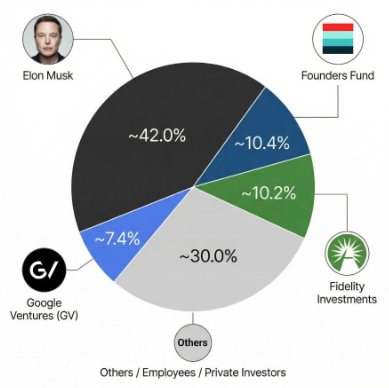
Source: Venture Capital
Founders fund one of the earliest and biggest outside winners
Founders Fund is one of the most important outside investors in SpaceX.
The firm backed the company when the story was far from obvious. At the time, SpaceX was not a mature satellite-internet business or a proven defense contractor. It was trying to prove that a private company could change launch economics and compete with government-linked aerospace giants.
Reusable rockets still had to work at scale. NASA and defense contracts still had to become recurring revenue streams. Starlink still had to move from idea to global infrastructure. Founders Fund was paid for taking that early risk before the market treated SpaceX as a core asset in aerospace, connectivity and national security.
Alphabet the strategic investor with a huge hidden asset
Google invested in SpaceX in 2015 alongside Fidelity. The logic at the time was strategic. SpaceX’s satellite network could expand global internet access, and more internet access ultimately supported Google’s own business. What began as a connectivity bet later became much more valuable.
Today, Alphabet’s stake is not only a financial win. It sits close to several themes that matter to the future of big tech: satellite communications, cloud infrastructure, AI compute, global data distribution and internet access.
That is why Alphabet’s investment is different from a normal passive stake. It gave Google exposure to a company that now sits at the intersection of space, defense, communications and AI infrastructure.
Fidelity the institutional backer that helped validate SpaceX
Fidelity also played a major role in SpaceX’s ownership base.
Its importance is not only the size of the stake. It is the signal that came with it. Venture investors can support bold early ideas, but large asset managers help turn private growth stories into mainstream institutional assets. Fidelity’s involvement helped show that SpaceX was no longer just a founder-led moonshot. It was becoming a serious infrastructure and technology company.
Fidelity also mattered because many investors could not buy SpaceX directly for years. SpaceX stayed private for a long time, so access was limited. Funds and trusts that held SpaceX shares became one of the few ways for some investors to get indirect exposure.
Baillie Gifford patient capital for the private mega cap era
Baillie Gifford is another important long-term SpaceX backer.
The firm is known for investing in high-growth companies early and holding through volatility. That style fits SpaceX well. This was never a simple short-term earnings story. It required patience, tolerance for execution risk and belief that a private company could become a mega cap business before reaching public markets.
Baillie Gifford’s SpaceX exposure also shows how private markets have changed. In the past, many investors expected the biggest gains to come after an IPO. SpaceX showed that much of the value could be created before ordinary public investors had direct access.
Why outside ownership matters
The outside investors who own SpaceX stock matter because they show how the market view of the company has changed.
Early investors were paid for taking technical and execution risks. Strategic investors like Alphabet were paid for seeing the link between satellites and internet infrastructure. Long-term asset managers were paid for accepting that the most valuable growth companies might stay private for much longer than expected.
Even after the IPO, SpaceX is not a company where outside shareholders appear to have normal control. Musk’s voting power means investors are largely backing his judgment. That can be a strength when the company is executing well, because it allows SpaceX to move quickly and ignore short-term pressure. It can also be a governance risk, because shareholders have less ability to challenge strategy if the company moves into more capital-intensive or uncertain areas.


