Help
Help 
Why Japan's verbal intervention is losing its grip on the yen
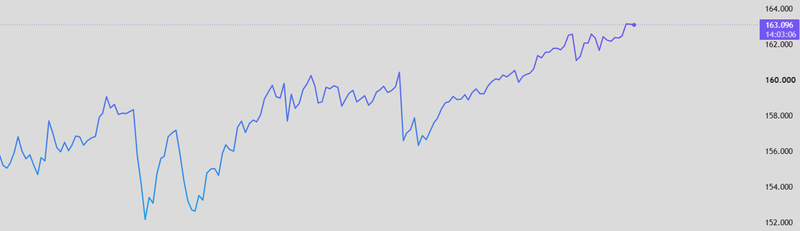
Japanese officials have once again warned that they are prepared to act against excessive moves in the currency market, but investors appear increasingly unconvinced that words alone will be enough to halt the yen's decline. The warning came after USD/JPY climbed above 163, pushing the currency back towards levels that have previously triggered official intervention.
USD/JPY moved above 163, renewing pressure on Japanese authorities.
Markets continue to expect the Bank of Japan to leave policy unchanged at its 31 July meeting.
Policymakers are prepared to support the currency through actions or at least through a policy path.
Verbal intervention is losing its impact
Finance Minister Satsuki Katayama reiterated that the government's position "has not changed at all" and said authorities would take decisive action whenever necessary if currency moves became excessive. Chief Cabinet Secretary Minoru Kihara delivered a similar message, repeating that the government remained ready to respond at any time.
The response in the foreign exchange market was telling
USD/JPY barely moved from the high 163.00 after the comments, suggesting investors no longer see repeated warnings as a strong deterrent. After several years of similar statements, traders have become more interested in whether officials are prepared to back up those words with either direct intervention or a meaningful shift in monetary policy.
Without a change in interest-rate expectations, verbal intervention has become increasingly difficult to sustain.
Source: Trading view
The focus is shifting back to the Bank of Japan
The renewed weakness in the yen is becoming more than a currency story.
A weaker exchange rate raises the cost of imported food, energy and raw materials, increasing inflationary pressure for households and businesses. While stronger inflation supports the Bank of Japan's long-term objective of moving away from decades of ultra-low inflation, a rapid depreciation risks squeezing consumers and complicating the economic outlook.
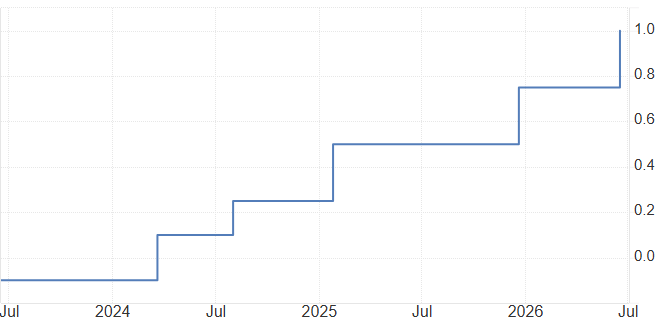
That helps explain why policymakers have become increasingly uncomfortable with the pace of the yen's decline, even as markets continue to expect the central bank to leave interest rates unchanged at its meeting next week.
Current market pricing still points to a policy hold on 31 July, with investors instead looking towards another rate increase later this year if inflation and wage growth remain firm.
Source: Bank of Japan
Managing expectations may prove more effective than intervention
Recent reports suggesting a more hawkish tone from policymakers have attracted almost as much attention as the official comments themselves.
Whether those reports are intentional or simply reflect internal discussions, they can still influence market expectations. Encouraging investors to consider an earlier or more aggressive tightening cycle may prove more effective than repeatedly warning about intervention.
If traders begin pricing in higher Japanese interest rates, the gap between US and Japanese bond yields could narrow, reducing one of the biggest drivers behind yen weakness. Even a modest shift in expectations has the potential to trigger short-covering among investors who have built sizeable bearish positions against the currency.
Unlike direct intervention, which requires Japan to spend foreign exchange reserves and often delivers only temporary results, changing expectations can support the yen without entering the market.
Supporting Yen through policy path
A decision to leave interest rates unchanged is widely expected, meaning the accompanying statement, updated economic projections and Governor Kazuo Ueda's press conference are likely to have a bigger market impact than the rate decision itself.
Behind the scenes, the relationship between the Bank of Japan and the government is becoming increasingly complex. Japan is facing growing policy friction as officials try to balance three competing priorities: containing inflation through higher interest rates, supporting economic growth with fiscal spending and preventing the yen's historic weakness from becoming even more disruptive. While the government wants to limit the inflationary impact of a weaker currency, the central bank must also avoid tightening policy too aggressively and derailing the recovery.
If policymakers acknowledge growing concerns over the yen or signal that further policy tightening remains on the table, investors may begin reassessing the outlook for Japanese interest rates. Even without an immediate rate hike, stronger guidance could encourage markets to price in a more hawkish path over the coming months, offering the yen some support through narrowing interest-rate expectations.
On the other hand, if the Bank of Japan maintains a cautious tone while the Federal Reserve keeps US yields elevated, pressure on the yen could quickly return as the wide rate differential continues to favour the dollar.